A VPN gateway is the device or managed cloud service that terminates encrypted VPN tunnels for a private network. It authenticates each remote user, device or peer gateway, decrypts incoming traffic and passes it to the internal network, and encrypts the replies on the way back. It may be standalone or built into a firewall or router.
The gateway is one component of a VPN, not the VPN itself. The same role appears in two other settings. In a consumer VPN service, the provider’s servers do this job for subscribers, but send the decrypted traffic on to the internet rather than into a private network. A home router running a VPN client becomes the gateway for the devices behind it, either all of them or only the ones you choose.
TL;DR
- A VPN gateway is where encrypted VPN tunnels end and a private network begins: one component of a VPN, not the whole VPN.
- It checks who is connecting, decrypts traffic, can give remote users’ devices internal addresses and passes traffic inward. One gateway can serve remote users and branch offices at once.
- It can be a dedicated or virtual appliance, a firewall or router feature, server software or a managed cloud service. A home router running a VPN client is the gateway for its network.
- Decrypted traffic should pass a firewall before reaching the internal network. Capacity depends on encrypted throughput, packet rate, concurrent tunnels and tunnel setup speed.
- It is usually reachable from anywhere on the internet and is a frequent target: CISA issued emergency directives on VPN gateway products in 2021, 2024 and 2025. Five countries’ cyber agencies advise fast patching and keeping management interfaces off the internet.
How does a VPN gateway work?
A VPN gateway does six jobs: ending tunnels, checking identity, decrypting traffic, assigning addresses to remote-access clients, moving traffic between the tunnel and the internal network, and applying access policy.
- Terminates tunnels. The gateway is the network end of each VPN tunnel from a remote user’s device or a peer gateway at another site.
- Authenticates. It checks each user or device in a remote access VPN, or the peer gateway in a site-to-site VPN, before admitting the tunnel. It can do this itself or consult a dedicated authentication server (NIST’s guide to IPsec VPNs, SP 800-77 Rev. 1), such as a RADIUS server or a cloud identity provider.
- Encrypts and decrypts. It decrypts incoming tunnel traffic and encrypts the replies, using a VPN protocol such as IKEv2/IPsec, a TLS-based protocol or WireGuard. The VPN protocols guide compares them.
- Assigns addresses. A remote-access client can receive an internal address from a pool, which applications on the device use to reach the internal network. IKEv2 can assign it while the tunnel is set up; WireGuard instead fixes addresses in its configuration files. Site-to-site peers keep their own addressing.
- Moves traffic inward. It routes decrypted traffic between the tunnel and the internal network, and it can translate addresses where two connected networks use overlapping ranges.
- Applies policy and logs. It enforces access policy and logs sessions, or it hands policy to a firewall behind it. NIST’s IPsec guide describes both designs.
A site-to-site connection involves the same jobs between two gateways, except address assignment, and the hosts behind each gateway need no VPN software.
One gateway, two jobs
A single gateway can terminate remote-access and site-to-site tunnels at the same time; one Azure VPN gateway, for example, can carry point-to-site and site-to-site connections together. Cisco’s documentation calls a gateway in this central role a headend. Sizing and access policy then have to cover both kinds of traffic, and an outage affects both.
What is a VPN gateway used for?
A VPN gateway is used when traffic has to cross the internet into a private network. Deployments include:
- Remote staff: employees reach internal applications from home or while travelling.
- Branch offices: a branch network joins head office or a data centre over the internet.
- On-premises to cloud: an office or data centre connects to a cloud network, such as an AWS virtual private cloud (VPC) or an Azure virtual network.
- Cloud to cloud: two cloud networks connect to each other, as in Azure’s VNet-to-VNet connections.
- Backup for a private circuit: a site-to-site VPN carries traffic when a dedicated circuit to a cloud provider fails.
For a consumer VPN subscriber, the provider’s servers are the gateway; how a VPN works follows that path step by step.
VPN vs VPN gateway vs VPN server vs VPN concentrator
A VPN is the whole system; the gateway is the component where its tunnels end. “VPN server” and “VPN concentrator” overlap with it and are used in narrower settings.
| Term | What it names | Where it is used |
|---|---|---|
| VPN | The whole system: clients, tunnels, gateways and authentication | General term for the whole system |
| VPN protocol | The rules for the handshake, framing and encryption that both ends follow. IPsec and IKEv2 are IETF standards; WireGuard has its author’s paper and code but, as NIST notes, no formal protocol specification; OpenVPN is defined by its open-source implementation. | The gateway runs it; it is not a device |
| VPN gateway | The component that terminates tunnels for a network | Enterprise and cloud documentation; NIST’s IPsec guide |
| VPN server | A machine that accepts individual users’ connections | Consumer VPN services and self-hosted setups |
| VPN concentrator | A vendor term for a gateway that terminates many tunnels | Cisco’s retired VPN 3000 Series; AWS documentation for its virtual private gateway and for Site-to-Site VPN Concentrator, which attaches to a transit gateway |
| Headend | The central gateway that branch and remote-user tunnels terminate on | Vendor and network engineering documentation |
| VPN client | Software on the user’s device that opens the tunnel to the gateway | Remote access and consumer VPNs |
NIST’s IPsec guide states: “There are four primary architectures for IPsec-based VPNs:” gateway-to-gateway, remote access (also called host-to-gateway), host-to-host and mesh. Gateways terminate the tunnels in the first two. In host-to-host and mesh, the hosts terminate their own tunnels, although NIST notes that a mesh can be combined with gateway-to-gateway links to extend it across two networks. A mesh VPN builds the same kind of host-to-host tunnels between laptops, phones and servers, with a coordination service handing out keys and no central gateway in the data path.
“Concentrator” is not a standards term, and it is not limited to remote access. AWS calls its virtual private gateway “the Site-to-Site VPN Concentrator on the Amazon side” of a connection. The L2TP Access Concentrator defined in RFC 2661 is a different thing: one end of an L2TP tunnel, paired with an L2TP Network Server at the other end.
Is a VPN gateway a router?
Not necessarily. A VPN gateway is a role, and a router is one of several devices that can hold it, alongside firewalls, dedicated appliances and servers. NIST’s IPsec guide states: “The VPN gateway may be a dedicated device that only performs VPN functions, or it may be part of another network device, such as a firewall or router.”
In general networking, a gateway is a system that connects two or more networks and passes traffic between them. A device’s default gateway is the router it sends traffic to when no more specific route applies. A VPN gateway is a gateway in the first sense, with encryption and authentication added.
At home, a router running a VPN client is the gateway for its network; the guide to setting up a VPN on a router covers which devices it sends through the tunnel.
Other things called a gateway
- AWS internet gateway, NAT gateway and virtual private gateway: three separate VPC components. Of the three, the virtual private gateway is the one that terminates VPN tunnels; AWS Transit Gateway, a separate service, can too.
- Secure web gateway: a web filter that inspects users’ outbound HTTP and HTTPS traffic (NIST SP 800-215). Its job is filtering, not terminating VPN tunnels, although some cloud platforms sell web filtering and remote access together.
- Remote Desktop Gateway: carries Remote Desktop sessions over HTTPS on TCP port 443, with an optional UDP transport, so users reach internal desktops without a VPN connection.
- VPN Gate: a University of Tsukuba academic experiment of volunteer-run relay servers, not a type of gateway.
Types of VPN gateway
VPN gateways can be grouped into six forms, which differ in who runs the hardware and software and in what else the device does besides VPN.
| Form | Who runs it | Typical use | Main trade-off |
|---|---|---|---|
| Dedicated VPN appliance | The organisation | Networks that keep VPN load off the firewall | Another device to patch and size |
| Firewall-integrated | The organisation | Networks that want one device at the perimeter | VPN and firewall work share one device’s capacity, which can overload it at peak times |
| Router-integrated | The organisation or, at home, the user | Branch sites and small offices; larger models also act as central headends | Capacity varies widely by model, and VPN shares the router’s processing |
| Virtual appliance | The organisation, on its own hypervisor or a cloud VM | Data centres and cloud networks | Performance depends on the host |
| Managed cloud service | The cloud provider | Connecting cloud networks to offices and users | No control over the software; limited control over the timing of maintenance |
| VPN software on a general-purpose server (open-source or commercial) | The organisation or an individual | Small teams, labs and self-hosting | All maintenance falls on the operator |
NIST’s IPsec guide notes that providing IPsec from a firewall or router “may put too high of a load on the device during peak usage”. High-end VPN routers can also serve as the headend at a central campus.
For managed services, AWS lets customers accept tunnel endpoint updates at a convenient time before a deadline, and Azure lets customers set maintenance windows.
Running VPN software on your own server is the self-hosted VPN model, where patching, uptime and key management all fall to the operator. Some server packages accept several protocols at once: SoftEther accepts L2TP/IPsec, OpenVPN, Microsoft SSTP, L2TPv3 and EtherIP alongside its own protocol.
Remote access, site-to-site, or both
A remote-access gateway admits individual devices running VPN clients; a site-to-site gateway connects to a peer gateway. Not every product does both: AWS handles remote users through a separate service, and Google Cloud HA VPN connects networks only.
Cloud VPN gateways
A cloud VPN gateway is the same role run by the cloud provider: you configure the gateway’s settings, and the provider deploys and maintains the instances behind it. Capacity is set by the gateway size or tunnel type you choose and by how many tunnels you run: Azure sells gateway sizes as SKUs, AWS offers standard and large-bandwidth tunnels, and Google Cloud sets a limit per tunnel.The term cloud VPN also covers vendor-run services that staff devices connect to directly.
AWS: virtual private gateway and Transit Gateway
A virtual private gateway attaches to one VPC at a time. AWS Transit Gateway acts as a regional hub for many VPCs and on-premises networks, and VPN connections terminate on the hub itself. Connections from individual users run through a separate service, AWS Client VPN.
Azure VPN Gateway
Azure VPN Gateway supports site-to-site, point-to-site (individual users) and VNet-to-VNet connections, and it can run alongside ExpressRoute. Azure builds each gateway from two or more Azure-managed virtual machines, configured automatically, in a dedicated gateway subnet, and new VpnGw1-5 gateways must use the zone-redundant (AZ) versions of those SKUs. For connecting many networks, Azure Virtual WAN places VPN gateways inside a managed hub network.
Google Cloud HA VPN
Google Cloud offers two managed gateways, HA VPN and Classic VPN. HA VPN connects a peer network to a VPC network over IPsec. Google Cloud assigns each HA VPN gateway two external IP addresses, one for each of its interfaces. For connecting many networks, Google Network Connectivity Center manages routes between VPN tunnels and other spokes.
VPN gateway vs ExpressRoute and Direct Connect
A VPN gateway sends encrypted traffic over the public internet; Azure ExpressRoute and AWS Direct Connect are private circuits to the cloud provider that bypass it. Neither encrypts the link between the customer’s router and the provider by default. Both offer MACsec on dedicated high-speed ports (ExpressRoute Direct on Azure; dedicated connections at selected locations on AWS), and both support running an IPsec VPN over the circuit. A VPN gateway can also serve as the backup path when the circuit fails; both AWS and Microsoft support that pattern.
Where a VPN gateway sits in the network
Wherever the gateway sits, the traffic it decrypts should pass a firewall before it reaches the internal network. NIST’s IPsec guide recommends this directly, and its SSL VPN guide recommends an additional firewall between the device and the internal network when the device sits inside the network or in a DMZ. The two guides differ on where the gateway itself should sit.
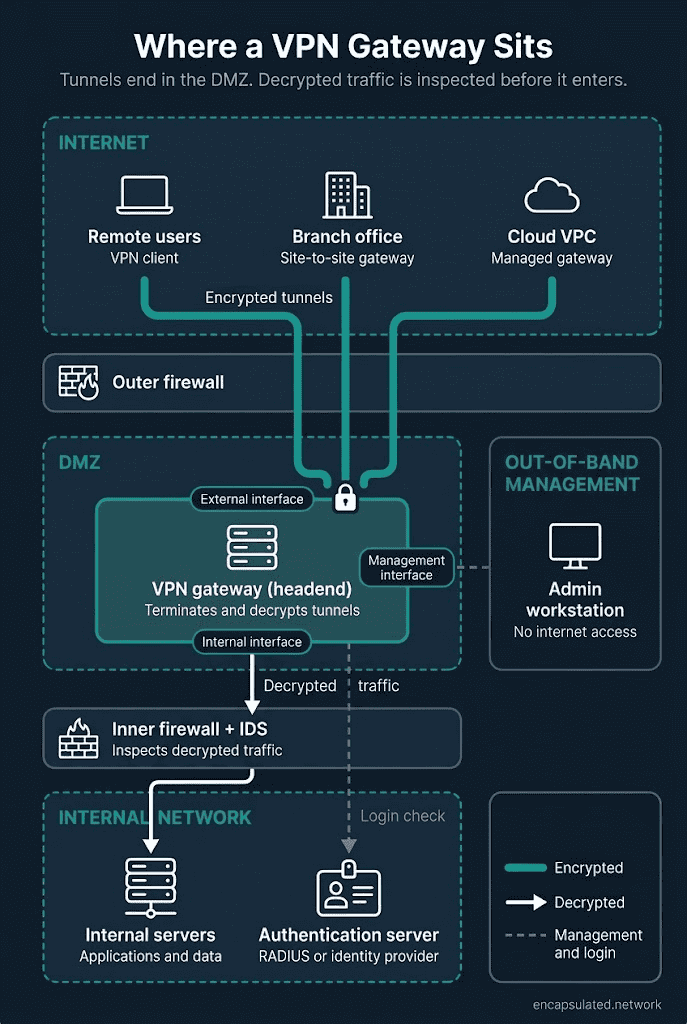
NIST’s IPsec guide, published in 2020, states that “it is generally recommended to design the IPsec architecture so that a firewall and intrusion detection software can examine the unencrypted traffic.” It then describes current practice: “Organizations most commonly address this by using their internet firewalls as VPN gateways or placing VPN gateway devices just outside their internet firewalls.” A gateway outside the firewall needs the segment between the two protected. A gateway placed inline at the internet connection also carries a single-point risk: “a gateway failure could cause a loss of all internet connectivity for the organization”.
NIST’s guide to SSL VPNs (SP 800-113), published in 2008, sets out three placements: on the firewall, inside the internal network, or in a DMZ. It advises against a fourth: “Placing the SSL VPN device outside the organization’s firewalls is not recommended because the device itself receives no protection from the firewall.” Of the three, it judges the DMZ best at limiting the impact of a VPN breach, and it recommends two network interfaces for a device placed there.
The management interface belongs on an out-of-band network (one separate from the traffic the gateway carries), not on the internet. An IPsec gateway can sit behind a NAT device: NIST lists NAT traversal among the extensions now built into IKEv2, though the standard itself makes support for it optional (RFC 7296, section 2.23). To accept incoming connections there, it also needs the IPsec ports forwarded to it.
How to size a VPN gateway
Several limits decide whether a gateway copes: encrypted throughput, which varies with packet size; packets per second; the number of tunnels or users it can hold; on some products, the number of licences; and how fast it can set up new tunnels.
- Throughput. Encryption costs processing. AES-NI, introduced by Intel in 2010, runs the heavy steps of AES in hardware. Some appliances add dedicated crypto hardware, such as network processors or Intel QuickAssist Technology, that takes encryption work off the main CPU. Software VPNs can also gain speed by moving data-channel processing into the kernel, as OpenVPN DCO does.
- Packet rate. AWS and Google Cloud cap the packets per second each tunnel carries, so small packets can hit the limit before bandwidth does.
- Tunnels and users. Vendor datasheets such as Cisco’s list a maximum number of VPN peers per model, and cloud SKUs list their tunnel and connection limits.
- Licences. Some vendors license remote access by user or connection count. Cisco does both: its Advantage and Premier licences count unique users, while VPN Only licences are bought per headend for a maximum number of concurrent connections.
- Tunnel setup rate. NIST’s IPsec guide warns that “If a remote access VPN server is too busy and has degraded to the point where an IKE session takes more than a few seconds to establish, the server will completely collapse under the load.” The cause is retries: “IKE clients usually time out after 5 to 10 seconds” and try again, adding load.
A sudden rise in remote users is one scenario that exposes these limits. In March 2020, CISA’s alert AA20-073A told organisations to test VPN limitations to prepare for mass usage and, if possible, to make changes such as rate limiting so that users who need more bandwidth get priority. Routing all user internet traffic through the gateway in full-tunnel mode adds to the load; split tunnelling is the alternative.
Datasheet figures are measured under test conditions. Cisco labels VPN throughput by packet size and test type, and real performance varies with features, traffic mix and packet size. Fortinet’s published figures use 512-byte packets with AES256-SHA256. Microsoft says its gateway benchmarks are not guaranteed. Size with your own traffic.
A gateway does not add bandwidth: encryption and tunnelling add overhead to every packet. On availability, NIST notes that “many VPN implementations actually tend to decrease availability somewhat” because they add components and complexity. For redundancy, remote-access gateways can be clustered or placed behind a load balancer, as in Cisco’s and Ivanti’s designs.
Why VPN gateways are a frequent attack target
In Verizon’s 2025 Data Breach Investigations Report, edge devices and VPNs were the target in 22% of the breaches where attackers exploited a vulnerability, up from 3% in the previous report. That figure covers 1,930 breaches, excluding error and misuse, from incidents between November 2023 and October 2024. In the same report, exploiting a vulnerability was the way in for 20% of breaches where the initial access vector was known (9,891 breaches, excluding error and misuse). Verizon’s 2026 edition reports that exploited vulnerabilities have since overtaken stolen passwords as the top way attackers get in.
Four properties make gateways attractive:
- They face the internet by design. Canada’s edge-device guidance, ITSM.80.101, defines edge devices as components “that bridge internally managed networks and external, untrusted networks such as the internet”, and names VPNs, firewalls and routers as the most common. It notes that they are “usually connected to the Internet and have public IP addresses that can be reached from anywhere”.
- They answer before anyone logs in. A remote-access gateway must accept connections from anywhere, so its login and key-exchange services are reachable before a user proves who they are. Several gateway flaws, including CVE-2024-3400 and CVE-2025-0282, needed no credentials.
- They sit on the boundary. A compromised gateway gives an attacker a way into the internal network. In several recent cases, attackers also took credentials or session tokens from the device.
- They are hard to investigate. In a July 2026 blog post, NCSC-UK wrote that “many network devices still provide only limited support for incident investigation”.
Major VPN gateway compromises, 2023 to 2025
| Disclosed | Product and CVE | What it gave attackers | Official response |
|---|---|---|---|
| Sep 2025 | Cisco ASA and Firepower Threat Defense (FTD): CVE-2025-20362, CVE-2025-20333 | Access to restricted VPN pages without logging in; remote code execution in the VPN web server | CISA ED 25-03; Cisco links the attacks to the ArcaneDoor activity it identified in early 2024; Cisco updated its guidance in April 2026 |
| Jan 2025 | Ivanti Connect Secure: CVE-2025-0282 | Unauthenticated remote code execution; exploited from mid-December 2024 (security firm Mandiant) | Added to CISA’s Known Exploited Vulnerabilities catalogue on 8 Jan 2025 |
| Apr 2024 | Palo Alto Networks PAN-OS GlobalProtect: CVE-2024-3400 | Unauthenticated code execution as root; security firm Volexity found exploitation on 10 April, with attempts from 26 March | Vendor advisory and KEV entry on 12 Apr 2024 |
| Jan 2024 | Ivanti Connect Secure and Policy Secure: CVE-2023-46805, CVE-2024-21887 | Authentication bypass chained with command injection; exploited from December 2023 (Mandiant) | CISA ED 24-01; its supplemental direction told federal agencies to disconnect the products by 2 Feb 2024 |
| Oct 2023 | Citrix NetScaler ADC and Gateway: CVE-2023-4966 (“Citrix Bleed”) | Leaked session tokens that let attackers take over logged-in sessions and bypass MFA; exploited from late August 2023 (Mandiant) | Patched in October 2023; CISA advisory AA23-325A names LockBit 3.0 affiliates |
CVE-2024-3400 carries a CVSS 3.1 severity score of 10.0 from Palo Alto Networks, which the US National Vulnerability Database (NVD) marks as matching its own assessment. Scores for the other CVEs are not shown because vendors and NVD do not always agree. CISA has issued emergency directives on VPN gateway products in 2021 (ED 21-03, Pulse Connect Secure), 2024 (ED 24-01, Ivanti) and 2025 (ED 25-03, Cisco).
On the consumer side, the risk is a compromised provider server; what a VPN does not protect against covers that case.
How zero trust network access changes the exposure
Connector-based zero trust network access (ZTNA) removes the inbound listener: connectors inside the network make outbound connections to the provider’s service, and access decisions move to a policy service that checks each request. NIST’s zero trust architecture guide (SP 800-207) lists the inbound rule as a network requirement: “Enterprise resources do not accept arbitrary incoming connections from the internet.” Trust and exposure move to new components: NIST notes that the policy engine and policy administrator become key components that “must be properly configured and maintained”, and that attacks on them or on the enforcement points can disrupt access.
How to harden a VPN gateway
The edge-device guidance that the cyber agencies of five countries published in February 2025 includes six controls that apply to a VPN gateway:
- Patch quickly. Install security patches after testing them on a standby or test device.
- Log off the device. Send logs to a central system, at detailed log levels.
- Use phishing-resistant MFA for all administrative access.
- Disable unused features and services.
- Isolate management. Keep management interfaces off the internet, on an out-of-band management network.
- Replace before end of support. Keep an inventory with support timelines and retire devices before vendor updates stop.
The guidance, ITSM.80.101, was led by the Canadian Centre for Cyber Security with Australia’s ACSC, New Zealand’s NCSC, the UK’s NCSC, CISA and the NSA.
Integrity checks have limits. In February 2024, CISA found that Ivanti’s Integrity Checker Tool failed to detect compromise on affected gateways (AA24-060B).
In the US, replacing unsupported edge devices is now mandatory for federal civilian agencies: CISA’s Binding Operational Directive 26-02, issued on 5 February 2026, requires them to inventory and decommission edge devices that no longer receive vendor updates.
Product changes can force a protocol switch: from FortiOS 7.6.3, Fortinet replaced SSL VPN tunnel mode with IPsec VPN on all FortiGate models. SSL VPN web mode is now called “Agentless VPN” on models that still offer it.
Benefits and limitations of a VPN gateway
A VPN gateway centralises encrypted access to a network, and that concentration is the source of several of its weaknesses.
Benefits
- One place to authenticate users and apply access policy for every tunnel.
- No VPN client software on users’ systems or internal hosts for site-to-site connections.
- Cross-vendor connections: because IPsec and IKE are published standards, gateways from different vendors generally interoperate when their settings match, and cloud providers publish lists of devices they have tested.
- Encrypted access over ordinary internet connections, without a private circuit.
Limitations
- A single point of failure unless built with redundancy, and a capacity ceiling.
- When the gateway extends the network to the user, admitted users get network-level access, limited by tunnel and firewall policy, rather than per-application access.
- Usually internet-facing, and a target for attackers.
- Ongoing patching and lifecycle work.
Users’ apparent location follows the tunnel mode: with split tunnelling, their internet traffic leaves through their own connection; with full tunnelling, through the organisation’s.
Frequently asked questions
What is the difference between a VPN and a VPN gateway?
A VPN is the whole system: the client software, the encrypted tunnels, the authentication and the gateways. The VPN gateway is one component of that system, the point on the network side where tunnels end, users or peers are authenticated, and decrypted traffic enters the private network.
Is a VPN gateway just a router?
No. A VPN gateway is a role, not a device type, and a router is one of several devices that can hold it. Any router is a gateway between networks; it becomes a VPN gateway when it adds encryption and authentication, as a home router does when it runs a VPN client for the devices behind it.
Is a VPN gateway hardware or software?
Either. Appliances, firewalls and routers ship as physical devices, some with dedicated crypto hardware, and some are also sold as virtual appliances. Managed cloud services and VPN server software run as software on general-purpose servers or cloud instances. The role is the same in every form.
What is the difference between a VPN gateway and a VPN client?
The client runs on the user’s device and opens the tunnel; the gateway sits on the network side, authenticates the connection and accepts it. Site-to-site connections run gateway to gateway, so the devices behind each gateway need no client software.
Is VPN Gate the same as a VPN gateway, and is it safe?
No. VPN Gate is an academic experiment run from the University of Tsukuba, in which volunteers operate public relay servers. For privacy, no: connection logs from its relay servers are kept for three months or more, and each volunteer’s server records packet headers for two weeks or more.
Does a consumer VPN use a VPN gateway?
Yes, in function. The provider’s server terminates your tunnel and decrypts your traffic, which is the gateway’s job, but then sends the traffic to the internet instead of into a private network. The provider runs these servers for all its subscribers; a business runs its own gateway or uses a managed cloud service.
What is an example of a VPN gateway?
A firewall at the edge of an office network with its VPN feature turned on is a VPN gateway. So are the managed cloud services Azure VPN Gateway, the AWS virtual private gateway and Google Cloud HA VPN, and a home router running a VPN client for the devices behind it.
Does a VPN gateway slow down your connection?
It can. Every packet gains tunnel headers and encryption overhead, and the gateway’s encrypted throughput, packet rate and tunnel limits set a ceiling on what passes through it. That ceiling is reached sooner when many users connect at once or when all their internet traffic is routed through the gateway.
Does a VPN gateway need a public IP address?
The gateway that accepts connections over the internet does: its peers must reach it, so it needs a public IP address, or one with the VPN’s ports forwarded to it through NAT. Managed cloud gateways get provider-assigned public addresses, and AWS and Azure also offer VPN over private circuits. IKEv2 NAT traversal lets tunnels pass through NAT between the peers.