An SSL VPN is a remote access VPN that encrypts the connection between a user’s device and an organisation’s VPN gateway with TLS, the successor to SSL, usually on TCP port 443. Users reach internal resources through a web portal in their browser or through an installed client that builds a network tunnel.
Vendors kept the SSL name after their products moved to TLS. The Internet Engineering Task Force (IETF) has retired SSL 2.0 and SSL 3.0, and current products use TLS, so the same products are also called TLS VPNs. “SSL VPN” usually names a category of vendor products, not a single protocol.
TL;DR
- SSL VPNs come in two modes. A browser portal reaches only the web applications and file shares the gateway offers, and needs nothing installed. A tunnel client puts the device on the internal network and carries its traffic for that network. Only the portal is clientless.
- Unlike IPsec, an SSL VPN runs each vendor’s own protocol inside TLS (NIST’s 2008 guide found “no standards for any type of SSL VPN”), so clients and gateways from different vendors rarely work together. Running over TLS has one practical advantage: the UK’s National Cyber Security Centre (NCSC) notes that TLS VPN connections can be more reliable than IPsec through network address translation (NAT) devices and enterprise firewalls.
- Current TLS versions are sound; the weak point is the gateway, a web service exposed to the internet. The US Cybersecurity and Infrastructure Security Agency (CISA) lists several SSL VPN gateway flaws as exploited, and the vendor or the US National Vulnerability Database (NVD) describes each as exploitable without logging in.
- The SSL protocol is retired, but SSL VPN products are still sold, and some agencies and vendors are moving away from them. In 2024, Norway’s NCSC advised replacing SSL VPNs with IPsec using IKEv2, and in 2025 Fortinet replaced SSL VPN tunnel mode with IPsec VPN. The UK NCSC also recommends IPsec, for its built-in clients and interoperability, but sees very little difference in risk between the two, other things equal.
- The replacement depends on what users need to access: an IPsec VPN with IKEv2 when they need broad network access, zero trust network access (ZTNA) when they need individual applications. Whatever is in place, the gateway needs prompt patching and multi-factor sign-in.
What does SSL VPN mean?
“SSL VPN” names a remote access VPN secured with TLS (Transport Layer Security); the name stayed after TLS replaced SSL (Secure Sockets Layer). NIST’s 2008 guide to SSL VPNs (SP 800-113) states: “This type of VPN may be referred to as either an SSL VPN or a TLS VPN.” Cisco called the clientless (browser) SSL VPN on its ASA firewalls WebVPN.
SSL VPN vs SSL certificate and HTTPS
An SSL certificate proves a website’s identity and enables its HTTPS connection; an SSL VPN connects a user to an organisation’s network. An SSL VPN gateway also authenticates itself with a certificate during the TLS handshake, like any HTTPS server.
HTTPS uses the same TLS to protect the connection between a browser and one website. A consumer VPN does something else: it routes your internet traffic through a provider’s servers, using protocols such as WireGuard, OpenVPN or IKEv2.
A VPN does not replace HTTPS. The VPN’s encryption ends at its gateway or server, so anything the application does not encrypt itself travels unencrypted beyond it, while HTTPS keeps protecting the connection all the way to the website.
From SSL to TLS
The IETF has retired SSL 2.0, SSL 3.0, TLS 1.0 and TLS 1.1, so current IETF guidance allows only TLS 1.2 and 1.3. Each change, oldest first:
| Year | Change | Source |
|---|---|---|
| 2011 | SSL 2.0 prohibited | RFC 6176 |
| 2015 | SSL 3.0 deprecated | RFC 7568 |
| 2018 | TLS 1.3 published | RFC 8446 |
| 2021 | TLS 1.0 and 1.1 deprecated | RFC 8996 (BCP 195) |
| 2026 | TLS 1.3 respecified; RFC 8446 obsoleted | RFC 9846 (July 2026) |
The 2014 POODLE attack, which can recover plaintext from SSL 3.0 connections, was one of the reasons for retiring SSL 3.0 (RFC 7568).
TLS is a standard; the VPN built on it is not: NIST’s 2008 guide said there were “no standards for any type of SSL VPN”. The tunnel each product builds inside TLS is the vendor’s own design, so clients and gateways from different vendors rarely work together.
How does an SSL VPN work?
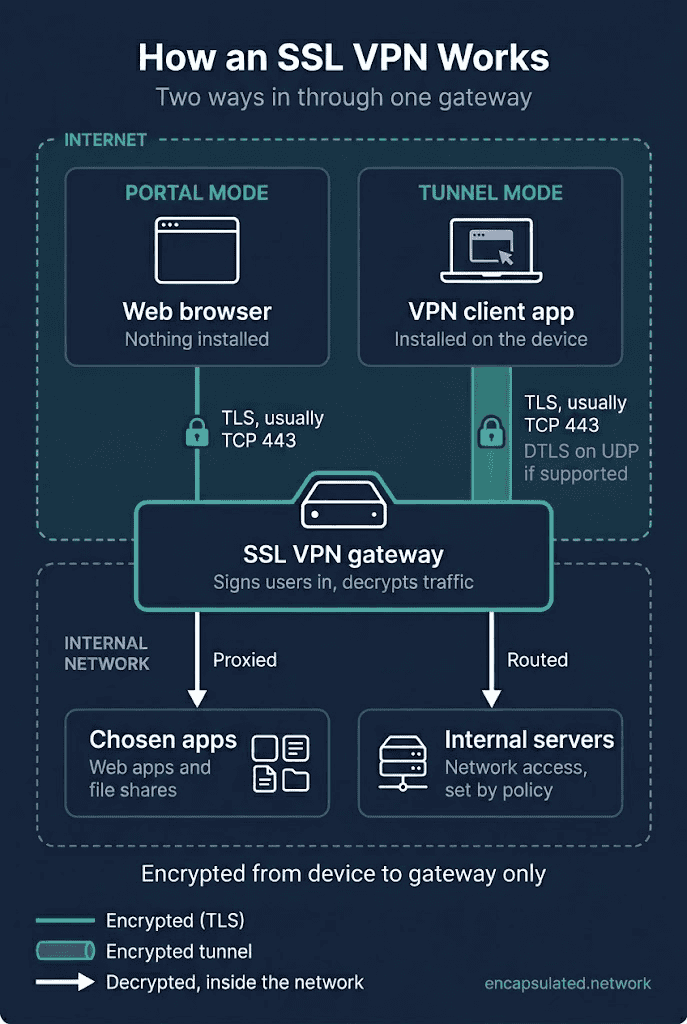
The user’s device opens a TLS session to the organisation’s SSL VPN gateway, signs in, and the gateway then either serves a portal of chosen applications or opens a tunnel into the network. A connection runs in five steps:
- Connection. The device connects to the gateway’s address over TCP, usually on port 443.
- TLS handshake. The device and gateway agree session keys, and the gateway proves its identity with a certificate that the device checks (RFC 9846, section 2).
- Sign-in. The user proves who they are with a password and a one-time code, a certificate or single sign-on. A certificate on the user’s device can be checked during the TLS handshake itself.
- Policy. The gateway applies the organisation’s access rules. A portal user gets a web page of permitted applications; a tunnel user’s client gets a virtual network interface and an internal address from a pool.
- Forwarding. The gateway decrypts the traffic and forwards it to internal systems.
The three core functions
NIST’s 2008 guide names three core functions and says most SSL VPNs have one or more: proxying, application translation and network extension.
- Proxying. The gateway fetches internal web pages on the user’s behalf and returns them over TLS. This is the core of portal mode.
- Application translation. The gateway speaks a non-web protocol, such as CIFS (Windows file sharing) or FTP to a file server, and shows the result as a web page.
- Network extension. A client gives the device partial or full network access, with full or split tunnelling. This is the core of tunnel mode. Port forwarding, a more limited form of network extension, tunnels chosen TCP or UDP ports only.
SSL portal VPN vs SSL tunnel VPN
A portal VPN gives browser access to chosen applications through the gateway; a tunnel VPN uses a client to put the device on the network.
| Portal VPN | Tunnel VPN | |
|---|---|---|
| How the user connects | Web browser to a portal page | Installed client app (in 2008, often a browser plug-in) |
| What it reaches | Chosen web apps, file shares and other proxied services | Almost all IP traffic to permitted networks |
| Layer (NIST, 2008) | Transport-layer VPN | Network-layer VPN |
| Main function | Proxying and application translation | Network extension |
| Software on the device | None beyond the browser | Client app, which needs administrator rights to install (NIST, 2008) |
| Current examples | Fortinet Agentless VPN | AnyConnect protocol clients, FortiGate tunnel mode before FortiOS 7.6.3, GlobalProtect’s SSL fallback |
Portal mode (clientless)
In portal mode, the gateway acts as a reverse proxy: it fetches internal pages and rewrites their URLs and the links inside their HTML, CSS and JavaScript so that they work through the portal, as F5’s portal access does. Complex or dynamic web applications can stop working after rewriting.
Users see links, often called bookmarks, to the resources they are allowed to reach. Some portals can also open remote desktop (RDP) and SSH sessions inside the browser, for example Ivanti Connect Secure’s HTML5 Access.
Portals have long reached other non-web applications through port forwarding: a small Java client tunnels chosen TCP ports, sometimes by editing the device’s hosts file, as Ivanti Connect Secure still documents. Unlike the rest of the portal, port forwarding needs software on the device.
Tunnel mode
In tunnel mode, a client on the device creates a virtual network interface and receives an internal address, so the device joins the internal network. Most SSL VPN products now expect users to install a client app, and some vendors have removed or limited the browser portal.
Several SSL VPNs, including the AnyConnect protocol and older FortiGate tunnel mode, can carry data over DTLS on UDP and fall back to TLS on TCP if the UDP channel cannot be used. UDP is preferred because TCP inside TCP can perform badly on lossy links (networks that drop packets), a problem RFC 9329 (section 9.1) calls “TCP meltdown”.
DTLS (Datagram Transport Layer Security, RFC 9147) adds an explicit sequence number to each record, so TLS-style encryption keeps working over UDP, where packets can be lost or arrive out of order. It can also detect replayed records.
Is an SSL VPN clientless?
Only in portal mode. A tunnel needs software on the device, and so does port forwarding inside a portal.
A third type: gateway-to-gateway
NIST’s 2008 guide describes a third type, gateway-to-gateway SSL VPNs, available in some products but rarely used, because they offer features similar to IPsec VPNs with less flexibility. Linking whole networks is the job of a site-to-site VPN, which commonly uses IPsec.
SSL VPN vs IPsec VPN
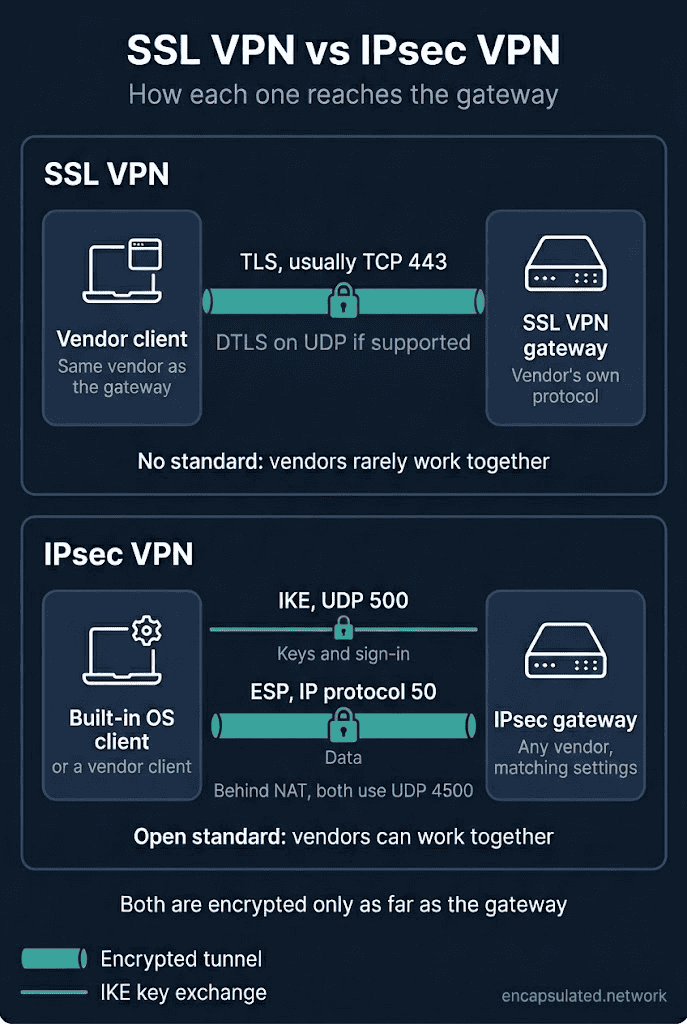
IPsec is an IETF standard that protects IP packets at the network layer; an SSL VPN is a vendor product that runs over TLS, either as a browser portal or as a client tunnel.
| SSL VPN | IPsec VPN | |
|---|---|---|
| Standard | None for the VPN itself (NIST, 2008); TLS is standardised | IETF standards suite |
| Layer (NIST, 2008) | Portal: transport layer; tunnel: network layer | Network layer |
| Client | Browser (portal) or vendor client (tunnel) | Built into many operating systems, or a vendor client |
| Usual transport | TCP 443; some products add DTLS on UDP | IKE on UDP 500 (UDP 4500 behind NAT); ESP as IP protocol 50, or inside UDP 4500 behind NAT |
| Restrictive networks | Can pass more reliably through NAT and firewalls (UK NCSC) | UDP can be blocked; RFC 9329 (2022) allows IKE and IPsec over TCP where both ends are configured for it |
| Cross-vendor | Products from different vendors rarely interoperate | Open standard; products from different vendors can work together when their settings match |
| Site-to-site | Rare (NIST, 2008) | Common |
| TCP-over-TCP risk | Present when data runs over TLS on TCP; DTLS on UDP avoids it | None with ESP over IP or UDP; present if TCP-encapsulated |
| Access scope | Portal can limit users to chosen apps; tunnel gives network access, limited by policy | Network access, limited by policy |
As an example of cross-vendor IPsec, Microsoft has validated IPsec devices from many vendors for site-to-site connections to its Azure VPN Gateway.
Which is more secure?
Neither is more secure by default: the UK’s National Cyber Security Centre (NCSC) sees very little difference in risk between IPsec and TLS VPNs, other things equal.
The agencies that advise IPsec give different reasons:
- Norway’s NCSC (May 2024) advises replacing SSL VPNs with IPsec using IKEv2 after repeated exploitation of SSL VPN flaws, while noting that IPsec with IKEv2 can also have vulnerabilities but presents a smaller attack surface.
- NSA and CISA (September 2021) advise avoiding non-standard SSL/TLS VPNs in favour of standardised IKE/IPsec VPNs, because custom features add risk even when the TLS settings are secure.
- The UK NCSC recommends IPsec, pointing out that IPsec clients are built into many operating systems and that products from different vendors work together.
Which is faster?
Speed depends on whether the data travels over TCP or UDP. When an SSL VPN carries data over TLS on TCP, TCP traffic inside the tunnel can slow down on lossy links; products that use DTLS on UDP avoid this. IPsec normally sends data as ESP (Encapsulating Security Payload, the IPsec protocol that carries encrypted packets) directly over IP, or inside UDP behind NAT. IPsec over TCP (RFC 9329), a fallback for networks that block UDP, brings back the same problem.
TLS VPN vs IPsec VPN
A TLS VPN is another name for an SSL VPN, so it differs from IPsec in the same ways. Among other VPN protocols, OpenVPN also uses TLS, and WireGuard uses neither TLS nor IPsec.
Advantages and disadvantages of an SSL VPN
An SSL VPN’s strengths come from running over TLS on the HTTPS port; its weaknesses come from having no common standard and an internet-facing web service.
Advantages of an SSL VPN
- Works through restrictive networks. To a filter that blocks by port alone, its traffic looks like ordinary HTTPS, and TLS VPN connections can be more reliable than IPsec through NAT devices and enterprise firewalls.
- No software for portal users. Portal mode needs nothing on the device beyond a browser.
- Narrow access. Portal mode can limit a user to chosen applications instead of the whole network.
- Mixed access from one gateway. One SSL VPN can give some resources through network extension and others through the proxy.
Disadvantages of an SSL VPN
- No common standard. Clients and gateways from different vendors rarely work together.
- Administrator rights. NIST’s 2008 guide notes that installing a tunnel client requires administrative access to the device.
- Slower over TCP. TCP traffic carried inside a TLS-on-TCP tunnel can slow down on lossy links unless the product uses DTLS on UDP.
- An internet-facing web service. Flaws in the gateway’s web service can be reached before sign-in, and attackers have exploited critical ones.
- Broad access in tunnel mode. As with a remote access IPsec VPN, per-application access controls are hard to enforce.
Which VPN protocols are SSL VPNs?
Any VPN that builds its tunnel on TLS fits the name, but “SSL VPN” usually means a vendor’s remote access product. Microsoft SSTP, OpenVPN and SoftEther also use TLS without being those products. Older OpenVPN project documents still called OpenVPN a full-featured SSL VPN.
| Protocol | Maker | How it uses TLS | Transport | Open source |
|---|---|---|---|---|
| SSTP | Microsoft | PPP carried over HTTPS | TCP 443 | No; specification published as [MS-SSTP] |
| OpenVPN | OpenVPN project | TLS on the control channel for keys; its own data format | UDP by default, or TCP | Yes (GPLv2) |
| SoftEther native protocol | SoftEther project | Ethernet frames over HTTPS | TCP (HTTPS), with optional UDP acceleration | Yes (Apache 2.0) |
| AnyConnect protocol | Cisco; also the OpenConnect client and ocserv server | TLS for control, DTLS for data where available | TCP 443, UDP | Cisco’s client: no; ocserv: yes (GPL) |
| FortiGate SSL VPN | Fortinet | PPP-based tunnel over TLS | TCP, optional DTLS | No |
| GlobalProtect | Palo Alto Networks | IPsec on UDP 4501 first, SSL tunnel on TCP 443 as fallback | UDP, TCP | No |
| Lightway | ExpressVPN (consumer) | wolfSSL library; DTLS on UDP or TLS on TCP | UDP, TCP | Yes (core) |
Other vendor SSL VPN protocols include those of Juniper, Pulse Connect Secure (now Ivanti Connect Secure), F5 BIG-IP and Array Networks.
Is an SSL VPN secure?
Current TLS versions are sound; the weak point is the gateway software, which runs a web service on the internet.
Critical SSL VPN flaws in CISA’s Known Exploited Vulnerabilities Catalog include these five; the vendor’s advisory or NVD describes each as exploitable without logging in:
| CVE | Product | Flaw | Exploitable without login | Added to CISA KEV |
|---|---|---|---|---|
| CVE-2024-3400 | PAN-OS GlobalProtect | Command injection | Yes | 12 Apr 2024 |
| CVE-2024-21762 | FortiOS SSL VPN | Out-of-bounds write | Yes | 9 Feb 2024 |
| CVE-2022-42475 | FortiOS SSL VPN | Heap buffer overflow | Yes | 13 Dec 2022 |
| CVE-2019-11510 | Pulse Connect Secure (now Ivanti Connect Secure) | Arbitrary file read | Yes | 3 Nov 2021 |
| CVE-2018-13379 | FortiOS SSL VPN web portal | Path traversal | Yes | 3 Nov 2021 |
Gateways from other vendors were also exploited between 2023 and 2025, among them Ivanti Connect Secure, Cisco ASA and Citrix NetScaler.
Port 443 does not make the gateway invisible. A filter that blocks by port alone sees ordinary HTTPS traffic, but firewalls that identify applications, often with TLS inspection, can recognise and block VPN apps.
Internet-wide scanners find gateways on any port. Shodan identifies services regardless of port, and Shadowserver reports SSL VPN gateways that still have known flaws.
On the user’s side, a shared or public computer can keep portal session data after the user logs out.
NSA and CISA advise applying patches promptly, using multi-factor authentication and turning off any gateway features that are not needed.
Is SSL VPN being phased out?
Norway’s NCSC has advised replacing SSL VPNs by a deadline, and Fortinet has replaced its tunnel mode with IPsec VPN. Other vendors have changed less: Cisco dropped only its browser portal, and SonicWall ended support for one product line.
| Date or version | Who | What changed |
|---|---|---|
| June and November 2025 | SonicWall | SMA 100 series appliances reached end of support: 18 June 2025 for the SMA 200 and 400, and 1 November 2025 for the SMA 210, 410 and 500v; SonicWall still sells its SMA 1000 series for remote access |
| FortiOS 7.6.3 (April 2025) | Fortinet | SSL VPN tunnel mode replaced with IPsec VPN on all FortiGate models; tunnel settings are not carried over on upgrade. SSL VPN web mode renamed Agentless VPN, which is not available on the 40F, 60F and 90G series |
| FortiOS 7.6.0 (July 2024) | Fortinet | No SSL VPN web or tunnel mode on models with 2 GB of RAM or less, such as the 40F and 60F families |
| 15 May 2024 (updated 3 September 2024) | Norway’s NCSC, part of the National Security Authority (NSM) | Advised replacing SSL VPN with IPsec using IKEv2, by the end of 2024 for organisations under the Security Act or otherwise defined as critical to society, and by the end of 2025 for others. These are recommendations: NSM says the advice changes no Security Act requirement |
| ASA 9.17(1) (December 2021) | Cisco | Removed clientless (portal) SSL VPN from ASA software; tunnel mode unaffected |
| September 2021 | NSA and CISA | Advised avoiding non-standard SSL/TLS VPNs in favour of standardised IKE/IPsec VPNs |
On Cisco’s newer Firewall Threat Defense software, the browser is used only to download the Secure Client app (formerly AnyConnect).
What replaces an SSL VPN
Replacements include IPsec VPNs with IKEv2, zero trust network access (ZTNA) and WireGuard-based remote access, which runs over UDP. Fortinet’s IPsec VPN, its replacement for tunnel mode, can run on TCP port 443, so it still works on networks that allow only web traffic. Norway’s NCSC, which recommends IPsec, says its advice does not rule out other options, such as WireGuard-based solutions.
Which one fits depends on what users need to access: IPsec suits broad network access, and ZTNA suits individual applications.
If your vendor has announced the change
- Find out which mode you use: browser portal, client tunnel or both.
- Check your firmware branch and the vendor’s own notice, not third-party summaries.
- Migrate the configuration before upgrading: FortiOS 7.6.3 does not carry SSL VPN tunnel settings over.
- Plan the client rollout for every device that used the old client.
- Keep the gateway patched during the move, and keep patching whatever replaces it.
SSL VPN vs ZTNA
An SSL VPN tunnel admits a device to the network after sign-in; zero trust network access (ZTNA) grants access to each application per session and keeps checking the user and device. NIST’s 2008 guide notes that some SSL VPNs can also recheck a device during a session.
NIST’s zero trust architecture (SP 800-207) expects most organisations to run zero trust and older perimeter-based access side by side for a time.
Terms confused with SSL VPN
Several “SSL” terms describe different things: certificates, inspection and offloading are about HTTPS traffic, not remote access.
| Term | What it is | Relation to SSL VPN |
|---|---|---|
| SSL certificate | Proves a website’s identity and enables HTTPS | The gateway uses one; it is not the VPN |
| TLS (SSL) inspection | A firewall or proxy decrypts TLS traffic, inspects it and re-encrypts it | Can identify and block VPN apps on port 443 |
| SSL offloading | Removing TLS encryption from incoming traffic to relieve a web server | Not a VPN |
| SSTP | Microsoft’s TLS-based VPN protocol | Technically an SSL VPN protocol |
| TLS VPN | Another name for an SSL VPN | Same thing |
Frequently asked questions
What is the difference between a VPN and an SSL VPN?
An SSL VPN is one kind of VPN: remote access to an organisation’s network over TLS, through a browser portal or an installed client. A consumer VPN serves one person instead, sending their internet traffic through a commercial provider’s servers over protocols such as WireGuard, OpenVPN or IKEv2.
Is an SSL VPN safe?
The encryption is sound when the gateway uses TLS 1.2 or 1.3, the versions current IETF guidance allows. The concern is the gateway software: several SSL VPN products have had critical flaws that could be exploited without logging in, and CISA lists them as exploited. Prompt patching and multi-factor sign-in reduce that risk.
Is SSL VPN outdated or deprecated?
The SSL protocol is outdated: the IETF prohibited SSL 2.0 in 2011 and deprecated SSL 3.0 in 2015. Whether SSL VPN products are outdated is disputed. Norway’s NCSC recommends IPsec with IKEv2 and Fortinet has replaced its tunnel mode with IPsec VPN; the UK NCSC also recommends IPsec but finds very little difference in risk, other things equal.
What can replace an SSL VPN?
An IPsec VPN with IKEv2 for users who need the whole network, or zero trust network access (ZTNA) for users who need only certain applications; WireGuard-based remote access is a third option. Norway’s NCSC recommends IPsec without ruling out WireGuard-based solutions, and Fortinet replaced its tunnel mode with IPsec VPN.
Why is Fortinet replacing SSL VPN tunnel mode?
Fortinet’s FortiOS 7.6.3 release notes do not give a reason. They say SSL VPN tunnel mode is replaced on all FortiGate models with IPsec VPN, which can run on TCP port 443. Because the upgrade does not migrate existing tunnel settings, administrators need to move the configuration first.
How do I connect to an SSL VPN?
Your organisation gives you a web address to open in a browser, a client app, or both. The browser alone means portal mode, though some portals only offer the app for download. The app builds a tunnel, in some products over IPsec rather than TLS. You then sign in with the credentials and any second factor it issued.
What port does an SSL VPN use?
Usually TCP port 443, the same port HTTPS websites use. Some products also send data over UDP, often port 443, using DTLS, which avoids some of the delays of carrying data over TCP. Administrators can change the port, for example when the firewall’s own admin page already uses 443.
Is OpenVPN an SSL VPN?
Broadly, yes. OpenVPN uses TLS to agree keys on its control channel and its own packet format for data, and older project documents called it an SSL VPN. It is a separate open-source protocol, though, not one of the vendor SSL VPN products sold with firewalls.
Do I need SSL if I have a VPN?
Yes. A VPN encrypts traffic only as far as its server or gateway, where it is decrypted and sent on. HTTPS, which relies on the website’s SSL/TLS certificate, protects the connection from your browser to the website itself, so it still matters with a VPN switched on.
Is an SSL VPN the same as a TLS VPN?
Yes. TLS replaced SSL, and SSL 2.0 and SSL 3.0 were retired in 2011 and 2015, but vendors kept the older name in their products and documentation. “SSL VPN” and “TLS VPN” therefore name the same category; neither name tells you which TLS version a product supports.
What layer does an SSL VPN operate at?
It depends on the mode. NIST’s 2008 guide describes portal VPNs as transport-layer VPNs that work over a single port, TCP 443, and states that “SSL tunnel VPNs operate as network layer VPNs.” IPsec also works at the network layer.
What is the difference between an SSL VPN and a site-to-site VPN?
An SSL VPN connects individual users to a network. A site-to-site VPN joins whole networks, such as a branch office and headquarters, and commonly uses IPsec. Some products can also link two gateways over TLS, which NIST’s 2008 guide calls gateway-to-gateway SSL VPNs and describes as rarely used.
Can an SSL VPN be blocked?
Yes. A firewall that filters only by port lets it through wherever HTTPS on port 443 is allowed, because the traffic looks like any other HTTPS connection. Firewalls with application identification, often combined with TLS inspection, can detect VPN apps and block them, and blocking the gateway’s IP address also stops it.