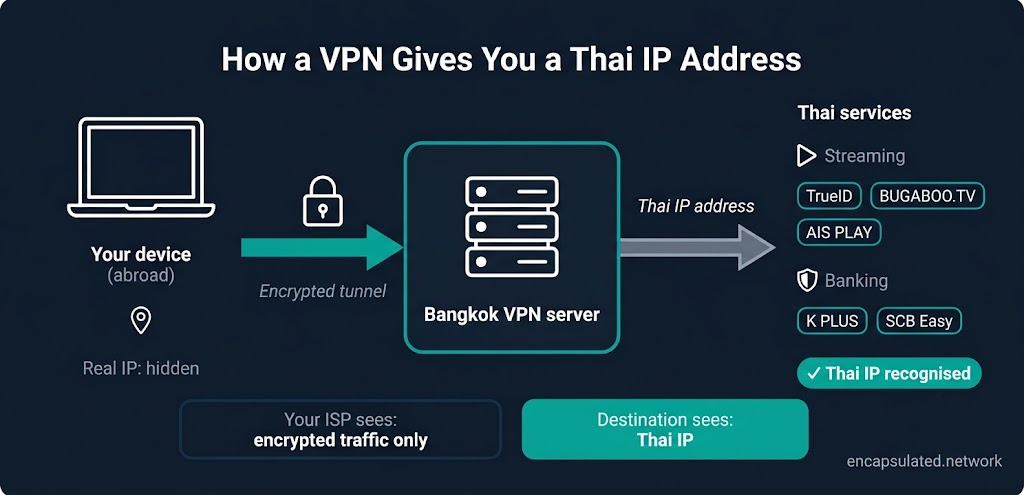
To get a Thai IP address, connect to a Bangkok server in a VPN application. TrueID, BUGABOO.TV, AIS PLAY, and CH3 Plus all read the connection as originating from Thailand.
Without a Thai IP, those platforms block access before any content loads. Open BUGABOO.TV from an apartment abroad and the platform returns an access error where Channel 7’s drama catalogue should be.
For streaming, a Thai IP address is the solution once you have an account, and for most platforms registration is straightforward. For banking, a second barrier exists that a VPN cannot touch. K PLUS and SCB Easy both require a one-time password sent to the Thai mobile number registered to the account before a new device can be activated or certain transactions authorised. A Thai IP removes the flag that marks an overseas login as suspicious. It does not deliver the SMS.
How to Get a Thai IP Address
The screenshots below use ProtonVPN, which is the VPN used across this site for demonstration purposes and is not a recommendation over other providers. The steps apply to any VPN application that offers a Thailand or Bangkok server location.
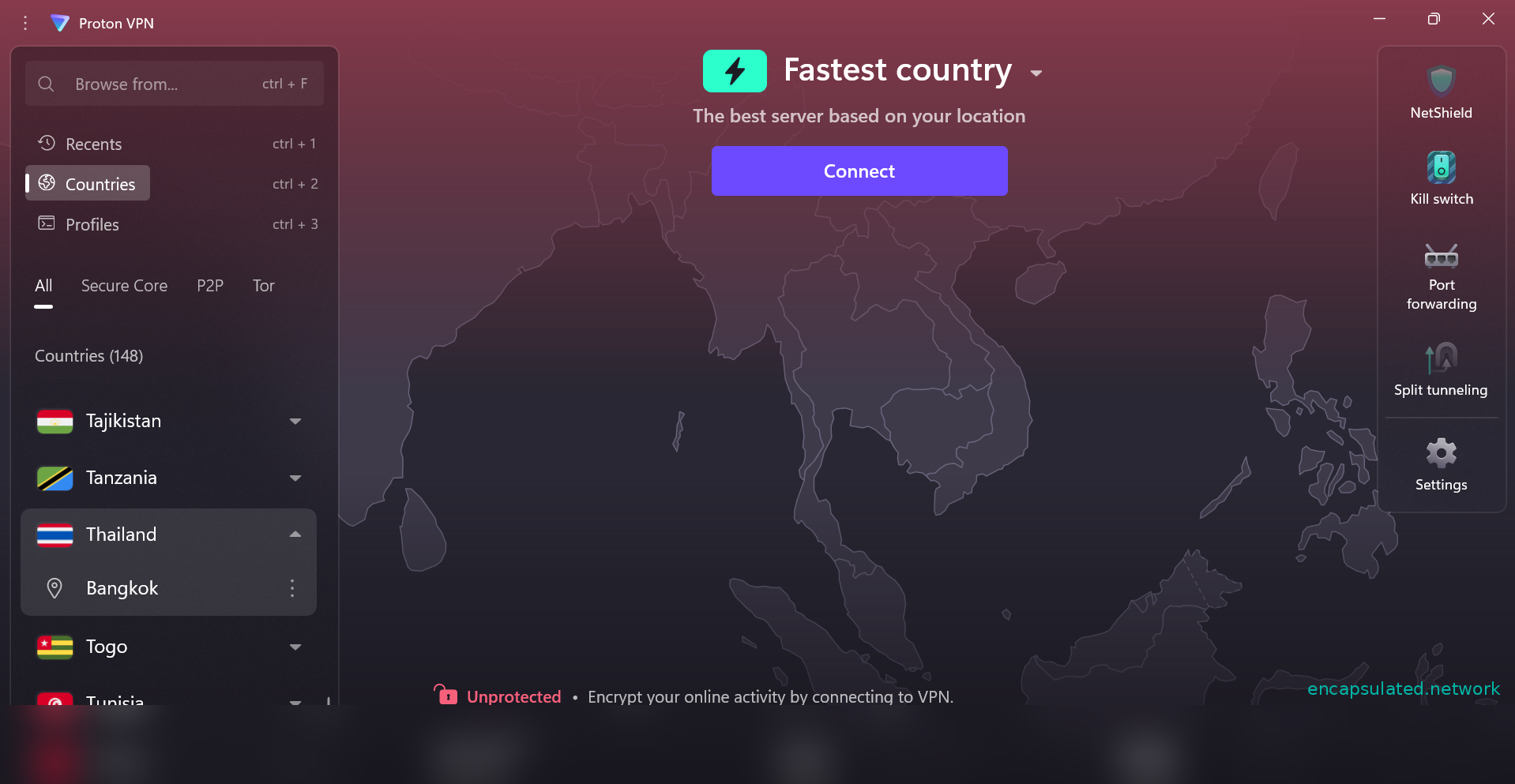
Select a Bangkok server
Open your VPN application and navigate to the server list. Search for Thailand or scroll to it by country. Where city-level selection is available, choose Bangkok. The majority of Thai streaming platforms, banking systems, and government portals are headquartered in Bangkok or route their geo-checks through infrastructure based there.
If your provider lists multiple Bangkok servers, note that different servers within the same city use different IP address ranges with different detection histories. When one server is blocked by a particular platform, another in the same Bangkok pool is often clean.
Before connecting, confirm two settings are active in your VPN application: the kill switch and DNS leak protection. The kill switch cuts your internet connection if the VPN drops unexpectedly, preventing your real IP from being briefly exposed during reconnection. DNS leak protection ensures that domain-name lookups travel through the encrypted tunnel rather than through your home ISP. Both should be enabled by default; check the settings panel if you are unsure. For a full explanation of what each setting does and why it matters, see the guide to changing your IP address location.
Connect and check your protocol
Select the Bangkok server and connect. Leave WireGuard as the default protocol. WireGuard is the current standard for consumer VPN connections: the encryption overhead is low, connection times are fast, and it performs well for streaming. There is no reason to change it unless a network is filtering it.
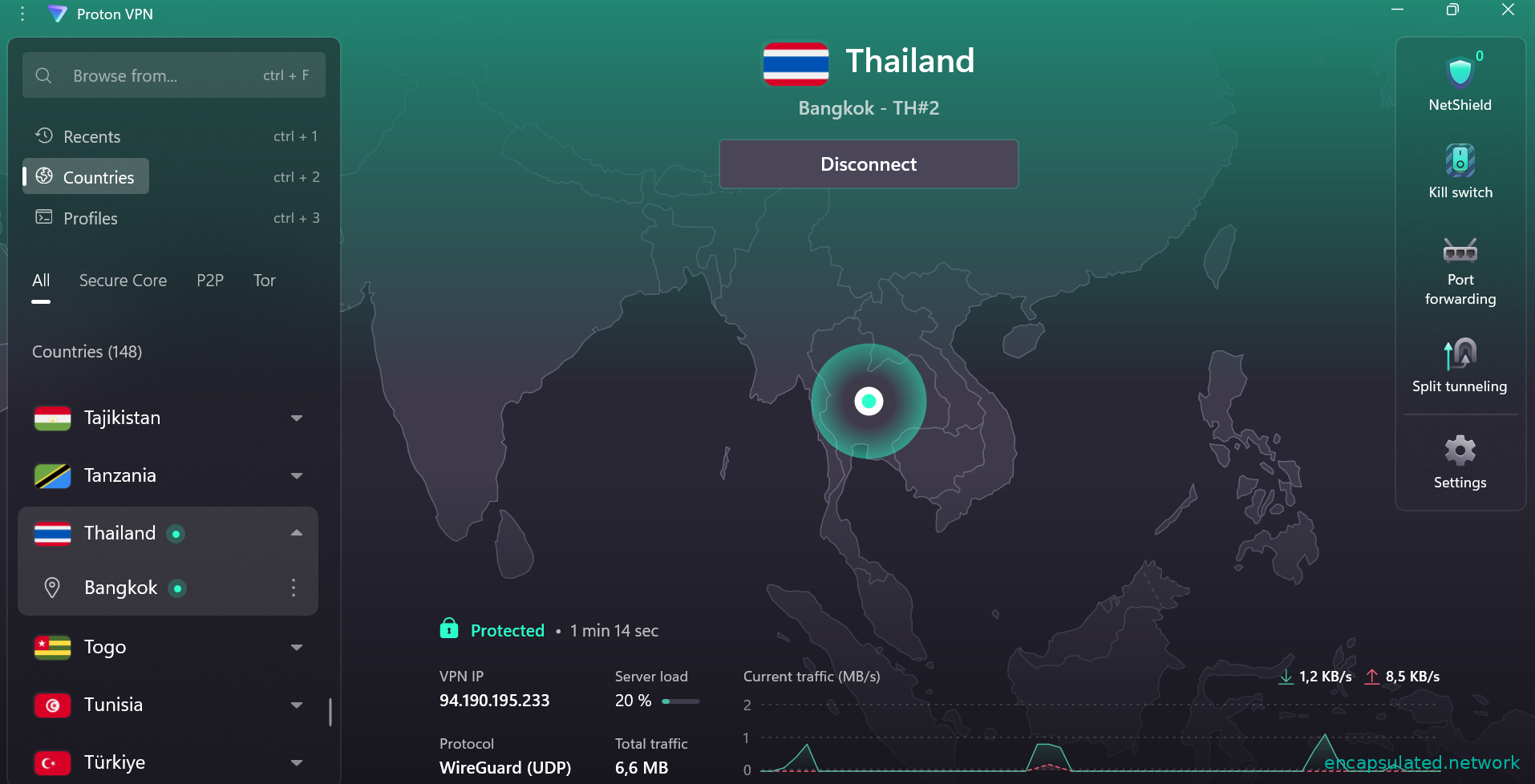
On some hotel Wi-Fi networks and corporate connections, WireGuard traffic on its default port may be filtered. If the VPN fails to connect or connects but Thai services remain unreachable on a restricted network, switch to OpenVPN using TCP on port 443. Port 443 is the standard HTTPS port and passes through most firewalls without inspection. This does not defeat deep packet inspection, but it resolves basic port-based blocks. For a full breakdown of when and why to switch protocols, see the VPN protocols guide.
Verify the Thai IP before opening any service
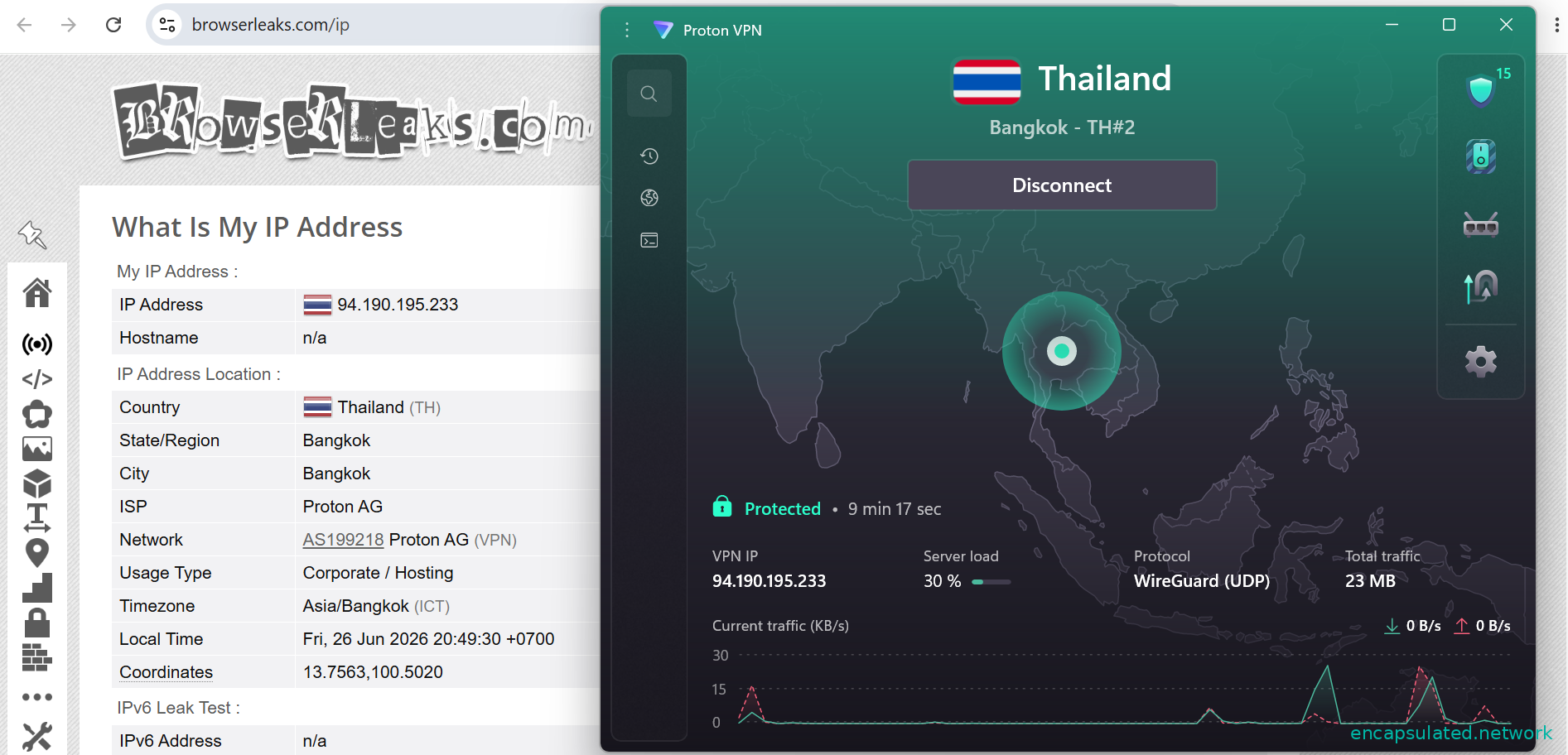
Once connected, navigate to browserleaks.com/ip before opening any Thai platform. The page returns your public IP address, its registered country, and the timezone associated with the connection. All three should reflect Thailand: a Thai IP address, a Thailand country entry, and an Asia/Bangkok timezone. If any of these show your home country, the VPN is not routing correctly.
The same page checks for DNS and WebRTC leaks. DNS leak protection ensures domain-name queries resolve through the VPN tunnel rather than your home ISP. A DNS leak shows your real ISP in the DNS section even when the IP is Thai, which some streaming platforms use as a mismatch signal to block access. WebRTC is a browser-level protocol that can expose your real network address independently of the VPN tunnel. If either leak appears, enable the relevant protection in your VPN settings before proceeding.
Virtual servers and what they mean for Thailand
Not all Thailand VPN servers are physically located in Bangkok. Several major providers route their Thailand location through hardware situated in Singapore, assigning a Thai-registered IP address while the physical connection exits in Singapore. NordVPN has confirmed this on their server-information page: their Thailand servers are virtual servers with a Singapore-based physical host.
For streaming, this makes no practical difference. The IP address your device receives is Thai-registered, and every geo-check run by TrueID, BUGABOO.TV, AIS PLAY, or any other Thai platform reads it as a Thai connection. For live sport specifically, the physical routing to Singapore and back adds latency compared to a server with hardware in Bangkok. During a Premier League match on AIS PLAY with high concurrent viewers, that additional distance can contribute to buffering. If live sport is your primary use case, check your provider’s server-information or FAQ page before subscribing to confirm whether the Bangkok location is a physical or virtual server.
Getting a Thai IP on different devices
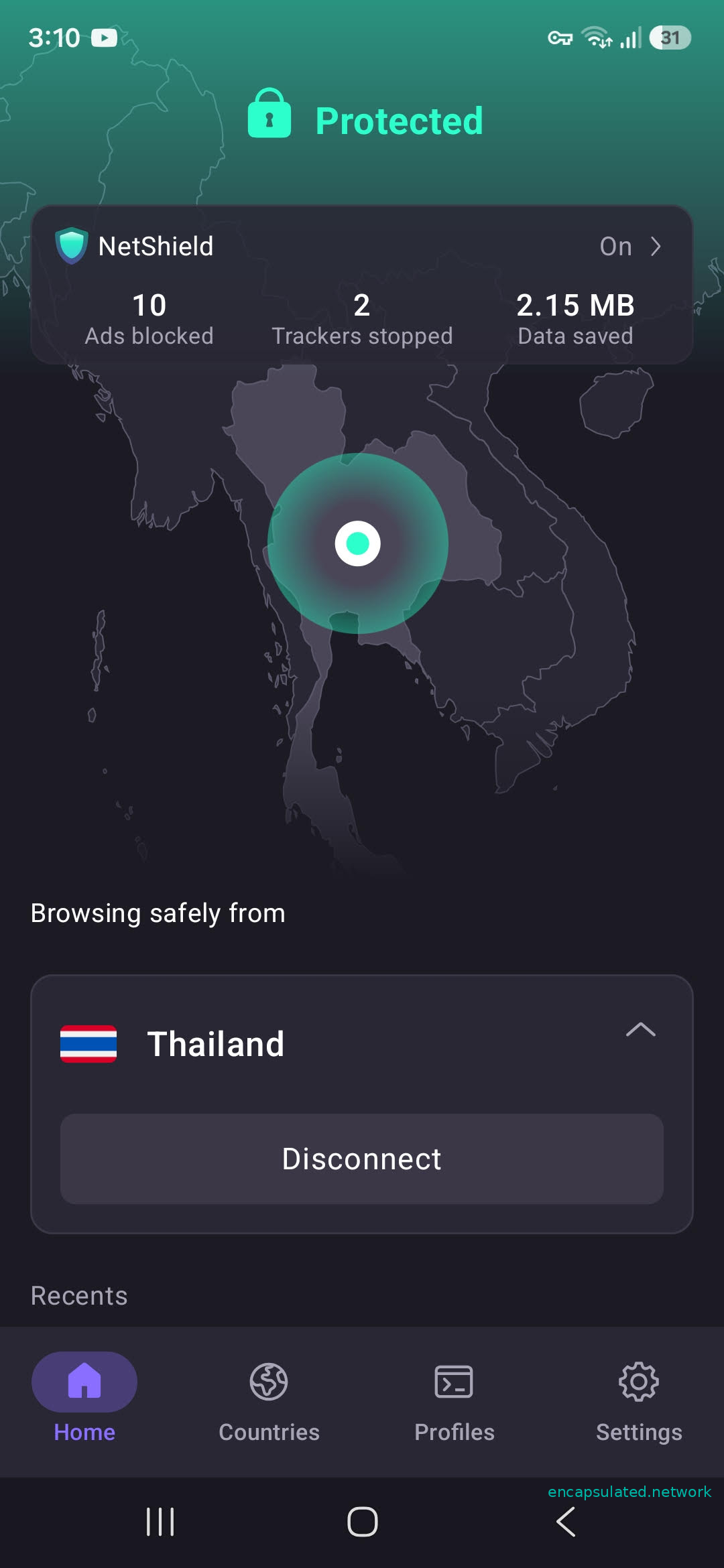
iPhone and iPad (iOS/iPadOS). VPN apps are available from the App Store and create the VPN configuration profile automatically on first connection. No manual profile installation is required. Once connected, open the streaming app fresh rather than from the recent apps tray, as iOS can cache the pre-connection state.
Android. VPN apps install from the Play Store. Split tunnelling is available on most Android VPN apps and is relevant if you want Thai streaming apps to route through the VPN while keeping other apps on your home connection. If you use a Thai banking app on the same device, disable any Accessibility Services before connecting.
Windows and macOS. Desktop browsers carry a higher WebRTC exposure risk than mobile apps, so the browserleaks.com/ip verification step is particularly important before opening any Thai streaming service in a browser tab.
Streaming sticks and boxes. Amazon Fire TV Stick, Android TV devices, Google TV devices, and Apple TV (tvOS 17 and later) all support native VPN apps installed directly from their respective stores. Samsung Tizen and LG webOS smart TVs do not support native VPN apps. For those devices and for games consoles, a router-level VPN is the standard approach.
If a Thai service still blocks you after connecting
Work through these steps in order. Most blocks resolve at the first or second step.
Switch to a different Bangkok server. Different servers in the same city pool use different IP ranges with different detection histories. A server range that appears on TrueID’s or Netflix’s block list may sit alongside a clean range on a neighbouring server. Disconnect, select a different Bangkok server, reconnect, and retry the service.
Clear your browser cache and cookies, or force-close the native app. A previously cached session can persist location data from before the VPN connected. On a browser, clear cache and cookies for the affected domain. On mobile, remove the app from the recent apps tray, confirm the VPN is still connected and showing Bangkok, then reopen the app.
Open the service after the VPN is connected, not before. Apps that were already running when you activated the VPN may have resolved your real IP at launch and cached it. Close the app completely, confirm the VPN shows Bangkok, then open the app fresh.
Check for IP leaks if the problem persists. Return to browserleaks.com/ip with the VPN active and confirm the DNS and WebRTC sections are clean. A WebRTC leak in particular can expose your real location to a web-based player even when the VPN IP is correct. Browser-level WebRTC mitigation is required in addition to the VPN app setting, as WebRTC operates at the browser layer rather than through the tunnel directly.
Thai Streaming Services That Need a Thai IP
Thailand’s major free-to-air broadcasters and both large streaming aggregators geo-restrict their content to Thai IP addresses. The detection approach and registration requirements vary by platform. Several services that appear on competitor lists as requiring a Thai IP are in fact accessible internationally without one.
| Platform | Operator | Thai IP required | Notes |
|---|---|---|---|
| BUGABOO.TV | BBTV / Channel 7HD | Yes | BUGABOO INTER available as a paid global alternative |
| MCOT Connect | MCOT | Yes | App downloadable abroad; content geo-restricted |
| CH3 Plus | Channel 3 / BEC | Yes | Formerly MELLO; premium content geo-restricted |
| VIPA | Thai PBS | Mostly no | Designed for diaspora; specific licensed content may be geo-locked |
| TrueID | True Corporation | Yes | Thai number required for Thai-market registration |
| AIS PLAY | AIS | Yes | JAS holds EPL rights; AIS PLAY is the distribution platform |
| Netflix Thailand | Netflix | Yes (Thai catalogue) | VPN datacenter IPs may be detected; switch servers if restricted to Originals |
| WeTV | Tencent | No | Thai drama accessible in WeTV markets without Thai IP |
| iQIYI International | iQIYI | No | Available in 190+ territories |
| Viu | PCCW Media | No (within Viu markets) | Covers Asia, the Middle East, and South Africa |
Free-to-air channels
BUGABOO.TV is Channel 7’s streaming platform, operated by Bangkok Broadcasting & T.V. (BBTV / Channel 7HD). The app carries Channel 7’s drama output, live news, and sport. Access from outside Thailand is geo-restricted. BBTV also operates BUGABOO INTER, a paid international tier that streams selected Channel 7 dramas worldwide without requiring a Thai IP. Its catalogue is drama-focused and narrower than the main BUGABOO.TV library.
MCOT Connect carries MCOT Channel 9 HD, including live streams and catch-up content. The app is available for download from foreign app stores, but the live stream and on-demand library are restricted to Thai IP addresses. This is a content-level geo-restriction rather than an app-store block: the app installs but the streams do not play without a Thai IP.
CH3 Plus (also listed as 3Plus) is Channel 3’s current streaming platform. The earlier branding that circulates online, MELLO and Channel 3+, has been consolidated under the CH3 Plus name; what was MELLO continues as a content category called Mello Original Content within the same app. Channel 3 carries the drama output that accounts for a significant share of overseas search demand for a Thai IP, driven in part by an international fanbase following Thai BL and GL series.
VIPA (vipa.me) is Thai PBS’s streaming app, marketed explicitly to the Thai diaspora as a free, globally accessible service. The majority of VIPA content is available without a Thai IP address. Where specific licensed content, such as certain sports broadcasts or international co-productions, is geo-locked, a Thai IP resolves the restriction. For standard Thai PBS programming, a VPN is not needed.
TrueID
TrueID is True Corporation’s flagship streaming aggregator. It bundles Thai broadcast channels, drama series, and sport into a single platform and geo-restricts access to Thai IP addresses.
The Thai-market version of TrueID uses a Thai mobile number to send the SMS registration code when creating a new account. Users without a Thai number can register through the regional version of the app, selecting a non-Thai market during setup, which accepts email-based registration. The content available may differ between the Thai-market and regional app versions. Existing account holders access TrueID from abroad by connecting to a Bangkok server and opening the app as normal; no re-registration is required.
TrueID offers a free tier that includes live Thai channel streams alongside premium subscription content. The free tier covers a substantial share of the live channel output.
AIS PLAY
AIS PLAY is AIS’s streaming platform and one of the two official distribution outlets for Premier League and FA Cup coverage in Thailand. The broadcast rights are held by JAS (Jasmine International), which secured exclusive rights for Thailand, Cambodia, and Laos across six seasons from 2025/26 through 2030/31. AIS PLAY and Monomax distribute those matches under a joint arrangement with JAS. Jasmine International also holds the Vietnamese Premier League rights from January 2026, distributed there through FPT Play — see How to Get a Vietnamese IP Address.
All Thai League matches stream free on AIS PLAY without a subscription. The Premier League and other premium content sit behind a paywall. AIS mobile and 3BB broadband subscribers receive preferential pricing on those packages, but registration is not restricted to AIS customers. Any user with a Thai IP address can create an account.
A Bangkok server is required to access AIS PLAY from outside Thailand. For live Premier League streams, the virtual server routing note applies: if your provider’s Bangkok location physically exits in Singapore, check latency before kick-off rather than at the start of the match.
Netflix Thailand
Netflix maintains a separate Thai regional catalogue containing original Thai productions and locally licensed drama series not available in other regional libraries. A Thai IP address on an existing Netflix account, regardless of the account’s registration country or billing address, gives access to the Thai catalogue.
Netflix actively identifies VPN IP ranges registered to commercial datacenter providers. When a VPN IP is flagged, Netflix typically restricts the session to Netflix Originals rather than blocking access entirely. The Thai catalogue returns once the IP passes detection. Switching to a different server in the Bangkok pool is the first step when the Thai catalogue does not appear after connecting.
Thai content on international platforms
WeTV, operated by Tencent, includes Thai drama as a core part of its international content offering. The catalogue is available to users in WeTV’s operating markets without requiring a Thai IP. Users connecting from outside WeTV’s service area can access the platform via a VPN pointed to any WeTV-active country; exiting in Thailand is not necessary.
iQIYI International (iQ.com) is available in more than 190 territories across 13 languages and distributes Thai content globally. No Thai IP is required. iQIYI International is a separate service from mainland iQIYI, which is restricted to users in China.
Viu carries Thai drama across its markets in Asia, the Middle East, and South Africa. Content is accessible within Viu’s coverage area without a Thai IP. Users outside all Viu markets can access the platform via a VPN to any Viu-active country. iQIYI International and Viu have announced a joint streaming bundle launching across Indonesia, Thailand, the Philippines, and Malaysia in the second half of 2026.
What does not require a Thai IP
Official Thai broadcaster YouTube channels, including Channel 7 and Thai PBS, are publicly accessible from any location. VIPA, Thai PBS’s dedicated streaming app, is designed for diaspora use and is available internationally for most of its library. WeTV, iQIYI International, and Viu distribute Thai drama to international audiences without a Thai IP within their respective service areas.
VPN or Smart DNS for Thai streaming?
Smart DNS is sometimes considered as an alternative to a VPN for streaming geo-unblocking because it proxies only the geo-detection portion of a connection, leaving the media stream to travel directly. This keeps throughput high and works on devices that cannot install a VPN application, such as Samsung Tizen and LG webOS smart TVs, which accept DNS settings but not VPN apps.
Smart DNS can unblock Thai streaming content without the overhead of a VPN tunnel. The limitation is scope: Smart DNS provides no encryption and does not replace the connection IP for services that check the actual connecting address rather than relying solely on the proxied geo-detection step.
For Thai banking apps, Smart DNS is not a viable alternative. K PLUS, SCB Easy, and Krungthai NEXT all require the connection to present a Thai IP address to the banking server, not just a proxied DNS response. Smart DNS cannot satisfy that check, cannot deliver the SMS OTP to the registered Thai number, and is not appropriate for any session involving financial credentials. For banking, a VPN is the only relevant tool and even then only addresses the first of the two barriers. For a full comparison of how VPN and Smart DNS handle streaming and non-streaming use cases, see the VPN vs Smart DNS guide.
Thai Banking Apps from Abroad
Thai banking apps apply geographic checks to logins as a fraud-prevention measure. A Thai IP address satisfies the geographic check. What it does not address is a second authentication requirement that several Thai apps apply independently of IP: a one-time password delivered by SMS to the Thai mobile number registered to the account. The two barriers are separate, and resolving one does not resolve the other.
The two-layer problem
The first barrier is the connection’s origin. Thai banking apps treat logins arriving from overseas IP ranges as a potential fraud signal. Connecting to a Bangkok VPN server before opening the app presents the connection as originating from inside Thailand, which removes this flag in most cases.
The second barrier is device authentication. New device registration, authorisation for certain transaction types, and account recovery all require a one-time password sent to the Thai mobile number on the account. That SMS is sent to the registered number regardless of the connection’s IP address. If the number is reachable and the OTP arrives, the process completes. If the number is unreachable, the authentication step fails regardless of how clean the Thai IP is.
A VPN resolves the first barrier. Whether the second resolves depends entirely on whether your registered Thai number can receive SMS at your current location. Both must be in place before the app operates fully from abroad.
| App | Bank | Users | VPN resolves IP flag | Thai SIM OTP required |
|---|---|---|---|---|
| K PLUS | Kasikorn Bank | 22M+ | Yes | Yes: new device registration, payees, high-value transfers |
| SCB Easy | Siam Commercial Bank | N/A | Yes | Yes: new device registration; no alternative path |
| Krungthai NEXT | Krungthai Bank | N/A | Yes | Yes: standard Thai banking OTP dependency |
| Bualuang mBanking | Bangkok Bank | N/A | Yes | Verify with bank directly |
K PLUS (Kasikorn Bank)
K PLUS is Kasikorn Bank’s mobile banking app, used by over 22 million customers. Standard functions, including balance checks, transfers to previously registered beneficiaries, and transaction history, are accessible from abroad once the overseas IP flag is resolved.
New device registration requires an OTP delivered to the Thai number registered to the account. Adding new payees and authorising transfers above certain thresholds follow the same path. There is no email OTP, authenticator app, or hardware-token alternative for retail users. KBank’s customer service cannot issue a remote workaround for users abroad whose registered number is unreachable.
KBank’s K Global Money Transfer service, available within K PLUS, supports transfers in 15 currencies to 62 countries.
SCB Easy (Siam Commercial Bank)
SCB Easy applies the same Thai SIM OTP dependency as K PLUS for new device registration. User reports on the app’s store listing describe it as the banking app that cannot be set up on a new device when abroad. No email OTP, authenticator, or hardware-token alternative is available to retail users.
SCB Easy uses NDID (National Digital ID) verification as an identity-proofing step primarily at new account onboarding. Existing account holders accessing the app from a new device abroad encounter the OTP barrier rather than NDID re-verification. NDID may be invoked for certain sensitive account changes, such as updating registered credentials, but it is not a routine per-login requirement for established users.
Krungthai NEXT
Krungthai Bank is Thailand’s principal state-owned commercial bank and the government’s main payment disbursement channel, operating the Paotang government-wallet ecosystem. Long-term residents and visa holders commonly use Krungthai NEXT for government-related payments such as visa fees and healthcare at public facilities.
Krungthai’s Global Savings account holds deposits in up to 20 currencies, including US dollar, euro, Japanese yen, British pound, Australian dollar, Swiss franc, Canadian dollar, Chinese yuan, and twelve additional currencies. International transfers through the app are available to approximately 42 destination countries across six currencies.
Bangkok Bank
Bangkok Bank is Thailand’s largest bank by total assets and has the most extensive overseas branch and correspondent banking network of the major Thai retail banks, built on a long-established SWIFT presence across Asia, Europe, and North America. Whether this international orientation translates to a more permissive access profile for the Bualuang mBanking app is worth confirming directly with Bangkok Bank’s overseas customer support before depending on it as a primary banking option.
If you do not yet have a Thai account
A Thai IP does not create a Thai identity, and any service that requires one at sign-up still needs to be addressed separately.
For streaming, the position varies by platform. TrueID’s Thai-market app uses a Thai mobile number for registration, but the regional version accepts email. AIS PLAY registration is open to any user with a Thai IP. CH3 Plus and BUGABOO.TV registrations similarly do not impose a Thai phone number requirement at account creation for most users. Most streaming platforms are accessible to international fans who register in advance.
For banking, the position is clear for non-residents. Opening a new account at any of the four major Thai retail banks requires a physical visit to a branch in Thailand. None of them offers a remote or fully online opening route for foreigners. The documents required are a passport and, in nearly all cases, a long-term non-immigrant visa such as a work, retirement, or education visa. A tourist stamp is not accepted at most branches, and the Destination Thailand Visa (DTV) does not qualify despite its five-year validity, because Thai banks classify it as a tourist visa under their current KYC rules. Thai nationals can open certain app-based savings accounts without visiting a branch, but that path still requires a Thai national ID and a registered Thai SIM for OTP verification, neither of which a foreigner abroad holds. A Thai IP address is a tool for accessing accounts that already exist, not for establishing banking relationships that do not.
Before you leave Thailand
Register any new devices in K PLUS and SCB Easy while still in Thailand if extended travel is planned. Device registration requires OTP delivery to the registered number, which processes cleanly on a local connection. Completing this step domestically removes the most common overseas activation problem.
Keep your Thai SIM active. Thailand’s three mobile networks are AIS, True (which completed its merger with DTAC in March 2023), and NT (National Telecom, the state-owned operator). On most prepaid plans, each top-up adds 30 days of service validity, to a maximum of 365 days. Once both the balance and validity period have lapsed and the SIM remains unused, the number enters a suspension period before being recycled and reassigned. A top-up every few months maintains continuous validity and keeps the number reachable for OTP delivery from abroad.
Android users should review and disable any Accessibility Services before travelling. Under a Bank of Thailand directive, Thai banking apps across all major providers suspend sessions on devices where certain Accessibility Services are active, in response to banking trojans that exploit these interfaces to intercept credentials and authorise fraudulent transactions. The block responds to device state rather than IP address or location and cannot be cleared remotely once you are abroad. This directive applies sector-wide across Thai banking apps, not only to K PLUS and SCB Easy.
When a VPN IP is consistently declined by a banking app, mobile data roaming on your Thai SIM is the most reliable alternative. Traffic exits through your Thai carrier’s network and arrives at the banking app with a mobile IP address that fraud-detection systems classify as a normal consumer connection. Data roaming addresses both barriers simultaneously: the IP is Thai and the registered number remains reachable for OTP. Confirm that your carrier’s roaming arrangement for your destination is home-routed rather than locally-routed, as some travel eSIM services assign an IP from the eSIM provider’s hub network rather than your home carrier’s, which does not satisfy the IP check.
Is Using a VPN Legal in Thailand?
VPN use by individuals is legal in Thailand. The governing legislation is the Computer-Related Crime Act B.E. 2550 (2007), as amended by Act (No. 2) B.E. 2560 (2017). The Act targets unauthorised access to computer systems and harmful online content. It does not contain any provision specifically prohibiting personal VPN use.
The Ministry of Digital Economy and Society (MDES) administers an active content block list and directs internet service providers to restrict access to specific URLs, IP addresses, and applications. Between October 2025 and February 2026, MDES removed 437,473 URLs from the Thai internet, the majority related to online gambling. Lèse-majesté content, unlicensed cryptocurrency exchange platforms, and adult content also appear on the list. In June 2025, MDES blocked access to five unlicensed cryptocurrency exchanges under the technology-crime decree: Bybit, 1000X, CoinEx, OKX, and XT.com. A separate court order under Section 20 of the Act in July 2025 directed the blocking of more than 500 URLs; the large majority were gambling and lottery sites, though the list also swept in the link-shortener Bit.ly. ISPs are directed to restrict access to listed destinations and are not instructed to inspect or block VPN tunnel protocols. Standard VPN protocols, including WireGuard and OpenVPN, function on Thai networks without interference from this system.
A 2026 analysis by the International Comparative Legal Guide characterised VPNs in Thailand as “not blocked but regulated for security,” with unlicensed services potentially subject to restrictions. Individual use of a commercial VPN for geo-unblocking is widely practised in Thailand and has not resulted in prosecution.
Section 112 of the Thai Criminal Code, the lèse-majesté provision, carries a sentence of three to fifteen years imprisonment per count. It is a content law targeting expression about the monarchy. It does not prohibit VPN use, and a VPN provides no legal protection for content that falls under Section 112.
Frequently Asked Questions
Does a VPN unblock TrueID outside Thailand?
Yes, for users with an existing account. TrueID applies an IP-based geo-restriction that a Bangkok VPN server resolves. Users who do not yet have an account and lack a Thai mobile number can register through the regional version of the app, which accepts email-based registration. The content library available through the regional version may differ from the Thai-market version.
Can I use K PLUS or SCB Easy from abroad with a VPN?
A VPN resolves the IP-based login flag that Thai banking apps apply to overseas connections. For functions already set up on a registered device, such as checking balances and transferring to saved beneficiaries, a Thai IP is usually sufficient. New device registration requires an OTP delivered to the Thai mobile number registered to the account, which a VPN cannot provide. If the registered number is reachable from abroad and receives SMS normally, the OTP arrives and the process completes. If the number is unreachable, device registration cannot be completed.
Do I need a Thai SIM card to use Thai banking apps abroad?
For new device registration and certain transaction authorisations, yes. K PLUS and SCB Easy send authentication OTPs exclusively to the Thai mobile number registered to the account. There is no email OTP or authenticator app alternative for retail users. If the registered Thai SIM is active and receives international SMS, OTPs arrive normally from abroad. If the SIM has lapsed in validity or is not reachable from your destination, those authentication steps cannot be completed.
Are VPNs legal in Thailand?
Yes. The Computer-Related Crime Act B.E. 2550 (2007), as amended in 2017, does not prohibit personal VPN use. The Ministry of Digital Economy and Society maintains an active URL block list primarily targeting gambling, lèse-majesté content, unlicensed cryptocurrency platforms, and adult content, but does not direct ISPs to block VPN tunnel traffic. Individual VPN use for geo-unblocking is widely practised in Thailand and has not resulted in prosecution. Using a VPN does not create legal protection for content that would otherwise be unlawful under Thai law.
Does a Thai IP address unlock Netflix Thailand?
Yes. Netflix enforces regional catalogue separation at the IP level. A Thai IP address on an existing Netflix account surfaces the Thai catalogue, including Thai-exclusive original productions not available in other regional libraries. Netflix actively identifies VPN IP ranges and may restrict flagged connections to Netflix Originals rather than blocking access entirely. Switching to a different Bangkok server clears this restriction in most cases.
Why do some VPN providers use virtual servers for Thailand?
A virtual server uses hardware physically located in another country, typically Singapore for Thailand, to resolve an IP address registered to Thailand. NordVPN has confirmed on their server-information page that their Thailand servers operate this way. The Thai-registered IP satisfies geo-checks on streaming platforms. The practical difference for users is latency: physical routing through Singapore adds distance compared to a server with hardware in Bangkok, which can affect buffering on live streams and real-time sport. Check your provider’s server-information page before streaming time-sensitive content to confirm whether the Bangkok location is physical or virtual.
Which Thai banking app is most accessible from abroad?
Of the major Thai banks, Bangkok Bank has the longest-established international banking infrastructure: an extensive overseas branch and SWIFT correspondent network built around serving Thai nationals abroad and remittance corridors. Whether this translates to a more permissive access profile for the Bualuang mBanking app is worth verifying directly with the bank before relying on it. For established users of K PLUS or SCB Easy who have a registered device and a reachable Thai number, those apps function from abroad with a Thai VPN IP.
Does AIS PLAY work outside Thailand?
AIS PLAY is geo-restricted. A Bangkok VPN server provides access. AIS PLAY distributes Premier League and FA Cup coverage for Thailand under an arrangement with JAS (Jasmine International), which holds exclusive broadcast rights for Thailand, Cambodia, and Laos through the 2030/31 season. All Thai League matches stream free on AIS PLAY. Premium Premier League packages are available to any registered user, with preferential pricing for AIS mobile and 3BB broadband subscribers.
Can I open a Thai bank account from abroad with a VPN?
No, for non-residents. Opening a new account at any of the four major Thai retail banks requires a physical visit to a branch in Thailand. None offers a remote or fully online opening route for foreigners. A passport is required alongside, in nearly all cases, a long-term non-immigrant visa: a work visa, retirement visa, or education visa. Tourist stamps are not accepted at most branches, and the Destination Thailand Visa (DTV), despite its five-year validity, is treated as a tourist visa under current bank KYC rules and refused. A VPN changes where a connection appears to originate; it does not substitute for in-person presence or the documentation Thai banks require. A Thai IP address is an access tool for accounts that already exist, not a means of establishing a new banking relationship remotely.