
A VPN encrypts the traffic that a device sends through a tunnel to a VPN server, and a VPN app usually sends all of the device’s traffic that way. Shadowsocks is an encrypted proxy built to get past internet censorship without being recognised. A VPN and Shadowsocks both encrypt the traffic between the device and a server, so the local network cannot read it, and both change the IP address that websites see. The two tools differ in what they carry, how they handle keys and how censors detect them.
TL;DR
- Is Shadowsocks a VPN: Shadowsocks is not a VPN, although some Shadowsocks clients call one of their modes VPN mode. A VPN app usually carries all of the device’s traffic. A Shadowsocks client carries only the apps that are set to use its proxy, unless it runs in VPN mode, which can carry all apps or chosen apps.
- Is it safe: A VPN and Shadowsocks both encrypt the link to the server. VPN protocols negotiate fresh session keys with a handshake. In standard Shadowsocks, every user of a server port shares one key, and anyone who obtains that key can decrypt the traffic that used it, including traffic recorded earlier. With either tool, the server operator can see where traffic goes and any traffic that HTTPS does not protect.
- Can it be blocked: Standard VPN protocols carry fixed header fields that identify them, while Shadowsocks traffic looks like random bytes. Even so, researchers documented that China’s Great Firewall detected and blocked Shadowsocks traffic at different times between 2019 and March 2023.
- Why do VPN apps offer it: Some VPN apps offer Shadowsocks as an obfuscation mode for networks that block VPN protocols. The mode carries the VPN tunnel inside a Shadowsocks connection, so the user keeps the VPN app’s coverage and the network sees Shadowsocks traffic.
- Which should you use: A VPN suits everyday privacy and public Wi-Fi, and Shadowsocks can help on networks that block VPN protocols. No published, reproducible benchmark compares the speed of Shadowsocks with WireGuard or OpenVPN. Censors have blocked both VPN servers and Shadowsocks servers, so a user should test a method before relying on it.
VPN vs Shadowsocks at a glance
A VPN usually works as a network-layer tunnel, while Shadowsocks is an encrypted proxy built to get past censorship.
| Feature | VPN | Shadowsocks |
|---|---|---|
| What it is | Usually a network-layer tunnel through a virtual network interface | Encrypted proxy that the client offers to apps |
| Carries by default | All device traffic, unless the app uses split tunnelling | Apps that use the proxy in proxy mode; all apps or chosen apps in VPN mode |
| How a client connects | A handshake that negotiates session keys | No key exchange; the first message carries a random value (the salt) and the encrypted destination |
| Keys and identity | Each peer’s own key pair (WireGuard) or, usually, its own certificate (OpenVPN); IKEv2 may use a shared secret | One key per server port; per-user keys only with Shadowsocks-2022’s SIP023 extension |
| Forward secrecy | Yes (WireGuard, OpenVPN in TLS mode, IKEv2 Diffie-Hellman) | No |
| What the network sees | Fixed header fields that identify the protocol | Random-looking bytes; the first packet’s length can still stand out |
| Built for | Protecting traffic | Getting past censorship unrecognised |
| What the server operator sees | Destinations and any traffic not protected by HTTPS | The same |
| Anonymity | No | No |
No published, reproducible benchmark compares the speed of Shadowsocks with WireGuard or OpenVPN.
What is Shadowsocks?
Shadowsocks is an encrypted proxy protocol, which the Shadowsocks project describes as a secure split proxy loosely based on SOCKS5.
Shadowsocks uses two components: a client on the device and a server outside the censored network. Unlike a plain HTTP or SOCKS5 proxy, Shadowsocks encrypts the traffic between the client and the server.
Is Shadowsocks a VPN?
Shadowsocks is not a VPN, and its newest specification calls it a secure proxy protocol. Some Shadowsocks clients label the mode that uses the operating system’s VPN interface “VPN”.
A VPN usually works at the network layer, while Shadowsocks stays a proxy protocol, whether a client runs it in proxy mode or in VPN mode.
How a Shadowsocks connection works
In the original specification with AEAD ciphers, a Shadowsocks TCP connection passes through five steps between an app on the device and the destination:
- In proxy mode, the app sends its traffic to the client’s local SOCKS5 interface, and in VPN mode, the client takes the app’s traffic from the operating system’s VPN interface.
- The client picks a random salt, a value that is new for each connection, and derives a session key from that salt and the key that the client and the server share.
- The client sends the salt, then the data in encrypted chunks, and the first chunk names the destination in the address format that SOCKS5 uses.
- The server derives the same session key from the shared key and the salt, decrypts the chunks and reads the destination.
- The server connects to the destination, forwards the decrypted data and sends the destination’s replies back to the client in encrypted form.
A Shadowsocks client performs no key exchange with the server before it sends data. Shadowsocks sends no plaintext header: everything after the salt is encrypted.
Where Shadowsocks came from
A developer known as clowwindy published the first Shadowsocks code in April 2012. In August 2015, clowwindy replaced the original repository with the notice “Removed according to regulations.” The Electronic Frontier Foundation reported that clowwindy had written, in a comment that was later deleted, that the police had first asked clowwindy to stop working on the project and then to delete all the code from GitHub.
Other developers continued Shadowsocks in community projects, and the Shadowsocks project later published the Shadowsocks-2022 specification.
Jigsaw, an incubator within Google, launched Outline in 2018, and Outline uses Shadowsocks. In January 2026, Jigsaw began to hand stewardship of Outline to the Outline Foundation, an independent non-profit organisation that now owns Outline.
How each tool carries your traffic
A VPN app sends into its tunnel all the traffic that the VPN’s routes cover. A Shadowsocks client carries the traffic of the apps that use its proxy in proxy mode, or of all apps or chosen apps in VPN mode.
A VPN app gives the device a virtual network interface for the tunnel. On Android, the system sends all network traffic through the VPN unless the VPN app sets a list of allowed or excluded apps. Leaving chosen apps outside the tunnel is one form of split tunnelling.
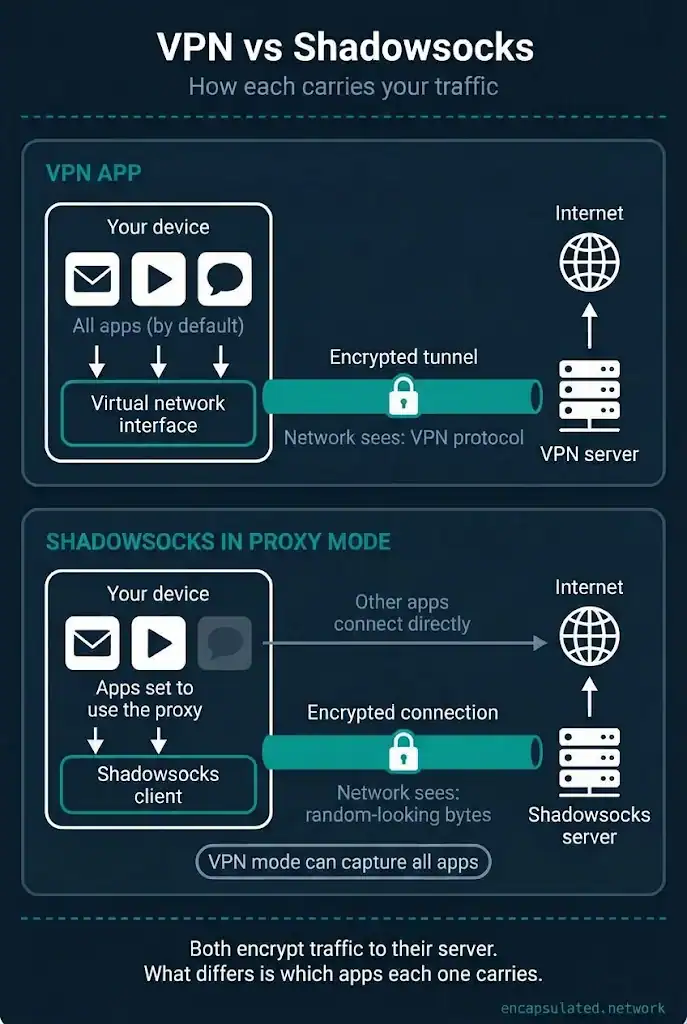
Proxy mode and VPN mode
In proxy mode, a Shadowsocks client carries only the traffic of apps that are set to use its local proxy, either in the app itself or through the system’s proxy settings, and every other app connects outside Shadowsocks. Some Shadowsocks clients also offer a VPN mode, which uses the operating system’s VPN interface to send the traffic of all apps, or of chosen apps, through Shadowsocks.
The mode also decides whether Android can block traffic outside the client’s tunnel, which a VPN app’s kill switch also does when the VPN connection fails. In proxy mode, a Shadowsocks client on Android does not use the operating system’s VPN interface, so Android’s settings that block traffic outside a VPN do not apply to it. In VPN mode, the client uses that interface in the same way as any other VPN app, so Android’s Always-on VPN and Block connections without VPN settings can apply to it, unless the client opts out of Always-on VPN.
DNS and UDP
Whether DNS lookups pass through Shadowsocks in proxy mode depends on the app, because the SOCKS5 address format lets an app give the proxy a domain name instead of an IP address. In VPN mode, a Shadowsocks client can capture DNS lookups along with the other traffic that it carries.
The Shadowsocks specification includes a UDP relay as well as TCP, so Shadowsocks can carry UDP traffic when the client and server support it.
Encryption, keys and trust
A VPN and Shadowsocks both encrypt the link to the server, but VPN protocols negotiate fresh session keys with a handshake, while standard Shadowsocks shares one key per server port. No edition of Shadowsocks provides forward secrecy, which protects recorded traffic when a key later leaks.
Shadowsocks vs WireGuard, OpenVPN and IKEv2
WireGuard identifies each peer by its own public key, and OpenVPN in TLS mode expects each peer to present its own certificate, while standard Shadowsocks shares one key per server port. WireGuard, OpenVPN in TLS mode and IKEv2 negotiate fresh session keys and provide forward secrecy.
WireGuard uses ChaCha20-Poly1305, and OpenVPN negotiates AES-GCM or ChaCha20-Poly1305 by default. IKEv2 negotiates its ciphers: RFC 8247 recommends AES-GCM and ChaCha20-Poly1305 but still requires support for AES-CBC.
Shadowsocks with AEAD ciphers uses the methods chacha20-ietf-poly1305, aes-256-gcm or aes-128-gcm, and the specification requires every compliant implementation to support chacha20-ietf-poly1305. Shadowsocks-2022 defines its own methods, such as 2022-blake3-aes-256-gcm. The Shadowsocks project calls the old stream ciphers completely broken and tells new users to choose AEAD ciphers.
In AEAD Shadowsocks, every user who connects to the same server port shares one key, so the protocol itself cannot tell those users apart. Shadowsocks-2022 adds an optional extension, SIP023, that gives each user a separate key on a shared port.
Shadowsocks does not provide forward secrecy. The Shadowsocks-2022 specification says so directly, and the earlier AEAD design also skips any key exchange: each session key comes from the shared key and a salt that the client sends in the clear. Anyone who obtains the key can therefore decrypt Shadowsocks traffic that was recorded before the key leaked.
| Feature | WireGuard | OpenVPN | IKEv2/IPsec | Shadowsocks (AEAD) | Shadowsocks-2022 |
|---|---|---|---|---|---|
| Ciphers | ChaCha20-Poly1305 | AES-256-GCM, AES-128-GCM or ChaCha20-Poly1305 by default | Negotiated; RFC 8247 recommends AES-GCM and ChaCha20-Poly1305 but still requires AES-CBC | ChaCha20-Poly1305 (required), AES-256-GCM, AES-128-GCM | AES-128-GCM and AES-256-GCM (both required), ChaCha20-Poly1305 optional; BLAKE3 key derivation |
| Key source | Each peer’s key pair plus a handshake | TLS certificates and keys | Diffie-Hellman exchange; a shared secret or certificates for authentication | A password or a key entered directly; session subkeys from the key and a salt | A base64 pre-shared key; session subkeys from the key and a salt |
| Per-user identity | Each peer’s public key | Usually each peer’s own certificate | The ID payload, with a certificate or a shared secret | None in the protocol; one key per port | Optional per-user keys (SIP023) |
| Forward secrecy | Yes | Yes (TLS mode) | Yes, through the Diffie-Hellman exchange | No | No (stated in SIP022) |
| What a leaked key exposes | Impersonation; past sessions stay protected | The same in TLS mode | Impersonation; past sessions stay protected | All traffic that uses the key, past and future | The same as AEAD |
| What the server operator sees | Destinations and any traffic that HTTPS does not protect | The same | The same | The same | The same |
Who can decrypt or see the traffic
On a server port that several people share, each person holds the same key, so any of them who captures another person’s traffic can decrypt its Shadowsocks layer, although traffic that uses HTTPS stays encrypted inside that layer. On a Shadowsocks-2022 server that uses the SIP023 extension, each user has a separate key, so one user’s key cannot decrypt the data of another user’s connections.
A 2025 study of popular Android VPN apps found Shadowsocks passwords hard-coded into the apps of two of the three app families it identified. The researchers wrote that a network eavesdropper with such a password could decrypt the traffic of every user of the affected apps. In one family, the apps’ Shadowsocks configuration used rc4-md5, a cipher that the Shadowsocks project had listed as deprecated by 2017.
The server operator can see each connection’s destination and any traffic that HTTPS does not protect, whichever tool the user chooses. Neither tool makes the user anonymous.
Detection and censorship
Standard VPN protocols carry fixed header fields that identify them, while Shadowsocks traffic looks like random bytes. Even so, researchers found that China’s Great Firewall (GFW) probed Shadowsocks servers in 2019 and 2020 and blocked some of them. From November 2021 until March 2023, the GFW also blocked fully encrypted traffic, such as Shadowsocks, which looks random from the first packet of a connection.
Each standard VPN protocol puts fields in fixed places in its packet headers, such as a field that names the type of message, and a message of a given type carries the same value in that field on every connection. Plain Shadowsocks does not mimic a known protocol.
Active probing, 2019 to 2020
Users in China reported the blocking of Shadowsocks servers from May 2019. Researchers who measured the Great Firewall between September 2019 and January 2020 found that it used the length and entropy of the first data packet in a connection to flag likely Shadowsocks traffic. The GFW then sent probes that replayed or imitated that traffic to confirm the server. The researchers advised Shadowsocks users to choose AEAD ciphers only.
Blocking of fully encrypted traffic, 2021 to 2023
In early November 2021, the Great Firewall began to block fully encrypted traffic, Shadowsocks included. The GFW exempted traffic that looked like a known protocol or seemed unlikely to be fully encrypted. It blocked the rest only on connections to certain IP ranges of popular hosting providers, with a probability of about one in four per connection. The researchers who documented the blocking reported that the GFW had stopped this dynamic blocking by 15 March 2023.
The researchers described the exemption rules as heuristics, among them a crude entropy test using the fraction of set bits, and rules on printable ASCII characters and on the first bytes of known protocols.
Replay protection, prefixes and plugins
Shadowsocks-2022 makes replay protection mandatory: each message carries a timestamp, and a server rejects any salt that it has already seen in the previous 60 seconds. The specification also requires a server to fail in a way that does not reveal how many bytes of a probe it read.
Since client version 1.9.0, Outline lets an access key set a prefix, a short run of bytes at the start of a Shadowsocks connection that makes the connection look like a protocol the network allows. Shadowsocks also supports plugins, which pass the traffic through a separate obfuscating tunnel. Plugins that follow the SIP003 design forward only TCP traffic.
V2Ray, Xray, Trojan and Hysteria 2 are other proxy projects, and Xray supports VLESS with REALITY.
What does Shadowsocks mean in a VPN app?
Some VPN apps offer Shadowsocks as an obfuscation mode that carries the VPN tunnel inside a Shadowsocks connection, so the user keeps the VPN app’s coverage and the network sees Shadowsocks traffic.
Mullvad added Shadowsocks obfuscation for WireGuard in 2024, and its announcement lists 2024.6 on desktop and 2024.7 on Android as the minimum app versions. Mullvad said that the mode would make its app more usable in countries and networks where WireGuard traffic is restricted or blocked.
Mullvad’s mode sends WireGuard through the Shadowsocks UDP relay, so it cannot help on a network that blocks all UDP, where WireGuard needs an obfuscation method that runs over TCP instead.
Surfshark stopped supporting Shadowsocks on 11 November 2021 and said that few of its users had chosen it.
Which should you use?
A VPN suits everyday privacy and public Wi-Fi, and Shadowsocks, or a VPN app’s Shadowsocks mode, can help on networks that block VPN protocols.
People who run their own server can choose a Shadowsocks server or a VPN server, and the protocol and its set-up decide whether each person gets a separate key.
| Situation | Fits |
|---|---|
| Public Wi-Fi, everyday privacy from the ISP | A VPN, which protects the traffic it carries from the local network and the internet provider |
| Whole-device coverage, including games, calls and background apps | A VPN, or a Shadowsocks client in VPN mode where the client and server support UDP |
| A network that blocks VPN protocols | A VPN app’s obfuscation mode, such as Shadowsocks, or a Shadowsocks server; test before relying on either |
| Travel to China | Test any option before arrival; the GFW blocked both VPN servers and Shadowsocks servers at different times |
| A self-hosted server for a few people | Either tool; standard Shadowsocks uses one key per server port, while WireGuard gives each peer its own key pair and OpenVPN usually gives each peer its own certificate |
| Anonymity | Neither tool; the server sees the user’s IP address and destinations |
The legal status of Shadowsocks, like that of a VPN, depends on the country. Censors have detected and blocked both Shadowsocks servers and VPN servers, so a user should test a connection method before travel. A test on an uncensored network shows that the client and the server connect, but it does not show how a censored network will treat the same connection.
Frequently asked questions
Is Shadowsocks a VPN?
Shadowsocks is an encrypted proxy, not a VPN: the Shadowsocks project describes it as a secure split proxy. Some Shadowsocks clients offer a mode that uses the operating system’s VPN interface, and some label that mode VPN. That mode changes which apps the client carries, but Shadowsocks stays a proxy protocol.
Is Shadowsocks the same as SOCKS5?
Shadowsocks is not SOCKS5. The Shadowsocks client offers apps a local SOCKS5 interface, but it sends their traffic to the server in its own encrypted protocol. The SOCKS5 standard defines no encryption of its own and leaves any protection to the authentication method that the client and server negotiate.
Is Shadowsocks safe to use?
Shadowsocks with AEAD ciphers encrypts the link to the server, but the server operator sees destinations and any traffic that HTTPS does not protect. It does not provide forward secrecy, so anyone who holds the key, as every user of a standard shared port does, can decrypt recorded traffic. The Shadowsocks project calls the old stream ciphers completely broken.
Is Shadowsocks free?
The main Shadowsocks implementations are free and open-source software, published under licences such as MIT, Apache 2.0 and the GNU GPL. A Shadowsocks server still costs money to rent or to run. Apps that bundle Shadowsocks raise a separate risk: a 2025 study found Shadowsocks passwords hard-coded into some popular Android VPN apps.
Is Shadowsocks better than a VPN?
Neither tool is better in general. A VPN app carries the whole device’s traffic by default and renews its session keys while it runs. Shadowsocks was built to get past censorship, so it can help on a network that blocks VPN protocols, and a VPN app’s Shadowsocks mode combines the two tools.
Can Shadowsocks be detected or blocked?
Censors have detected and blocked Shadowsocks. A Shadowsocks connection sends no plaintext header, but the length of its first packet and its random-looking bytes can still stand out, and a censor can send probes to confirm a server. Shadowsocks-2022 made replay protection mandatory, so a server must reject a probe that replays the start of an earlier connection.
Does Shadowsocks work in China?
Research published between 2020 and 2023 found that the Great Firewall detected and blocked Shadowsocks servers at some times. Those studies describe the Great Firewall up to March 2023, not its behaviour today. A traveller should test any connection method before the trip, although a test on an uncensored network cannot show how the Great Firewall will treat it.
Why does my VPN app offer Shadowsocks?
A VPN app’s Shadowsocks option carries the VPN connection inside a Shadowsocks connection, and VPN providers offer it to help users on networks that block VPN protocols. Mullvad, for example, added a Shadowsocks mode for WireGuard in 2024, and that mode cannot help on a network that blocks all UDP, because it uses the Shadowsocks UDP relay.
Can you use Shadowsocks and a VPN together?
A VPN app with a Shadowsocks mode combines the two tools, and some VPN clients, such as OpenVPN, can also send their connection through a separate Shadowsocks proxy. In both set-ups, the local network sees Shadowsocks traffic, while the VPN still encrypts the traffic to the VPN server.
Is Shadowsocks legal?
The legal status of Shadowsocks depends on the country, in the same way as the legal status of a VPN, and some countries restrict tools that get past internet censorship. A traveller should check the rules of the destination before using either tool.