Perfect forward secrecy (PFS) is the cryptographic property that protects past VPN sessions even if the server’s private key is obtained in the future. Session keys are derived from temporary key material generated fresh for each connection and permanently deleted after use; no persistent key can reach keys that no longer exist.
What most accounts of PFS leave out is the mechanics: how each VPN protocol delivers this property in practice, how frequently keys rotate within a live session, what the scope of exposure looks like if a session key is compromised, and how to confirm the property is active on your connection.
TL;DR
- Perfect forward secrecy means session keys are derived from ephemeral material generated fresh for each session and permanently discarded when it ends. A future compromise of the server’s long-term key cannot reach those keys.
- Without PFS, one key compromise sets the blast radius (the full scope of damage from a single compromise) to every past session ever protected by that material, retroactively. Heartbleed (2014) is the proof: servers without PFS saw years of recorded traffic become decryptable the moment their private key was extracted.
- All three modern VPN protocols provide PFS but differ in how often they rekey within a session. WireGuard rekeyes every 120 seconds by hard-coded kernel constant. OpenVPN renegotiates at 3,600 seconds by default. IKEv2 operates on a two-tier schedule where the CHILD SA rekeyes separately, with PFS at that boundary enabled by default in major implementations but optional per RFC 7296.
- PFS does not protect against active interception during the handshake, a compromised endpoint, the current session key while it is in use, traffic metadata, or an enterprise network team’s ability to passively inspect encrypted sessions.
What perfect forward secrecy is
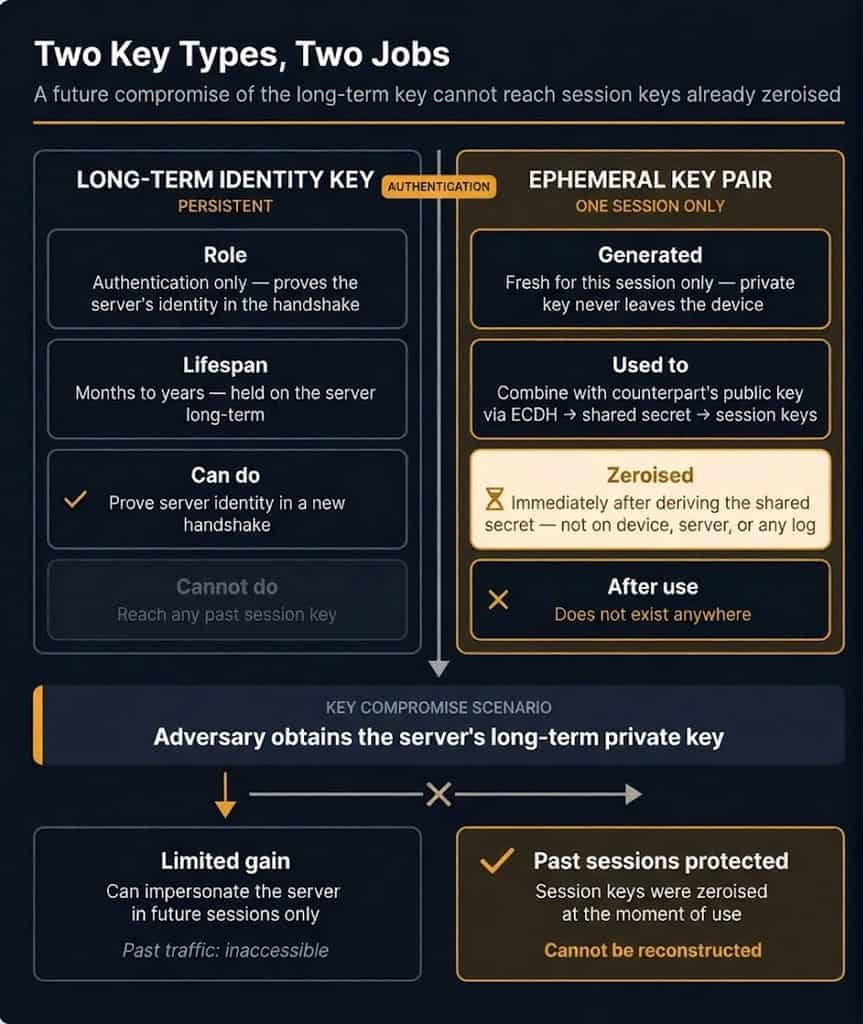
Perfect forward secrecy means session keys are derived from ephemeral material: a key pair generated fresh for this session only and discarded the moment the handshake completes. When the session ends, the keys derived from that material are discarded too. A future adversary who obtains the server’s long-term private key cannot derive any past session key. The material that produced those keys no longer exists.
Every VPN session involves two key types with separate roles. The long-term identity key authenticates the handshake: it proves the server is genuine and never directly encrypts session data. The ephemeral key pair produces the shared secret from which session keys are derived. The security separation between these two types is what forward secrecy rests on: compromising one does not compromise the other. VPN Encryption Explained covers the full hybrid encryption model, including how ECDH and HKDF convert ephemeral key exchange into session keys. Readers who need the VPN session concept first should start with How Does a VPN Actually Work.
Perfect forward secrecy in plain terms
Every VPN session uses a temporary key, generated for that session and permanently deleted the moment the session opens. The server holds a permanent identity key, but that key proves the server is genuine: it never locked your session data directly. If someone obtains that permanent key later, all they have is proof of the server’s identity. Every lock from previous sessions has already been destroyed; there is nothing left to open.
The technical name for the temporary key is an ephemeral key pair. The permanent deletion is called zeroisation.
Forward secrecy as a general cryptographic property
Forward secrecy is not unique to VPNs. It is a property of any key-exchange protocol that uses ephemeral key pairs and discards them after use. TLS 1.3, which protects HTTPS connections, mandates forward secrecy by design. In a VPN, the same property applies to the session between your device and the VPN server.
What a VPN session looks like without PFS
Without perfect forward secrecy, the blast radius of a single key compromise extends to every past session ever protected by that material. Session keys are derived from or decryptable using a persistent long-term secret. If that secret is later obtained, traffic recorded months or years earlier by a passive observer becomes plaintext.
The mass collection precedent. Documents published in 2013 revealed that signals intelligence programmes including GCHQ’s TEMPORA had been intercepting and buffering encrypted traffic from transatlantic fibre-optic cables at their UK landing stations at scale. The operational model is collect now, process later: encrypted traffic is stored against the possibility that the key material protecting it becomes available in the future. For sessions protected by static key exchange, any future key compromise retroactively exposes the collected traffic.
Heartbleed: the key extraction proof. CVE-2014-0160, disclosed in April 2014, was a buffer over-read in OpenSSL’s heartbeat implementation that allowed an attacker to read up to 64 KB of server memory per request, including long-term private key material. On servers using static RSA key exchange, any VPN or HTTPS session traffic a passive adversary had recorded could now be decrypted retroactively. On servers using ephemeral key exchange (DHE or ECDHE), completed sessions were protected: their session keys had already been zeroised, and the long-term private key alone could not reconstruct them. Heartbleed still exposed the private key itself, enabling active impersonation until certificate rotation. PFS limited the retrospective threat; it did not prevent the live disclosure.
The ephemeral key lifecycle: how PFS actually works
At session start, both parties independently generate a fresh key pair for this session only. The private key never leaves the device. The ephemeral public key is transmitted to the other party.
Each party then combines its own ephemeral private key with the other party’s ephemeral public key through an elliptic-curve Diffie-Hellman operation. Both arrive at the same shared secret without it ever being transmitted: only the public keys crossed the network. A key derivation function converts the shared secret into the symmetric session keys that will encrypt traffic for the duration of the connection.
Both parties zeroise their ephemeral private keys immediately after deriving the shared secret. The session keys are now in memory and in use. The material that produced them no longer exists anywhere: not on the device, not on the server, not in any log.
A future adversary who obtains the server’s long-term private key can do one thing: prove the server’s identity in a new handshake. That long-term key was never used to derive any session key. The ephemeral private keys that did derive those session keys were zeroised at the moment of use. There is no path from the long-term key to any past session key.
Rekeying: how each protocol delivers PFS in practice
PFS operates at two levels. Between sessions: every new connection generates a new ephemeral key pair, so two separate sessions from the same device on different days are cryptographically unrelated. Within sessions: all three modern VPN protocols also rotate keys during a long-lived connection on a timer or threshold, bounding the blast radius of any single session key compromise to a fixed window of traffic. The three protocols differ in how often within-session rekeying occurs, and that difference determines the per-key exposure window.
WireGuard: the 120-second boundary
WireGuard rotates session keys every 120 seconds by hard-coded kernel constant. There is no configuration option that changes this interval. The constants governing the session lifecycle are defined in drivers/net/wireguard/messages.h:
| Constant | Value | Purpose |
|---|---|---|
REKEY_AFTER_TIME | 120 seconds | Initiates a new Noise_IKpsk2 handshake to derive fresh session keys |
REJECT_AFTER_TIME | 180 seconds | Invalidates the session if no completed rekey exists by this point |
REKEY_AFTER_MESSAGES | 260 | Message count trigger for rekeying, whichever limit arrives first |
When REKEY_AFTER_TIME fires, WireGuard initiates a new Noise_IKpsk2 handshake. A new Curve25519 ephemeral key pair is generated; new HKDF-derived session keys replace the current ones. Both parties zeroise their ephemeral private keys as soon as the new shared secret is derived. The existing session continues while the handshake completes, so traffic is uninterrupted.
The 60-second gap between REKEY_AFTER_TIME (120 s) and REJECT_AFTER_TIME (180 s) is the window WireGuard has to complete the rekey before cutting off the session. During the transition, WireGuard holds three sessions in memory simultaneously: the active session, the previous session, and the pending new session. Retaining the previous session keeps packets still in flight under the old key decryptable through the transition, so none are dropped at the rekeying boundary.
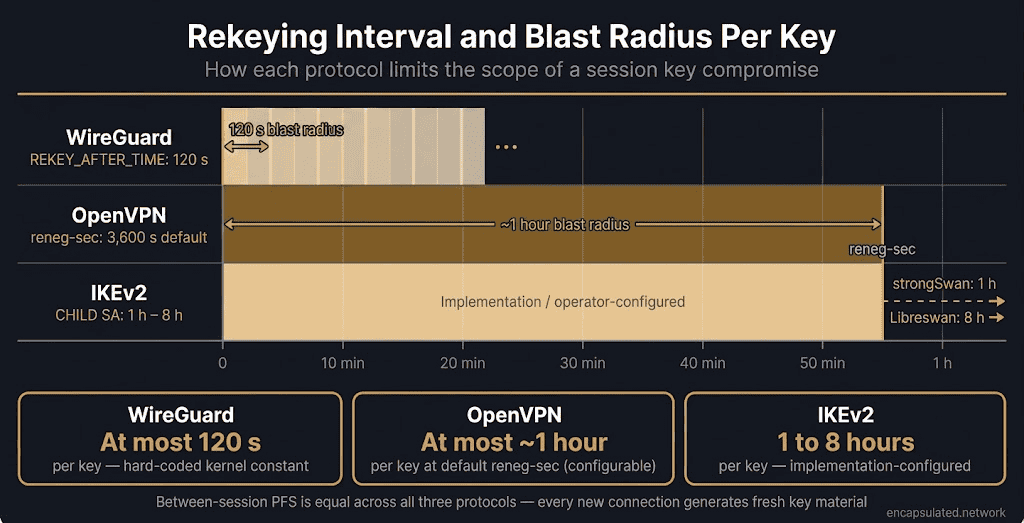
The blast radius per key is at most 120 seconds of traffic. Keys from before or after that window came from different ephemeral exchanges and are cryptographically unrelated.
PFS is structural and non-configurable in WireGuard. PersistentKeepalive, the only user-tunable WireGuard timer, governs NAT keepalive only: it has no effect on rekeying. See WireGuard Explained for the full Noise_IKpsk2 handshake mechanics and timer state machine.
OpenVPN: reneg-sec and the renegotiation model
OpenVPN renegotiates data-channel keys every 3,600 seconds by default. The directive controlling this is reneg-sec, and unlike WireGuard’s kernel constants it is configurable: a shorter value (600 or 900 seconds) reduces the blast radius per key.
Renegotiation works as follows: both peers re-run the TLS control-channel handshake to derive new data-channel session keys via a fresh ECDHE key exchange. The tunnel does not drop during this process. Traffic continues to flow under the current keys until the new keys are confirmed, at which point both parties zeroise the previous session keys.
Servers trigger renegotiation between 90% and 100% of the reneg-sec value, which at the 3,600-second default means between 3,240 and 3,600 seconds. This spreads renegotiations across simultaneous connections rather than concentrating them. Clients use the exact configured value.
An alternative trigger, reneg-bytes, fires renegotiation after a configured volume of data has been transferred under the current key. It is disabled by default for modern AEAD cipher suites (AES-256-GCM, ChaCha20-Poly1305), which are not subject to the birthday-bound volume attacks that affected 64-bit block ciphers.
The blast radius per key is at most 3,600 seconds of traffic at the default reneg-sec: 30 times as large as WireGuard’s 120-second window.
PFS in OpenVPN comes from the control channel, not from data-ciphers. The data-ciphers directive specifies the bulk encryption cipher for the data channel. It does not determine the key exchange method, and checking it does not verify PFS. PFS depends on whether the TLS control channel uses ephemeral Diffie-Hellman. In modern OpenVPN 2.6 and 2.7, the control channel defaults to ECDHE-based cipher suites under TLS 1.2 and negotiates TLS 1.3 when both ends support it. Under TLS 1.3, PFS is guaranteed: the protocol removed all static RSA and static DH key exchange, so every certificate-based TLS 1.3 handshake uses ephemeral keys. Under TLS 1.2, PFS is present when the negotiated cipher suite contains ECDHE. Legacy configurations using static RSA key exchange on the control channel do not provide PFS regardless of reneg-sec. See OpenVPN Explained for the full control-channel architecture and cipher suite configuration.
IKEv2: the two-tier rekeying model
IKEv2 maintains two Security Associations with independent lifetimes.
The IKE SA is the authenticated control channel between the two endpoints. When it renegotiates, RFC 7296 Section 2.18 requires a fresh Diffie-Hellman exchange: PFS is mandatory at this boundary. Default lifetimes vary by implementation: strongSwan uses 4 hours; Libreswan uses 8 hours; some commercial gateways use 24 hours.
The CHILD SA carries actual IPsec traffic, and its lifetime determines the per-key blast radius. Default lifetimes also vary: strongSwan defaults to 1 hour; Libreswan defaults to 8 hours. When the CHILD SA expires, IKEv2 negotiates a new one via the CREATE_CHILD_SA exchange. The IKE SA manages this in the background; the tunnel does not drop.
PFS at the CHILD SA rekeying boundary is enabled by default in major implementations but is not mandated by the RFC. RFC 7296 Section 2.17 makes the KE payload in CREATE_CHILD_SA optional: a fresh DH exchange when rekeying a CHILD SA is permitted, not required. strongSwan and Libreswan both enable it by default. When a fresh DH exchange is included, the new CHILD SA’s key material combines the DH output with SK_d from the IKE SA: it is not independent of the IKE SA’s keying material, but the fresh DH component means compromise of one CHILD SA’s keys cannot expose any other CHILD SA. Contrast with IKE SA rekeying, where RFC 7296 Section 2.18 mandates fresh DH.
IKEv2 rekeyes CHILD SAs within the existing authenticated IKE SA: no re-authentication is required.
The blast radius per key is the CHILD SA lifetime: 1 hour by default in strongSwan, 8 hours in Libreswan, or whatever the operator has configured. See IKEv2/IPsec Explained for the full SA architecture and DH group recommendations.
Which protocol gives the shortest exposure window?
All three modern VPN protocols provide perfect forward secrecy. The question is not which protocol has it, but how much traffic a single stolen session key could ever expose.
WireGuard gives the tightest boundary: 120 seconds, hard-coded and non-configurable. OpenVPN’s default window is 30 times as large at 3,600 seconds, but reneg-sec is the one value that can be tuned down to as little as a few minutes. IKEv2 varies by implementation and operator, from 1 hour in strongSwan to 8 hours in Libreswan by default. Between-session PFS is equal across all three: every new connection generates fresh key material regardless of protocol.
The blast radius: what rekeying actually limits
Session key compromise and long-term key compromise are different threats. Long-term key compromise is the threat PFS was designed to defeat. Obtaining a session key requires access to live server memory during an active session.
The rekeying interval sets the blast radius of any single session key compromise:
| Protocol | Within-session rekey | Blast radius per key |
|---|---|---|
| WireGuard | Every 120 s (REKEY_AFTER_TIME, hard-coded) | At most 120 seconds of traffic |
| OpenVPN | Every 3,600 s default (reneg-sec, configurable) | At most ~1 hour of traffic |
| IKEv2 | CHILD SA lifetime: 1 h (strongSwan), 8 h (Libreswan), or operator-configured | 1 to 8 hours, implementation-configured |
Keys from outside a given window came from different ephemeral exchanges and are cryptographically unrelated.
Between-session PFS is a stronger guarantee than within-session rekeying, and equal across all three protocols. A new connection always generates new ephemeral key material. Two sessions from the same device on different days are cryptographically unrelated regardless of when each rekeyed. The rekeying interval governs within-session blast radius only.
Rekeying cannot contain a session key that is actively being extracted. If an adversary compromises the VPN server and reads session keys from memory while a session is live, they can decrypt traffic encrypted under those keys regardless of the rekeying interval. Rekeying reduces the volume of past traffic at risk per key: it does not protect a key that is currently in use and under active attack.
What PFS does not protect
Active interception during the handshake
PFS protects recorded past traffic from future key compromise. If an adversary is actively substituting their own keys during the handshake, PFS provides no protection. Protection against this comes from authentication: certificate verification in OpenVPN and IKEv2; Curve25519 static public key matching in WireGuard. Authentication and PFS are complementary properties; PFS is not a substitute for correct authentication.
Endpoint compromise
Session encryption protects what travels across the network. If the device or application is compromised before data enters the tunnel, the plaintext is available before encryption occurs. PFS has no bearing on that threat.
The current session key in use
PFS protects past sessions from future key compromise. The session key currently in use is in memory and in use. An adversary who compromises the server and reads memory while a session is active can decrypt data encrypted under the current key. Rekeying limits the volume of traffic at risk to the current interval’s worth, but cannot protect a key that is actively being extracted.
Metadata
Session encryption protects content in transit. It does not conceal that a connection was made, when, to which server, for how long, or how much data was transferred. Traffic analysis and metadata collection are separate concerns outside PFS’s scope.
Enterprise passive inspection
The same zeroisation that protects past sessions from retrospective decryption also means a corporate network team cannot passively capture and later decrypt traffic for compliance monitoring, debugging, or threat detection. Session keys are gone before any passive inspection could occur. Organisations that require visibility into encrypted VPN traffic must use active TLS inspection proxies rather than passive decryption. This is an intended consequence of the guarantee, not a flaw in it.
PFS and the post-quantum threat model
PFS protects against a classical adversary who later obtains long-term key material. Shor’s algorithm bypasses this protection by attacking the problem differently. Given the ephemeral public keys transmitted during a VPN handshake, a quantum computer of sufficient scale can reconstruct the corresponding ephemeral private keys directly from the recorded transcript, without needing anything either party currently holds. Zeroisation does not help when the public key alone is sufficient to recover the private key.
PFS and post-quantum PSK protection address different attack classes. PFS protects against classical retrospective key compromise, which remains the more realistic near-term threat for most users. Post-quantum key exchange addresses the recorded-handshake attack that a future quantum computer would enable. Enabling post-quantum protection does not remove the need for PFS.
WireGuard’s Noise_IKpsk2 construction includes an optional preshared-key slot — the psk2 suffix indicating that a pre-shared key is mixed into the handshake after the second message — designed for this extension: injecting a quantum-resistant symmetric key on top of the existing ephemeral DH exchange, so that breaking the classical layer alone is insufficient to recover session keys. The psk2 slot does not replace or disable the ephemeral DH exchange and has no effect on PFS. For the full treatment of the post-quantum threat model, Shor’s mechanism, and which providers have deployed hybrid post-quantum protection, see Post-Quantum VPN Encryption Explained.
Does your VPN have PFS? How to verify
Do you need to enable or configure PFS?
For most users, the answer is: nothing. The reason differs by protocol:
- WireGuard: PFS is structural and non-configurable. No action is required or possible.
- OpenVPN: Modern OpenVPN 2.6 and 2.7 provide PFS on the control channel by default via ECDHE. Action is only needed on a legacy deployment using static RSA key exchange on the control channel, which is not the default in any current version.
- IKEv2: PFS is enabled by default in both strongSwan and Libreswan for CHILD SA rekeying. The one thing worth confirming is that the DH group is Group 14 or better.
WireGuard: guaranteed by design
If you are using WireGuard, PFS is operating. The Noise_IKpsk2 pattern requires a fresh Curve25519 ephemeral key pair at every session initiation and every rekey. REKEY_AFTER_TIME fires at 120 seconds by hard-coded kernel constant. No configuration option can disable this or extend the interval.
OpenVPN: check the connection log
PFS in OpenVPN comes from the TLS control channel, not from the bulk encryption cipher. The data-ciphers directive in a .ovpn file specifies what encrypts traffic. It says nothing about whether the key exchange is ephemeral, and checking it does not verify PFS.
The correct check is the connection log. Connect to your provider and look for the line beginning Control Channel: (most VPN apps surface this in a Logs or Activity tab):
- If it shows TLSv1.3, forward secrecy is guaranteed. TLS 1.3 removed all static RSA and static DH key exchange (RFC 8446, since replaced by RFC 9846, which keeps the rule): every certificate-authenticated TLS 1.3 handshake uses ephemeral keys.
- If it shows TLSv1.2, check that the cipher name contains ECDHE (for example,
ECDHE-RSA-AES256-GCM-SHA384). That is the ephemeral key exchange that provides PFS. A cipher name without ECDHE indicates a non-forward-secret handshake.
Modern OpenVPN 2.6 and 2.7 uses ECDHE on the control channel by default, so a current deployment almost always has PFS. The log line is how you confirm it.
IKEv2: check the DH group
PFS is enabled by default in both strongSwan and Libreswan for CHILD SA rekeying. The verification step is confirming the DH group your provider uses:
| Group | Type | Status (RFC 8247) |
|---|---|---|
| Group 31 | ECDH Curve25519 | Recommended |
| Group 20 | ECDH P-384 | Recommended |
| Group 19 | ECDH P-256 | Recommended |
| Group 14 | 2048-bit MODP | Mandatory baseline: considered secure and acceptable |
| Group 5 | 1536-bit MODP | SHOULD NOT (RFC 8247) |
| Group 2 | 1024-bit MODP | SHOULD NOT (RFC 8247); deprecated — do not use |
Any major consumer VPN provider using IKEv2 in 2026 is using Group 19 or better. If your provider publishes their IKEv2 configuration, look for the DH group. A configuration listing Group 5 or Group 2 is the flag worth raising.
Frequently asked questions
What is perfect forward secrecy?
Perfect forward secrecy means that session keys are derived from ephemeral material generated fresh for each session and permanently discarded when it ends. A future compromise of the server’s long-term private key cannot be used to decrypt any past session, because the material that produced those session keys no longer exists anywhere.
Does WireGuard have perfect forward secrecy?
Yes, by design. PFS is built into WireGuard’s handshake and cannot be disabled: no configuration option removes it.
How often does WireGuard rekey?
Every 120 seconds, governed by the kernel constant REKEY_AFTER_TIME. Rekeying also fires after 260 messages under the same key (REKEY_AFTER_MESSAGES), whichever limit arrives first. Both constants are hard-coded and cannot be changed via configuration.
What is reneg-sec in OpenVPN?
reneg-sec is the OpenVPN directive that sets the data-channel key renegotiation interval in seconds. The default is 3,600 seconds (1 hour). Setting a lower value (such as 600 or 900 seconds) reduces the blast radius per key.
Does OpenVPN always provide perfect forward secrecy?
Not always. PFS in OpenVPN depends on the TLS control channel using ephemeral key exchange. Modern OpenVPN 2.6 and 2.7 use ECDHE by default, so current deployments almost always have PFS. Legacy configurations using static RSA key exchange on the control channel do not provide PFS regardless of reneg-sec.
What is a CHILD SA in IKEv2 and how does it relate to PFS?
In IKEv2, the CHILD SA is the Security Association that carries actual traffic; it has a separate lifetime from the IKE SA control channel and rekeyes independently. The CHILD SA lifetime sets the per-key blast radius: 1 hour in strongSwan, 8 hours in Libreswan by default. PFS at the CHILD SA rekeying boundary is enabled by default in major implementations but optional per RFC 7296; at the IKE SA boundary, fresh DH is mandatory.
What is the difference between PFS and encryption?
Encryption protects data from being read by anyone who does not hold the current session key. PFS is a property of how that session key was derived: specifically, that the derivation used ephemeral material that was zeroised immediately after use, so a future key compromise cannot retroactively expose the data. A session can be strongly encrypted without PFS if the session keys are derived from a persistent long-term secret.
Does perfect forward secrecy protect against quantum computers?
No. PFS protects against a classical adversary who later obtains the server’s long-term key; Shor’s algorithm instead recovers ephemeral private keys from the public keys in the recorded handshake, making zeroisation irrelevant. PFS and post-quantum key exchange are complementary protections addressing different threat classes.
What happens if a VPN session key is compromised?
An adversary who obtains a session key can decrypt traffic encrypted under that key. With PFS, the blast radius is bounded to the traffic from that key’s window: at most 120 seconds for WireGuard, up to 3,600 seconds for OpenVPN at the default reneg-sec, and the CHILD SA lifetime for IKEv2. Keys from before or after the compromised window came from different ephemeral exchanges and are unaffected. Without PFS, compromise of the long-term key potentially exposes all historical sessions.
Is “forward secrecy” the same as “perfect forward secrecy”?
Yes. The terms are used interchangeably today. “Perfect forward secrecy” was the original formulation; modern standards documents including RFC 8446 (TLS 1.3) use “forward secrecy.” There is no technical distinction between the two terms as currently used.
Which VPN protocol has the shortest rekeying interval?
WireGuard, at 120 seconds by hard-coded kernel constant: 30 times shorter than OpenVPN’s 3,600-second default and well inside IKEv2’s 1-to-8-hour CHILD SA range.
How do I know if my VPN provider uses perfect forward secrecy?
For WireGuard: PFS is always present, no check needed. For OpenVPN: connect and look at the “Control Channel:” line in the connection log; TLSv1.3 guarantees PFS, TLSv1.2 provides it when the cipher name contains ECDHE. For IKEv2: PFS is enabled by default in major implementations; confirm the DH group is Group 14 or better (Groups 19, 20, and 31 are preferred). If your provider does not publish their configuration, contact their support team and ask about the control-channel key exchange for OpenVPN or the CHILD SA PFS setting and DH group for IKEv2.
Is TLS 1.3 forward secret by default?
es, for any certificate-authenticated connection. TLS 1.3 removed all static RSA and static DH key exchange, so every certificate-based TLS 1.3 handshake uses ephemeral keys. The only exceptions are niche modes (pure pre-shared-key resumption without a fresh key exchange, and 0-RTT early data) that do not apply to VPN control channels.
What is perfect forward secrecy in simple terms?
Each VPN session uses a key that exists only for that session and is destroyed when it ends; no copy survives, so a future compromise of the server’s permanent key has nothing to unlock.