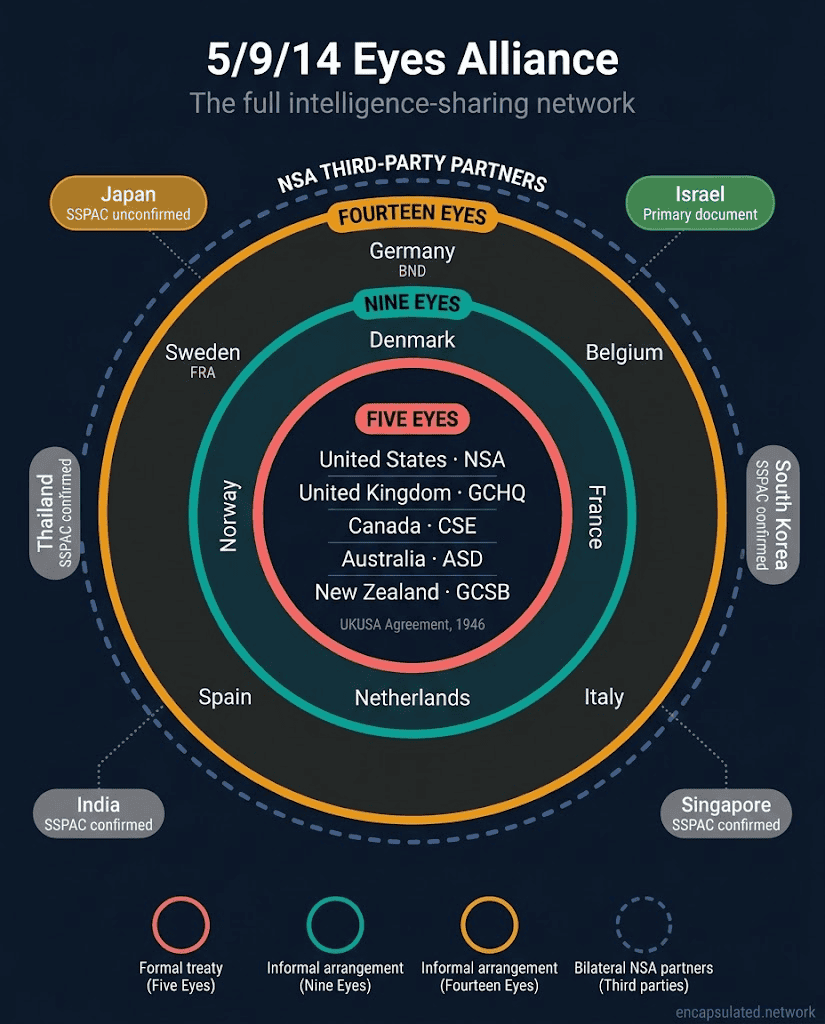
The Five Eyes, Nine Eyes, and Fourteen Eyes are three nested tiers of a Western signals intelligence network covering fourteen nations. Only the innermost tier rests on a formal written agreement: the UKUSA Agreement, signed on 5 March 1946. The Nine Eyes and Fourteen Eyes are informal extensions with no equivalent multilateral document.
TL;DR
- The name “Five Eyes” originated as a document classification caveat: “SECRET AUS/CAN/NZ/UK/US EYES ONLY.” It marked material restricted to those five nations’ agencies. It was an access restriction, not a surveillance metaphor.
- Five Eyes is the only tier with a formal written agreement: the UKUSA Agreement, signed 5 March 1946 and renamed from its original name (BRUSA) in 1954. Nine Eyes and Fourteen Eyes are informal cooperative arrangements with no equivalent multilateral document.
- The Snowden disclosures confirmed five collection programmes: PRISM (selector-targeted data compelled from US internet companies under FISA Section 702), UPSTREAM (backbone-level interception under the same authority), XKeyscore (an NSA data-exploitation system fed by bulk intercepts), Tempora (GCHQ’s fibre-optic cable-tapping programme), and MUSCULAR (covert joint NSA/GCHQ access to Google and Yahoo’s internal data-centre traffic).
- The alliances produce a documented outcome: intelligence collected about one country’s citizens by a partner agency can be shared back to the home government, a structural consequence the Electronic Frontier Foundation calls the “lowest common privacy denominator.”
- For VPN users, jurisdiction sets a legal ceiling, but that ceiling matters far less when the provider holds no data to produce. A verified no-log architecture in a Fourteen Eyes country can offer stronger practical privacy than an unverified provider in a so-called privacy haven.
Quick reference
What is signals intelligence (SIGINT)?
Signals intelligence, abbreviated SIGINT, is intelligence gathered by intercepting communications and electronic signals: telephone calls, internet traffic, radio transmissions, radar, and telemetry. It is distinct from human-source intelligence (HUMINT), which is gathered from people, and imagery intelligence (IMINT), which is gathered from satellite and aerial photography. The Eyes alliances are, specifically, arrangements for sharing SIGINT between member nations. ECHELON, PRISM, UPSTREAM, XKeyscore, Tempora, and MUSCULAR are all SIGINT collection or exploitation programmes.
The fourteen nations at a glance
| Tier | Country | Primary SIGINT agency | Party status | Notable |
|---|---|---|---|---|
| Five Eyes | United States | NSA (National Security Agency) | First Party | |
| Five Eyes | United Kingdom | GCHQ (Government Communications Headquarters) | Second Party | |
| Five Eyes | Canada | CSE/CSEC (Communications Security Establishment) | Second Party | Direct UKUSA signatory status contested; CANUSA bilateral (1949) is the documented instrument |
| Five Eyes | Australia | ASD (Australian Signals Directorate) | Second Party | |
| Five Eyes | New Zealand | GCSB (Government Communications Security Bureau) | Second Party | |
| Nine Eyes | Denmark | Third Party | ||
| Nine Eyes | France | Third Party | ||
| Nine Eyes | Netherlands | Third Party | ||
| Nine Eyes | Norway | Third Party | ||
| Fourteen Eyes | Germany | BND (Bundesnachrichtendienst) | Third Party | NSA cooperation documented via Operation Eikonal/RAMPART-A |
| Fourteen Eyes | Belgium | Third Party | ||
| Fourteen Eyes | Italy | Third Party | ||
| Fourteen Eyes | Spain | Third Party | ||
| Fourteen Eyes | Sweden | FRA: National Defence Radio Establishment (Försvarets radioanstalt) | Third Party | 2023 Mullvad VPN police search; no customer data recovered |
The US holds First Party status as the original signatory to the UKUSA Agreement. The other four Five Eyes nations (UK, Canada, Australia, and New Zealand) are Second Parties, carrying full raw-SIGINT sharing and the no-targeting convention. Third Party status (Nine and Fourteen Eyes) carries formal bilateral agreements with the NSA but without those two features of Second Party membership.
Key terms and agencies
The alliance literature is dense with acronyms. The following glossary covers every agency, agreement, programme, and legal instrument.
Member agencies
- NSA: National Security Agency; the United States’ primary SIGINT agency and First Party to the UKUSA Agreement.
- GCHQ: Government Communications Headquarters; the United Kingdom’s primary SIGINT agency.
- ASD: Australian Signals Directorate; Australia’s SIGINT agency (formerly the Defence Signals Directorate, DSD; renamed ASD in 2013).
- CSE/CSEC: Communications Security Establishment; Canada’s SIGINT agency.
- GCSB: Government Communications Security Bureau; New Zealand’s SIGINT agency.
- BND: Bundesnachrichtendienst; Germany’s foreign intelligence service, whose SIGINT cooperation with the NSA is the best-documented Fourteen Eyes operational example.
Agreements and alliances
- UKUSA Agreement: The formal written agreement (signed 1946 as BRUSA; renamed UKUSA 1954) that established the Five Eyes framework; the only formal multilateral instrument in the three-tier structure.
- SSEUR: SIGINT Seniors Europe; the official name for the Fourteen Eyes grouping, established 1982.
- SSPAC: SIGINT Seniors Pacific; the Pacific-facing counterpart to SSEUR, established 2005.
Collection programmes
- ECHELON: Five Eyes satellite interception network (part of NSA’s FROSTING programme, 1966); collected telephone, fax, telex, and electronic data routed via Intelsat satellites.
- PRISM: NSA downstream collection programme; selector-based data compelled from US internet companies under FISA Section 702.
- UPSTREAM: NSA backbone interception programme; intercepts data from US telecommunications carriers under FISA Section 702; distinct from PRISM in mechanism and scope.
- XKeyscore: NSA data-exploitation system; fed by bulk intercepts at approximately 700 servers globally; content buffered 3 to 5 days, metadata 30 days; self-certified analyst querying.
- Tempora: GCHQ fibre-optic cable-tapping programme; content buffered 3 days, metadata 30 days.
- MUSCULAR: Joint NSA/GCHQ programme; covert access to Google and Yahoo’s unencrypted internal data-centre traffic.
Legal instruments
- FISA Section 702: A provision of the Foreign Intelligence Surveillance Act (added by the FISA Amendments Act of 2008); the legal authority for both PRISM and UPSTREAM.
- NSL: National Security Letter; an FBI-issued compulsion instrument requiring no prior judicial approval; reaches non-content records only (subscriber information and transactional data under 18 U.S.C. §2709).
- IPA: Investigatory Powers Act 2016 (UK); its “telecommunications operator” definition (s.261) likely captures VPN providers serving UK users.
Intelligence terms
- SIGINT: Signals intelligence; intelligence gathered by intercepting communications and electronic signals.
- HUMINT: Human-source intelligence; gathered from people rather than intercepted signals.
- Second Party: A full member of the UKUSA Agreement other than the US First Party; specifically the United Kingdom, Canada, Australia, and New Zealand; entitled to full raw-SIGINT sharing and the no-targeting convention.
- Third Party: A nation with a formal bilateral agreement with the NSA but without Second Party status; all Nine Eyes and Fourteen Eyes additions are Third Parties.
Where the name comes from
The term “Five Eyes” is not a surveillance metaphor. It originated as a document handling caveat: “SECRET AUS/CAN/NZ/UK/US EYES ONLY.” This label appeared on intelligence material cleared for release only to agencies of the five named nations: Australia, Canada, New Zealand, the United Kingdom, and the United States. Personnel adopted “Five Eyes” as verbal shorthand because the full releasability string was cumbersome to say aloud.
The term therefore describes who may read a document, not a posture of watching. That the phrase became synonymous with mass surveillance is a historical irony.
When the Nine Eyes and Fourteen Eyes arrangements formed in later decades, they adopted the same naming convention. There is no evidence the “EYES ONLY” document-classification usage was applied to those groupings in the same way; the connection is largely one of borrowed vocabulary rather than a shared formal system.
The origin: Bletchley Park to the postwar framework
February 1941: the relationship that preceded everything
Most of global internet traffic travels through a finite number of fibre-optic cable landing points. That infrastructure is not incidental to the Five Eyes story; the alliance was eventually built to exploit it. But the relationship began before a single cable was tapped, during wartime, in a room at Bletchley Park.
In January 1941, a four-person American delegation known as the Sinkov mission departed the United States. The team arrived at Bletchley Park in February 1941, ten months before the United States entered the war. It was the first formal intelligence-sharing visit between the two nations.
The Americans brought a full working replica of Japan’s Purple cipher machine. What Britain shared on Enigma in return was more cautious. The team departed with documentary materials and what researchers have described as a “paper Enigma,” but not full access to the Bombe or the operational Enigma decryption picture. The 1941 exchange was asymmetric: the United States gave more than it received. Subsequent scholarship in Cryptologia and the NSA’s own historical monographs treats the precise scope of British disclosure in February 1941 as an active area of debate.
The relationship formed before any treaty and before any formal obligation. It was driven by shared strategic interest. The agreements that followed codified something already operational.
BRUSA (1943) and the naming trap
The BRUSA Agreement, signed 17 May 1943, formalised wartime signals intelligence cooperation between the US War Department and Britain’s Government Code and Cypher School. It was a bilateral instrument, covering the two nations at war, focused on active cryptanalytic cooperation against Axis communications.
The postwar agreement signed in 1946 was also originally called BRUSA. It was not renamed UKUSA until 1954. There are therefore two agreements sharing the BRUSA name, eight years apart. To keep them distinct: “the 1946 agreement” names the postwar instrument; “UKUSA” names it from 1954 onward. The shorthand of calling the 1946 agreement “the UKUSA Agreement” is common but anachronistic for its first eight years.
The UKUSA framework: 5 March 1946
The postwar agreement was signed on 5 March 1946 by Colonel Patrick Marr-Johnson for the United Kingdom and Lieutenant General Hoyt Vandenberg for the United States. At signing it was bilateral: US and UK only.
The agreement established the division of signals intelligence collection responsibilities by geographic sphere and a near-unrestricted exchange of raw intelligence between the two parties. It introduced a formal structure: the United States as First Party; the United Kingdom and the eventual dominion partners as Second Parties. Second Party status carries the deepest level of integration: full raw-SIGINT sharing and the no-targeting convention.
The agreement operated as BRUSA from 1946 to 1953, was renamed UKUSA in 1954, and was not publicly acknowledged by any government until 25 June 2010, when the NSA and GCHQ simultaneously released the founding documents to their national archives. A date sometimes cited in secondary sources is 2005; this reflects a period of broader public awareness and journalistic coverage, not a specific governmental act of acknowledgment. The 2010 release was the first official avowal.
UKUSA is formally described as a treaty in most secondary sources and in government statements, but it was never legislatively ratified. GCHQ’s official historian has noted that over time it functioned as “the equivalent of a Masonic handshake,” relying on institutional trust as much as the written instrument.
The dominions join: and Canada’s contested status
Before full integration, Canada, Australia, and New Zealand held subordinate positions in a system of Empire Intelligence directed from London. They gained signals intelligence sovereignty progressively rather than through a single accession event.
By 1955 all three had been designated “UKUSA-collaborating Commonwealth countries.” Australia and New Zealand formally accepted the agreement in 1956. The Australian Signals Directorate confirms 1956 for Australia; New Zealand’s 1956 date rests on secondary sources reading the declassified files, with no equivalent primary confirmation from a New Zealand agency.
Canada’s integration has no clean accession date. The commonly cited year is 1948; Canada’s status as a direct UKUSA signatory is genuinely contested. Prime Minister Pierre Trudeau stated in 1974 that Canada was not a UKUSA signatory. The Communications Security Establishment (CSE) routes Canada’s primary bilateral integration through the CANUSA agreement, concluded in 1949. Specialist historians place more weight on CANUSA than on a 1948 UKUSA accession, and the formal signatory question has not been resolved in the public record. CANUSA is the documented bilateral instrument. The “Canada 1948” date is the commonly cited but contested figure.
The Australian government acknowledged the existence of the “UKUSA relationship” in 1999, more than a decade before the 2010 declassification of the founding documents.
Timeline: from Bletchley Park to Gothenburg
The alliance was assembled over eight decades. The dates anchor its documented history; contested dates are flagged.
| Date | Event |
|---|---|
| February 1941 | Sinkov mission arrives at Bletchley Park (departed US January 1941); first formal US-UK intelligence exchange; asymmetric: the US gave more than it received. |
| 17 May 1943 | BRUSA Agreement signed by US War Department and Britain’s GC&CS; formalises wartime SIGINT cooperation. |
| 5 March 1946 | Postwar agreement signed by Marr-Johnson (UK) and Vandenberg (US); bilateral US-UK; originally named BRUSA. |
| 1949 | CANUSA bilateral agreement concluded between US and Canada; the documented instrument for Canada’s SIGINT integration (the “Canada 1948” accession date is commonly cited but contested). |
| 1954 | Postwar agreement renamed UKUSA. |
| 1956 | Australia and New Zealand formally accept the UKUSA Agreement; preceded by 1955 designation as “UKUSA-collaborating Commonwealth countries.” |
| 1982 | SIGINT Seniors Europe (SSEUR) established with nine member nations; focused on monitoring Soviet military communications. |
| Post-2001 | SSEUR expands to fourteen members; focus shifts to counterterrorism following September 2001. |
| 25 June 2010 | NSA and GCHQ simultaneously release the founding UKUSA and BRUSA documents to their respective national archives; first official government avowal of the agreement’s existence. |
| June 2013 | Snowden disclosures begin. PRISM, UPSTREAM, XKeyscore, Tempora, and MUSCULAR confirmed; SSEUR membership and history documented; NSA-ISNU MOU published by The Guardian (11 September 2013). |
| 18 April 2023 | Swedish National Operations Department officers execute a search warrant at Mullvad VPN’s Gothenburg office. No customer data is found; officers leave without seizing anything. |
The Five Eyes: the formal written agreement tier
The structure and its agencies
Five Eyes is the only tier in the three-tier structure with a formal written agreement. The five member agencies are the NSA (United States), GCHQ (United Kingdom), ASD (Australia), CSE/CSEC (Canada), and GCSB (New Zealand). Each takes primary responsibility for signals intelligence collection across certain geographic regions, with deliberate overlap and redundancy built into the division.
Second Party status has two defining features. The first is full raw-SIGINT sharing: intelligence collected by one Second Party is exchanged across all five essentially without restriction. The second is the no-targeting convention: a common understanding among member governments that they will not target each other’s citizens or persons for signals intelligence collection. The convention is not a clause in the 2010-declassified UKUSA text; Canada has described it as “a long-standing convention” rather than a written obligation. The 2007 NSA-GCHQ memorandum, reported by The Guardian in November 2013, records the convention as a shared understanding, and records that governments “reserved the right” to conduct intelligence operations against each other’s citizens when it is in their best national interests. The no-targeting convention is real; it is not absolute.
ECHELON was the Cold War infrastructure through which Five Eyes agencies intercepted international telecommunications routed via satellite. Part of the NSA’s FROSTING programme, established 1966, ECHELON covered Intelsat satellite communications specifically, as confirmed by NSA internal documents published via the Snowden archive in 2015. Signal types intercepted included telephone calls, fax traffic, telex, and electronic data. The 2001 European Parliament report (Schmid, A5-0264/2001, adopted 5 September 2001) is the authoritative public account of ECHELON’s scope. The network originated in the Cold War and continued into the 2000s; the EP report noted that only a limited proportion of total traffic could be intercepted and analysed.
How the programmes actually work: PRISM and UPSTREAM
Both foundational US collection programmes operate under Section 702, added to FISA by the FISA Amendments Act of 2008. The authoritative public account of both is the Privacy and Civil Liberties Oversight Board (PCLOB) Section 702 report, published in 2014 and updated in 2023.
PRISM is a “downstream” collection programme. The FBI serves legal directives to US internet companies compelling them to hand over communications to or from specific selectors. The companies comply under legal obligation; the NSA receives the data. Collection is selector-based: each selector must be associated with a specific person or entity. PRISM is not bulk collection, and the mechanism is not unilateral access to company servers. The “direct server access” framing appeared in the initial June 2013 NSA slides and was disputed by every named company. The confirmed companies receiving directives include Microsoft, Yahoo, Google, Facebook, PalTalk, AOL, Skype, YouTube, and Apple.
UPSTREAM is a “backbone” collection programme, also authorised under Section 702. Where PRISM targets the edge companies that store and process user data, UPSTREAM targets the carriers that operate the internet backbone: US telecommunications companies such as AT&T and Verizon, operating under programmes including FAIRVIEW and STORMBREW. UPSTREAM scans a far larger volume of transiting traffic to find selector matches than PRISM does; what it retains is still selector-targeted. UPSTREAM collects telephone calls in addition to internet data, which PRISM does not. Only the NSA (not the CIA or FBI) receives unminimised UPSTREAM data.
PRISM is the “front door,” a lawful compulsion process directed at content providers. MUSCULAR is the “back door,” a covert programme exploiting infrastructure those same companies did not know was being accessed. UPSTREAM occupies a third position: backbone-level interception under legal authority, at the carrier level rather than the content-provider level.
XKeyscore, Tempora, and MUSCULAR
XKeyscore is an NSA data-exploitation and search system, with access shared across Five Eyes partners including GCHQ. It is fed by bulk-intercept collection at approximately 700 servers across approximately 150 sites globally, buffering intercepted content for three to five days and metadata for 30 days. Analysts query the buffered data using a search interface that requires them to enter a stated reason for the query and to assert the foreignness of the target (the roughly 51% threshold). This is self-certification: The Guardian’s reporting on the XKeyscore training materials is explicit that the query is not reviewed by a court or by any NSA personnel before it is processed. XKeyscore is not merely a query layer on pre-existing databases; it ingests and buffers the raw traffic.
Tempora is GCHQ’s programme for tapping fibre-optic cables landing in the United Kingdom, including the transatlantic submarine cables. The retention window is three days for content and 30 days for metadata, enabling retrospective querying of intercepted traffic. The Guardian confirmed Tempora’s existence and retention figures in 2013.
MUSCULAR is a joint NSA/GCHQ programme that collected data moving between Google’s and Yahoo’s internal data centres by accessing the cables carrying that internal traffic. It exploited a structural fact: data moving inside the companies’ private cloud infrastructure was unencrypted between data centres, captured in the phrase “SSL added and removed here” annotated on a leaked NSA diagram of Google’s internal network. Access point: DS-200B (United Kingdom), via Level 3, under the WINDSTOP collection umbrella. Volume: approximately 181 million records in a 30-day sample period covering December 2012 to January 2013. Primary source: Washington Post (Gellman and Soltani, 30 October 2013). MUSCULAR is the back-door counterpart to PRISM’s front-door mechanism: PRISM compels production through lawful process; MUSCULAR accessed the same companies’ traffic without their knowledge through their infrastructure.
The legal architecture: how domestic law gets bypassed
The spy-on-each-other’s-citizens mechanism
Most Five Eyes nations have domestic legal constraints limiting the ability of their intelligence agencies to surveil their own citizens without judicial authorisation. The alliance structure produces a documented outcome alongside those constraints: intelligence collected about Country A’s citizens by Country B’s agency can be shared with Country A’s agency, which receives intelligence about its own citizens through a route that domestic law would have constrained had the collection been attempted directly.
This is documented as a capability and an outcome, not as an explicitly designed scheme to circumvent domestic law. The 2007 NSA-GCHQ memorandum, reported by The Guardian in November 2013, shows the arrangement was used in practice regarding UK persons: the memo describes an agreement under which the NSA could retain and use certain personal data about British nationals that had previously been handled differently. The same memo records the no-targeting convention and the reserved-right exception. The legal-arbitrage outcome and the no-targeting convention coexist within the same document, bridged by the reserved-right clause.
Edward Snowden has characterised the alliance as “a supra-national intelligence organisation that does not answer to the known laws of its own countries.” That phrasing is Snowden’s own, from his public statements during this period, not a finding from the leaked documents.
The “lowest common privacy denominator”
The Electronic Frontier Foundation uses the phrase “lowest common privacy denominator” to describe the structural consequence of the legal-arbitrage mechanism. Intelligence collected legally by the most permissive alliance member, whether through expanded surveillance authority, a broad legal framework, or access to cable infrastructure, can flow through the sharing network to all other members. Privacy protections that apply in one jurisdiction do not travel with the data when it moves to a partner agency. The nation with the weakest domestic privacy constraints sets the floor for what intelligence all members can ultimately access.
This is an EFF analytical framing, not a term from the Snowden documents or any NSA or GCHQ memorandum; the mechanism it describes is real and documented, but the phrase is an advocacy organisation’s characterisation of it.
The Nine Eyes: informal extension into Europe
The Nine Eyes is not a written agreement. As a named grouping, “Nine Eyes” rests on limited Snowden-era reporting rather than any declassified primary document. It is the least firmly evidenced of the three tiers.
Four countries are added to the Five Eyes in the Nine Eyes grouping: Denmark, France, the Netherlands, and Norway.
The access differential between the Five Eyes (Second Parties) and the Nine Eyes additions (Third Parties) flows from the documented Second Party/Third Party structure built into the UKUSA framework, not from a separately documented “Nine Eyes rule.” Third Parties have formal bilateral agreements with the NSA and can share intelligence through the network and access certain shared resources. What they do not hold is the full raw-SIGINT sharing and the no-targeting convention that define Second Party status. The Nine Eyes additions are Third Parties in that tiering; their additional cooperation with the Five Eyes core is documented through the Guardian reporting, but the specific mechanics are less thoroughly sourced than either the Five Eyes or Fourteen Eyes tiers.
The Fourteen Eyes: SIGINT Seniors Europe (SSEUR)
SSEUR: what it is and how it formed
The Fourteen Eyes grouping has an official name: SIGINT Seniors Europe, abbreviated SSEUR.
SSEUR was established in 1982 with nine member nations, focused on monitoring Soviet military communications during the Cold War. This founding membership of nine is a separate documented fact from the informally labelled “Nine Eyes” grouping; the two rosters are not confirmed as identical. After September 2001 SSEUR expanded to fourteen members with a shift toward counterterrorism. This Cold War origin and post-2001 expansion are documented in Der Spiegel’s reporting on Snowden materials and in The Intercept’s reporting on NSA SIDToday newsletters.
The five countries added to the Nine Eyes to form the Fourteen Eyes are: Germany, Belgium, Italy, Spain, and Sweden.
SSEUR is not a multilateral treaty, but it is not purely informal either. Each member nation has a formal bilateral agreement with the NSA, and the grouping holds regular organised “Seniors” meetings. “Informal” means the absence of an equivalent multilateral document on the scale of UKUSA. Intelligence sharing at this tier is more selective and target-specific than within the Five Eyes; this characterisation follows from Third Party status in the UKUSA framework structure, not from a separately documented SSEUR rule.
How it works in practice: Operation Eikonal
The Germany-NSA relationship is the most thoroughly documented example of how Fourteen Eyes cooperation functions at the operational level, drawn from Der Spiegel’s Snowden-based reporting and the German Bundestag’s parliamentary inquiry (NSAUA, 2014 to 2017).
Operation Eikonal, running under the NSA’s RAMPART-A programme, involved NSA-BND collaboration capturing telephony and internet traffic at a Deutsche Telekom switching centre in Frankfurt. The collection agreement dates to 2002; active collection ran from 2003 to 2008.
At Bad Aibling station, the exchange operated in the opposite direction: the NSA provided most of the equipment for the station, and the BND shared the results of its satellite collection. The Germany-NSA relationship was therefore bidirectional: Germany provided cable infrastructure access in one operation and received equipment and intelligence selectors in another.
Beyond the Fourteen Eyes: third-party partners and parallel structures
NSA third-party partners
A tier of intelligence partnerships exists beyond the Fourteen Eyes. These are NSA third-party partners: nations with formal bilateral agreements specifically with the NSA, not with “Five Eyes” as a collective body. The agreements are bilateral between the NSA and each partner agency; the Five Eyes as a multilateral arrangement is not a signatory to these partnerships.
The Pacific-facing counterpart to SSEUR is SIGINT Seniors Pacific (SSPAC), confirmed by the NSA’s own 2009 Presidential Transition Book, which pairs SSEUR and SSPAC as equivalent organisational structures. SSPAC was founded in 2005 and had reached approximately 17 members by 2018. Its composition is third-party-heavy: confirmed members include Australia, Canada, France, India, South Korea, New Zealand, Singapore, Thailand, the United Kingdom, and the United States.
The documented partners beyond the Fourteen Eyes vary considerably in evidentiary basis.
Israel has the strongest evidentiary basis of any named third-party partner. A leaked primary document exists: the Memorandum of Understanding between the NSA and the Israeli SIGINT National Unit (Unit 8200), agreed in 2009 and published by The Guardian on 11 September 2013. The agreement governs raw, unminimised signals intelligence that the NSA collects and shares with Israel, not the reverse. The document excludes ISNU’s own independent collection from its provisions. The handling provisions are non-binding: the agreement states explicitly that it “is not intended to create any legally enforceable rights and shall not be construed to be either an international agreement or a legally binding instrument according to international law.” The non-binding character of the provisions was the central finding when The Guardian published the document.
South Korea and Singapore are confirmed SSPAC members per the Snowden documents. Singapore’s intelligence relationship with the NSA includes documented cable-access arrangements. Snowden-derived reporting by the Sydney Morning Herald (Philip Dorling, November 2013) and NRC Handelsblad (November 2013) identified Singapore as having partnered with Britain, the United States, and Australia to tap the SEA-ME-WE-3 cable (and SEA-ME-WE-4) at the Tuas landing station in Singapore, operated by SingTel, under the TEMPORA umbrella. The operation involved GCHQ, the NSA, Australia’s ASD, and Singapore’s SID collectively; Australia’s ASD is identified in the reporting as the closest partner. This is not a bilateral NSA-Singapore arrangement.
Japan is a documented NSA partner bilaterally. Its multilateral SSPAC membership is classified by Electrospaces as “most likely” rather than confirmed. Bilateral partnership is documented; multilateral participation in SSPAC rests on a lower confidence level.
India and Thailand are confirmed SSPAC members per the NSA’s 2009 Presidential Transition Book and Snowden SIGINT summaries. Their inclusion as SSPAC members is documented; the specific bilateral arrangements and collection activities are less thoroughly sourced than those of South Korea or Singapore.
Parallel structures: Maximator and the broader ecosystem
The 5/9/14 framework is the most thoroughly documented set of Western intelligence alliances. It is not the complete picture.
The Maximator Alliance was revealed in a peer-reviewed academic paper: Bart Jacobs, “Maximator: European signals intelligence cooperation, from a Dutch perspective,” published in Intelligence and National Security in 2020 (vol. 35, pp. 659 to 668). Initial coverage following publication came from a Dutch investigative radio programme (Argos), The Register, and The Economist. Its five members are Denmark, Sweden, Germany, the Netherlands, and France. All five are also SSEUR/Fourteen Eyes members, meaning these countries operate simultaneously across at least two separate cooperative intelligence structures. The alliance operated across two pillars: signals interception and cryptanalysis.
Maximator and the Crypto AG affair are distinct operations that are documented as connected. Operation Rubicon (codenamed Thesaurus in its early phase; the CIA’s internal history of the operation is titled Minerva) was the covert joint CIA and West German BND ownership of Crypto AG, a Swiss company supplying cipher equipment to approximately 120 governments. CIA and BND control of the company began around 1970. The BND sold its stake to the CIA in 1993 for $17 million. Crypto AG’s assets were liquidated around 2018. The Washington Post, ZDF, and SRF published a joint investigation on 11 February 2020 based on the classified CIA Minerva history. The connection to Maximator: the BND was a member of both; Jacobs’ paper and the leaked BND and CIA documents show that Maximator partners could access Crypto AG-encrypted traffic, because equipment sold to some governments connected to Maximator-adjacent nations had been deliberately weakened. The two operations are linked by overlapping BND membership and by this documented access; they are not the same operation, and Maximator was not centred on Crypto AG.
Treating the Fourteen Eyes as the outer boundary of Western intelligence cooperation is an oversimplification. Some member countries operated simultaneously across multiple overlapping structures. The full architecture is not publicly known.
British Overseas Territories
British Overseas Territories, including Bermuda and the Cayman Islands, fall under UK sovereignty. The UK Parliament has the power to legislate for them. This does not mean UK domestic law applies automatically. UK legislation extends to a British Overseas Territory only when an Order in Council expressly extends it to that territory. The Investigatory Powers Act 2016 does not apply in Bermuda or the Cayman Islands unless extended through that mechanism, provided for under IPA section 272 and the Investigatory Powers (Amendment) Act 2024 section 31.
The VPN-jurisdiction implication is more specific than the flat “UK law applies to BOTs” framing common in secondary coverage. A provider incorporated in a British Overseas Territory is governed primarily by that territory’s own interception and data law. The UK retains the legal mechanism to extend its surveillance framework to BOTs; it has not done so automatically.
Known, inferred, and speculative: reading the evidence
The alliance literature carries a risk of epistemic collapse: claims confirmed by primary documents sit alongside claims sourced to Snowden leaks, which sit alongside journalistic inference, which sometimes sits alongside speculation that has been repeated often enough to acquire an air of fact.
Declassified primary documents are the strongest category. The UKUSA Agreement and the 1943 BRUSA Agreement were released on 25 June 2010 by the NSA to the US National Archives and Records Administration and by GCHQ to the UK National Archives. The NSA’s 2009 Presidential Transition Book, which appears in the Snowden archive, is a primary government document. Privacy International’s FOIA challenge produced additional tranches of processed declassified material; the Unredacted archive is the best single repository of this processed material.
Snowden materials are the second category. NSA slides and GCHQ documents passed to journalists at The Guardian, Washington Post, Der Spiegel, and The Intercept beginning in 2013 are credible but not government-verified. Some initial reporting was subsequently corrected or refined: the “direct server access” framing for PRISM that appeared in the first wave of coverage was walked back as the mechanism was better understood.
Journalism, academic scholarship, and FOIA outputs are the third category. Bart Jacobs’ 2020 paper on the Maximator Alliance is peer-reviewed scholarship. The 2001 European Parliament ECHELON report is a formal governmental inquiry. The German Bundestag’s NSAUA parliamentary inquiry (2014 to 2017) into NSA-BND cooperation produced documented findings. These sources carry weight, but they are not equivalent to declassified primary documents.
What remains unknown: the precise terms of the Nine Eyes and Fourteen Eyes arrangements have no equivalent to the 2010-declassified UKUSA text. The complete SSPAC membership is not fully confirmed in the public record. The current operational scope of the programmes Snowden revealed, whether they continue in their original form, have been modified, or have been replaced by successor programmes, is not publicly documented. The full list of NSA third-party partners extends beyond what appears in the Snowden material and has not been confirmed.
What this means if you use a VPN
The legal ceiling: NSLs, the IPA, and what can be compelled
A VPN incorporated in a Fourteen Eyes country operates within a legal environment where intelligence agencies may have compulsion tools available, and where data shared with one agency may reach others. This is a real legal ceiling.
In the United States, National Security Letters can be issued by FBI field officials without prior judicial approval. They are authorised under 18 U.S.C. section 2709, which covers non-content records: subscriber information and transactional data. An NSL served to a VPN provider could compel subscriber information and certain connection metadata. It could not compel communications content, which requires a separate legal process. NSLs typically carry a non-disclosure requirement preventing the recipient from informing the user that one has been served. The USA FREEDOM Act of 2015 added a mandatory periodic review and termination mechanism (18 U.S.C. section 3511); the Ninth Circuit upheld the amended statute in 2017. Gag orders are no longer automatically indefinite, but EFF’s analysis finds the FBI overwhelmingly favours gag orders of unlimited duration. In practice, most NSL recipients remain gagged.
In the United Kingdom, the Investigatory Powers Act 2016 defines a “telecommunications operator” (section 261) as a person who offers or provides a telecommunications service to persons in the UK, or who controls or provides a telecommunications system wholly or partly in the UK. Legal commentary indicates this definition is broad enough to capture VPN providers serving UK users; the definition does not clearly distinguish public from private services or create an explicit exemption for VPNs. The Investigatory Powers (Amendment) Act 2024 modified the notice-review process. The practical limits on what the IPA can compel from an overseas VPN provider are not definitional but operational: a specific notice must be served, enforcement against providers with no UK presence is practically constrained, and what data the provider actually holds determines what can be compelled.
Why architecture determines what sits under that ceiling
The ceiling matters far less when the provider holds no data to produce. A verified no-log architecture changes the practical risk profile regardless of jurisdiction. The clearest real-world demonstration of this principle in a Fourteen Eyes country is the April 2023 police search at Mullvad VPN’s Gothenburg office. Sweden is a Fourteen Eyes member. Swedish National Operations Department officers arrived on 18 April 2023 on a search warrant sought by German judicial authorities in connection with an investigation into a cyberattack. They intended to take computers containing customer data. Mullvad demonstrated that no such data existed. Officers consulted the prosecutor on-site and left without seizing anything and without any customer information. That outcome is a matter of public record, not a marketing claim.
That outcome followed from Mullvad’s no-logs and data-minimisation policy: the computers the officers sought to seize held no customer activity records to take. Mullvad completed its full RAM-only VPN server migration in September 2023, five months after this search; the 2023 result demonstrates the no-logs policy in operation rather than the server architecture. Related architectural protections, including RAM-only server infrastructure and independently audited data practices, are covered in what is a RAM-only VPN server.
If you are new to how VPNs encrypt and route traffic, and why the provider becomes the new intermediary once your ISP is removed from the picture, how a VPN actually works covers every step before you weigh a provider’s jurisdiction.
How to weigh a provider’s jurisdiction
Behind “which Eyes is my VPN in” are two questions: what a government could legally compel from that provider, and what the provider holds that could be compelled. Jurisdiction answers the first. The provider’s data architecture answers the second.
Jurisdiction sets the legal ceiling. A provider in a Fourteen Eyes country operates under a legal framework where compulsion tools exist and where data shared with one agency may reach others. But a provider that holds no activity logs, no session metadata, and no connection records beyond what payment processing requires has nothing to produce under compulsion, regardless of where it is incorporated. A Fourteen Eyes jurisdiction with a verified no-log architecture may offer stronger practical privacy than a provider in a so-called privacy haven with no independent verification of any kind.
Four factors to weigh together when assessing any provider: whether the no-log policy has been independently audited under a formal assurance standard, covering the full server infrastructure, within the last 18 months; whether the server architecture prevents data from persisting at the hardware level; who ultimately owns the company and whether that ownership chain reaches a jurisdiction with different obligations; and whether the no-log claim has been tested under real legal pressure rather than only in a policy document. The full framework for working through these factors, and for understanding which providers have been independently tested under each of them, is in the no-log VPN verification guide.
Frequently asked questions
What is signals intelligence (SIGINT)?
Signals intelligence is intelligence gathered by intercepting communications and electronic signals: telephone calls, internet traffic, radio transmissions, radar, and telemetry. It is the category of intelligence the Eyes alliances are built to share. It is distinct from human-source intelligence (HUMINT), which is gathered from people, and from imagery intelligence (IMINT), which comes from satellite or aerial photography. ECHELON, PRISM, UPSTREAM, XKeyscore, Tempora, and MUSCULAR are all SIGINT programmes.
What is the Five Eyes alliance?
The Five Eyes is an intelligence-sharing arrangement between the United States, United Kingdom, Canada, Australia, and New Zealand. It is the only tier in the three-tier alliance structure based on a formal written agreement: the UKUSA Agreement, signed as a bilateral US-UK instrument on 5 March 1946, renamed UKUSA in 1954, and not publicly avowed by any government until 25 June 2010. Member agencies exchange raw signals intelligence under near-unrestricted terms and maintain a convention of not targeting each other’s citizens, subject to a documented reserved-right exception.
What are the Nine Eyes countries?
The Nine Eyes adds Denmark, France, the Netherlands, and Norway to the Five Eyes. It is an informal arrangement with no equivalent multilateral document, and as a discrete named grouping it rests on limited Snowden-era reporting rather than any declassified primary document. Its members hold Third Party rather than Second Party status under the UKUSA framework, meaning they operate at a different level of access and trust than the Five Eyes core.
What are the Fourteen Eyes countries?
The Fourteen Eyes adds Germany, Belgium, Italy, Spain, and Sweden to the Nine Eyes, for a total of fourteen nations. It is officially named SIGINT Seniors Europe (SSEUR), established in 1982 with nine members to monitor Soviet military communications, and expanded to fourteen after September 2001 with a counterterrorism focus. The five added nations are Third Parties under the UKUSA structure, operating through formal bilateral agreements with the NSA rather than through the UKUSA Agreement itself.
What is SSEUR?
SIGINT Seniors Europe, abbreviated SSEUR, is the official name for the Fourteen Eyes grouping. It was established in 1982 with nine member nations focused on Soviet military signals intelligence. After September 2001 it expanded to its current fourteen members with a focus on counterterrorism. It holds regular organised meetings and rests on formal bilateral agreements between the NSA and each member agency. It is not a multilateral treaty.
Where does the “Five Eyes” name come from?
The name traces to a document handling caveat rather than a surveillance metaphor. Intelligence material restricted to the five nations’ agencies carried the marking “SECRET AUS/CAN/NZ/UK/US EYES ONLY.” Personnel shortened the releasability string to “Five Eyes” for everyday use. Nine Eyes and Fourteen Eyes later borrowed the same naming convention, though without the same document-classification basis.
What did Edward Snowden reveal about the Five Eyes?
The Snowden disclosures, beginning June 2013, confirmed five collection programmes. PRISM: an NSA programme under FISA Section 702 through which the FBI serves legal directives to US internet companies compelling them to hand over targeted communications. UPSTREAM: backbone-level interception under the same Section 702 authority, targeting carrier infrastructure rather than content companies. XKeyscore: an NSA data-exploitation system fed by bulk intercepts at approximately 700 servers globally, with self-certified analyst querying. Tempora: GCHQ’s programme for tapping fibre-optic cables landing in the UK, buffering content for three days and metadata for 30 days. MUSCULAR: a joint NSA/GCHQ programme that covertly accessed unencrypted traffic between Google’s and Yahoo’s internal data centres. The Snowden materials are credible and were published by major news organisations, but they have not been formally verified by any government.
Are there countries beyond the Fourteen Eyes in the alliance?
Yes. A tier of NSA third-party partners exists beyond the Fourteen Eyes, organised in part through SIGINT Seniors Pacific (SSPAC), the Pacific counterpart to SSEUR. The documented partners include Israel, where a leaked 2009 Memorandum of Understanding between the NSA and Israel’s Unit 8200 provides the strongest evidentiary basis of any named third party. South Korea and Singapore are confirmed SSPAC members. India and Thailand are confirmed SSPAC members per the NSA’s 2009 Presidential Transition Book. Japan is a documented bilateral NSA partner whose SSPAC membership is classified as “most likely” rather than confirmed. The full list of NSA third-party partners is not publicly known.
What is the difference between Five Eyes, Nine Eyes, and Fourteen Eyes access levels?
The US is the First Party to the UKUSA Agreement; the other four Five Eyes nations (the UK, Canada, Australia, and New Zealand) are Second Parties, carrying the deepest level of integration: full raw-SIGINT sharing and the no-targeting convention. Nine Eyes and Fourteen Eyes nations are Third Parties, with formal bilateral agreements with the NSA but without the unrestricted raw-SIGINT exchange and no-targeting convention that define Second Party status. The access differential between the tiers flows from this documented Second Party/Third Party structure, not from separately documented rules specific to the Nine or Fourteen Eyes groupings.
Can a VPN protect you from Five Eyes surveillance?
A VPN cannot prevent a government from issuing a compulsion order to a provider it has jurisdiction over. What it can do is reduce what exists to be compelled. A provider that holds no connection logs, has no subscriber records beyond payment processing, and has had its no-log architecture independently verified has nothing to hand over regardless of jurisdiction. The April 2023 search at Mullvad VPN’s Gothenburg office, in Fourteen Eyes member Sweden, returned nothing because nothing existed to return. The architecture, not the jurisdiction, was the decisive variable.
Is a VPN based in a Fourteen Eyes country unsafe?
Not automatically. Jurisdiction sets the legal ceiling; the provider’s data architecture determines how much sits under that ceiling. A provider in a Fourteen Eyes country with a passed independent audit, RAM-only server infrastructure, and a documented legal test where no data was produced may offer stronger practical privacy than an unverified provider in a jurisdiction marketed as a privacy haven. Assess both dimensions.
Which VPN jurisdiction is safest?
No jurisdiction is automatically safest; the question conflates two separate variables. Jurisdiction determines what legal tools a government can use to compel a provider to hand over data. The provider’s data architecture determines what exists to be handed over. A provider with a verified no-log architecture and RAM-only servers in a Five Eyes country may offer stronger practical privacy than a provider in a jurisdiction with no surveillance alliance membership but no independent verification of its claims. The factors to assess together are: the audit record, the server architecture, the ownership structure, and the track record under real legal pressure.
Is my country in the Five Eyes, Nine Eyes, or Fourteen Eyes?
The Five Eyes are the United States, United Kingdom, Canada, Australia, and New Zealand. The Nine Eyes adds Denmark, France, the Netherlands, and Norway. The Fourteen Eyes adds Germany, Belgium, Italy, Spain, and Sweden.