A VPN gives a device an encrypted connection into an organisation’s network, while zero trust network access (ZTNA) connects a user and device to individual applications after checking them against policy. A VPN authenticates the user when it sets up the tunnel, and some VPN products also check the device at that point. The VPN gateway’s filtering rules then decide what the device can reach. ZTNA decides access to each application separately, per session.
VPNs and ZTNA both let staff reach company systems from outside the office, and a client-based ZTNA app can carry traffic in an encrypted tunnel as a VPN client does. The difference lies in what the connection can reach and where the access decision is made.
TL;DR
- What each connects: ZTNA is not a VPN. A VPN client admits the device to a network, while ZTNA connects a user and device to the applications that policy allows. A client-based ZTNA app can still use an encrypted tunnel, which the UK’s National Cyber Security Centre (NCSC) says may itself be a VPN, so encryption does not separate a VPN from ZTNA.
- Where access is decided: A VPN authenticates the user when it builds the tunnel, some VPN products recheck the device during the session, and the gateway’s filtering rules set what the device can reach. ZTNA decides access to each application separately, per session, from the user, the device and other signals, and the NCSC says ZTNA solutions should support re-evaluating that decision during the session.
- Security: The NCSC says a well-designed ZTNA architecture should limit how far a stolen login or an infected device can reach, and when ZTNA uses connectors that connect outwards, the applications it reaches need no inbound connection from the internet. A ZTNA deployment that still grants broad network access may let an incident spread almost as far as in the old walled-garden model, and the ZTNA service sits in a critical access path.
- Replacing a VPN: ZTNA can replace a remote access VPN for staff reaching private applications, and the NCSC also counts staff access to software-as-a-service (SaaS) applications as a ZTNA job. VPNs still carry site-to-site links, and the US National Institute of Standards and Technology (NIST), in its 2020 zero trust guide, expects most enterprises to run zero trust and perimeter-based access side by side for an indefinite period.
- Which one fits: Neither model wins in every case. ZTNA suits users who need specific applications, browser-based ZTNA suits contractors on unmanaged devices, and a VPN suits network-level access and links between sites. For personal use, a consumer VPN is the tool for hiding browsing from the local network and the internet provider, while ZTNA’s job is access to applications.
What is the difference between a VPN and ZTNA?
A VPN gives the device access to an organisation’s network, as far as the gateway’s filtering rules allow, while ZTNA decides access to each application separately, per session, and connects the user to the applications that policy allows.
Client-based ZTNA runs an app on the device, and browser-based ZTNA works through a web browser.
| Remote access VPN | ZTNA | |
|---|---|---|
| What it connects | A device to a network | A user and device to individual applications |
| Where access is decided | At the VPN gateway | At policy engines in the ZTNA service or an identity provider |
| When it is decided | When the tunnel is set up; some products recheck the device during the session | For each application separately, per session; NCSC guidance says ZTNA solutions should support re-evaluating policy during the session |
| What the device can reach | Whatever the gateway’s filtering rules allow | The applications that policy allows |
| Encrypted tunnel | Yes | Client-based: can use an encrypted tunnel; browser-based: HTTPS to the service |
| Software on the device | A VPN client or a built-in client | A ZTNA app, or only a browser |
| What faces the internet | The VPN gateway, run by the organisation or a provider | The ZTNA service, and connectors that connect outwards to it from inside the organisation’s network |
| Jobs it suits | Network-level access for remote users | Staff and contractors reaching private and SaaS applications |
ZTNA connects users, so its counterpart is a remote access VPN; a site-to-site VPN connects networks rather than users. Not every remote access VPN builds a network tunnel: an SSL VPN in portal mode gives a web browser access to chosen applications through the VPN gateway, without network-level access.
How a VPN grants access
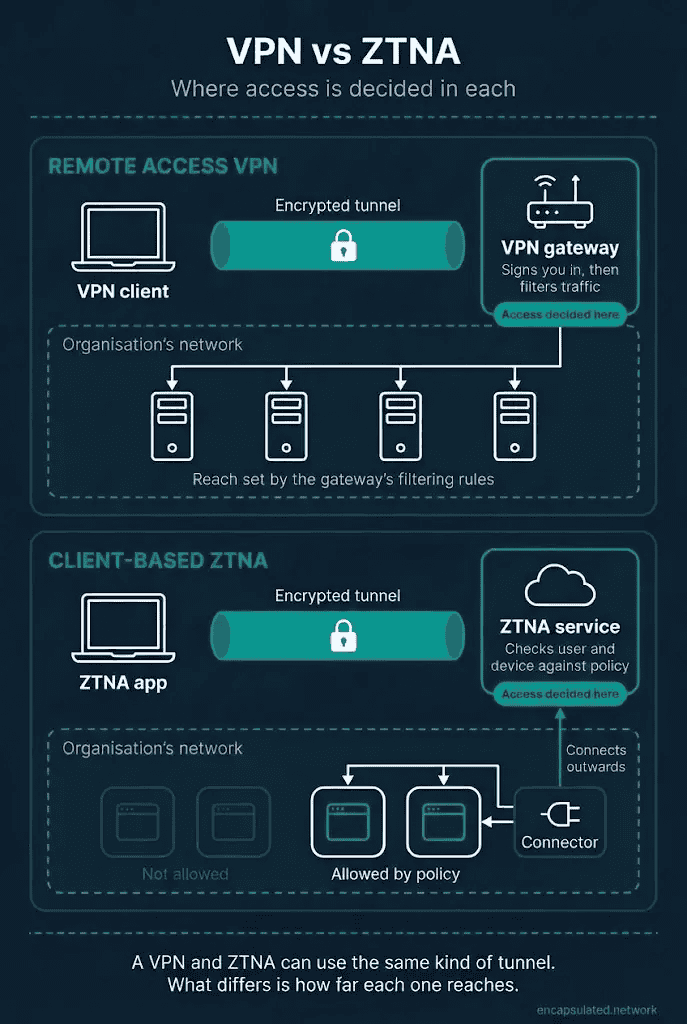
A remote access VPN authenticates the user when it sets up the tunnel and then gives the device a path into the organisation’s network. A connection can follow four steps:
- The VPN client on the device connects to the organisation’s VPN gateway.
- The user signs in, and some VPN products also check the device before the tunnel is set up.
- An IPsec remote access VPN can give the device an IP address on the organisation’s network while it sets up the tunnel.
- The gateway can filter traffic so that each user reaches particular network resources.
Some VPN products check the device again during the connection. The US National Institute of Standards and Technology (NIST) notes in SP 800-113, its 2008 guide to SSL VPNs, that some SSL VPNs check the host before a session begins and may recheck it periodically during the session. Palo Alto Networks documents that its GlobalProtect app repeats these host checks every hour while connected.
Once the tunnel is up, the gateway’s filtering rules decide how far a stolen login or an infected device can go.
A remote access VPN can send all the device’s traffic through the gateway, or only the traffic meant for the organisation’s network, which is called split tunnelling.
A consumer VPN also encrypts the device’s traffic to a server, but the provider’s server sends that traffic on to the internet instead of into a company network.
How ZTNA grants access
ZTNA puts a policy decision in front of the organisation’s applications: a ZTNA service checks the user, the device and other signals, then connects the user to the applications that policy allows.
The UK’s National Cyber Security Centre (NCSC), in its 2026 ZTNA guidance, describes ZTNA as “an architectural approach for controlling how users and devices access applications over a network”. The NCSC’s description of a ZTNA approach adds that “network connectivity alone never grants access to a service”.
A client-based ZTNA connection through a connector can follow five steps:
- A connector inside the organisation’s network makes an outbound connection to the ZTNA service.
- The ZTNA app on the device connects to the ZTNA service over an encrypted connection.
- The user signs in, and the app can report the device’s state as a signal.
- The ZTNA service’s policy engine checks the user, the device and other signals against policy and decides whether they may reach the application.
- The ZTNA service connects the user to the application through the connector.
The access decision
NIST states in its zero trust architecture guide, SP 800-207, that access to each enterprise resource “is granted on a per-session basis”. Access to one resource does not automatically grant access to another.
NIST splits the policy decision point into two logical components, the policy engine and the policy administrator. The policy engine decides whether a user or device may reach a resource, and the policy administrator opens or closes the path between them. These components communicate on a control plane, which NIST describes as logically separate from the data plane that carries application traffic. The policy enforcement point works on both planes and enables, monitors and ends the connection.
The NCSC lists device signals such as the device’s compliance status from its management platform and a risk score from its endpoint detection and response (EDR) tool.
The NCSC describes a ZTNA approach in which “each access request is explicitly authorised, based on defined policy and contextual information”. The NCSC also says ZTNA solutions should support re-evaluating policy during a session, and that access should be restricted or revoked when the conditions for access are no longer met.
The NCSC says network location “may be used as a supporting signal to inform policy decisions, but it must not act as a standalone trust decision”.
In the NCSC’s reference design for private applications, a network policy engine first grants access to the relevant network segment rather than to the application itself, and an application policy engine then authorises access to the application.
The ZTNA service and connectors
For private applications, the NCSC describes ZTNA as providing “secure, brokered access to internally hosted applications”.
Because the connector connects outwards, the application needs no inbound connection from the internet. NIST lists as a network requirement that enterprise resources should not be reachable without passing through a policy enforcement point, and adds: “Enterprise resources do not accept arbitrary incoming connections from the internet.”
The connector still needs outbound ports, and the ZTNA service itself faces the internet.
Client-based and browser-based ZTNA
NIST’s zero trust guide describes four deployment variations, among them a device agent model and a resource portal model that needs no software on the device. Vendors call browser-based access “agentless” or “clientless”.
A client-based ZTNA app carries traffic from the device to the ZTNA service over an encrypted connection. Some apps build a tunnel with protocols such as WireGuard or MASQUE, and others connect over HTTPS to an access proxy.
Browser-based ZTNA can work as a reverse proxy in front of the application, and some services instead render the application in a remote browser, so the user needs only a web browser. Browser-based ZTNA reaches web applications, and some services also open SSH or remote desktop sessions in the browser.
NIST notes that in the portal model “limited information can be inferred from devices requesting access”, while the device agent model suits enterprises with a robust device management programme.
| Client-based ZTNA | Browser-based ZTNA | |
|---|---|---|
| Software on the device | A ZTNA app | A web browser only |
| Connection to the service | An encrypted connection from the app | HTTPS from the browser |
| What it reaches | The applications policy allows, including non-web applications | Web applications; in some services, SSH or remote desktop sessions in the browser |
| Device checks | The app can report the device’s state as a signal | The service can see less of the device’s state |
| Suits | Managed staff devices | Devices the organisation does not manage |
Is ZTNA a VPN?
ZTNA is not a VPN in what it grants: a VPN gives the device access to a network, while ZTNA grants access application by application, although the encrypted tunnel underneath can be the same kind as a VPN’s.
In the NCSC’s reference design for reaching a private application, the user’s managed device builds a secure tunnel to a network policy engine, and “This tunnel may be provided using a VPN, VPN-as-a-Service or a cloud platform such as Secure Service Edge (SSE) or Secure Access Service Edge (SASE).” On the application side, a connector, a proxy or a VPN endpoint makes its own outbound tunnel to the policy engine.
Some enterprise clients include both a VPN module and a ZTNA module, so one app on the device can make either kind of connection.
Some VPN products add access rules for individual applications or resources, and their makers describe them as zero trust VPNs. OpenVPN, for example, documents how to configure its Access Server to implement ZTNA principles. Mesh VPNs can also limit each device to particular devices and ports.
Browser-based ZTNA needs no app on the device: the browser connects to the ZTNA service over HTTPS. The difference therefore lies in what the connection can reach and where the access decision is made, not in the tunnel.
Zero trust, ZTNA and SASE
Zero trust is a set of security principles, ZTNA applies those principles to access, and secure access service edge (SASE) is an architecture that delivers networking and security functions together as a cloud service.
Zero trust and zero trust architecture
NIST’s zero trust architecture guide describes zero trust as a collection of concepts and ideas, and uses “zero trust architecture” for an organisation’s cybersecurity plan built on those concepts. The NCSC says “ZTNA applies zero trust principles specifically to access.”
Zero trust and ZTNA are therefore not the same thing. The NCSC expects a wider zero trust strategy to cover identity, devices, applications, services, data and monitoring, and ZTNA covers the access part of that strategy.
Zero trust vs a VPN
Zero trust is a set of security principles, and a VPN is one way to connect a device to a network. In the NCSC’s reference design for private applications, a VPN can carry the user’s tunnel to a network policy engine, and policy engines then make the access decisions. The NCSC counts legacy access routes that bypass the policy engine, such as VPN access that provides broad network connectivity, as an anti-pattern.
Where ZTNA sits in SSE and SASE
NIST notes in SP 800-215 that Gartner coined the term secure access service edge (SASE) in 2019 for an architecture that combines networking and security functions and delivers them as a cloud service.
Some vendors sell ZTNA as part of a security service edge (SSE) offering. Microsoft, for example, describes SSE as an identity-aware, cloud-delivered network perimeter and counts its ZTNA service as part of that offering. Some of these platforms also include a VPN service, and the NCSC lists SSE and SASE platforms among the ways a ZTNA user’s tunnel may be provided.
Is ZTNA more secure than a VPN?
A well-designed ZTNA architecture should limit what a stolen login or an infected device can reach, but ZTNA does not remove the need for trust: when a provider runs the ZTNA service, the NCSC notes that relying on that provider “moves part of the organisation’s trust boundary outside its direct control”.
What ZTNA improves
The NCSC says a well-designed ZTNA architecture should restrict lateral movement “so that compromise of one device or account cannot easily spread across the network” and should limit the blast radius of a security incident, which is the set of systems the incident can affect.
The NCSC’s guidance on implementing ZTNA warns that “Broad network access, even when encrypted, undermines ZTNA objectives and increases the potential impact of credential compromise.”
A VPN gateway accepts connections from the internet, and the US National Security Agency (NSA) and Cybersecurity and Infrastructure Security Agency (CISA) describe VPN gateways as popular targets for attackers. An inbound listener is a service that waits for connections from the internet. Connector-based ZTNA needs no inbound listener on the organisation’s network for the applications it reaches, because connectors make outbound connections to the ZTNA service.
What ZTNA does not fix
NIST notes that an attacker with valid credentials may still reach the resources the account is allowed to use. NIST says a properly implemented zero trust architecture should stop a compromised account or device from reaching resources outside its normal access patterns.
NIST also says the policy engine and policy administrator “must be properly configured and maintained”, and warns that disrupting them or the enforcement points can disrupt the organisation’s operations.
The ZTNA service faces the internet, and the NCSC says connectors are internet-facing components that should be hardened. ZTNA services and clients have had serious security flaws of their own. The NCSC notes that “Adopting ZTNA commonly involves introducing a third-party service into a critical access path for users, devices, and applications.”
The NCSC names four ZTNA anti-patterns:
- Recreating the walled-garden trust model: an SSE or SASE platform replaces a VPN but still grants broad network access once users sign in, which is the model ZTNA is meant to replace.
- Trusting network location: the organisation grants access to an application solely because a request comes from a trusted IP address or network location.
- Exposing private applications to the internet: internal services not designed to face the internet are reachable from it directly, instead of through a hardened connector or proxy.
- Maintaining legacy access routes that bypass the policy engine: older routes, kept for convenience, legacy systems or a phased migration, let users reach the network without the ZTNA policy check.
Narrowing access on a VPN
A VPN gateway can filter traffic so that each user reaches particular network resources, and some VPN clients recheck the device during the session. The NSA and CISA advise organisations to patch remote access VPNs immediately and to use multi-factor authentication.
Does ZTNA replace a VPN?
ZTNA can replace a remote access VPN for staff reaching private applications, and the NCSC also counts staff access to software-as-a-service (SaaS) applications as a ZTNA job, typically enforced through single sign-on. NIST adds that a remote user should not be required to use a VPN to reach services that a public cloud provider hosts for the organisation. ZTNA does not take over every job a VPN does.
What a VPN still does
Linking two networks is not one of the NCSC’s ZTNA scenarios, and some ZTNA providers handle it with separate site-to-site IPsec tunnels.
Some ZTNA connectors carry only connections that the user starts. Cloudflare, for example, documents that its Tunnel connector does not support server-initiated protocols such as voice over IP (VoIP) and the Session Initiation Protocol (SIP). Vendors that support server-initiated traffic name uses such as remote assistance, software distribution and VoIP. A VPN can make the device reachable from the organisation’s network: when a VPN gives the device an address on that network, NIST notes in SP 800-77 Rev. 1 that other hosts on that network “can potentially reach the remote VPN clients as if they were present locally”.
An organisation replacing an SSL VPN can move to an IPsec VPN that uses IKEv2, as Norway’s National Cyber Security Centre recommends, and can move access to individual applications to ZTNA. A VPN and ZTNA can also run side by side.
Moving from a VPN to ZTNA
NIST’s 2020 zero trust guide expects most enterprises to run zero trust alongside perimeter-based access for an indefinite period. The NCSC describes the perimeter-based model as one that “implicitly trusts users based on network location”. The NCSC says legacy access routes that bypass the policy engine, including VPN access that provides broad network connectivity, should be removed wherever possible.
The NCSC sets out what an organisation should do before it builds a ZTNA architecture:
- Identify its users, devices, services and applications.
- Understand its data flows and user journeys.
- Recognise its architectural constraints, legacy systems and dependencies.
- Understand its risks through threat modelling.
- Meet the identity, device and internet access prerequisites, including an authoritative identity provider that acts as the single source of truth for user identities.
- Treat the choice of ZTNA service and provider as a risk management and assurance decision, not only a procurement activity.
When each one fits
The better fit depends on the job:
| Situation | Fits better | Reason |
|---|---|---|
| Staff reach a few private web applications | ZTNA | Access is granted per application, and with connectors the applications need no inbound connection |
| Staff reach SaaS applications | ZTNA principles, through single sign-on and application-level policy | The NCSC lists SaaS access among the places ZTNA applies, typically enforced through single sign-on |
| Contractors on devices the organisation does not manage | Browser-based ZTNA | Browser-based ZTNA needs only a web browser on the device |
| Two offices, or an office and a cloud network | Site-to-site VPN | The NCSC’s guidance on where ZTNA applies covers users reaching applications, not links between networks |
| An application where the server starts connections to the user’s device | A VPN, or a ZTNA product that documents support for server-initiated connections | Some ZTNA connectors carry only connections that the user starts |
| Moving from a VPN to ZTNA | A VPN and ZTNA side by side during the move, with the VPN’s access tightly restricted | NIST expects side-by-side running; the NCSC says legacy routes that bypass the policy engine should be removed wherever possible and tightly restricted where they remain |
| Hiding browsing from public Wi-Fi or an internet provider | A consumer VPN | The Electronic Frontier Foundation notes that a consumer VPN hides browsing from the internet provider and the local network owner |
VPN vs ZTNA for personal use
At home, ZTNA controls access to applications for a person whose employer provides it, or for a person who sets up a ZTNA service to reach applications they run themselves.
A consumer VPN hides a user’s browsing from the internet provider and from the owner of the local network, such as a café or hotel, and websites see the VPN server’s location instead of the user’s.
The Electronic Frontier Foundation (EFF) notes that the VPN provider can see the browsing that the internet provider no longer sees, so a VPN moves the user’s trust from the internet provider to the VPN provider. A VPN is not a tool for anonymity, and it does not protect against every threat.
On a work laptop, the employer’s policy decides which work applications the ZTNA app can reach, and the app’s connection can be an encrypted tunnel of the kind a VPN app builds. Some ZTNA services also route the device’s internet traffic through the provider so that the employer can filter it.
Frequently asked questions
Is ZTNA better than a VPN?
Neither ZTNA nor a VPN is better for every job. ZTNA can limit what a user or device can reach, while a VPN suits site-to-site links and some applications in which a server starts the connection. Browser-based ZTNA also suits contractors on devices the organisation does not manage, because it needs only a web browser.
What is replacing VPNs?
For staff reaching private applications, organisations can move from a VPN to ZTNA, which some providers offer inside SSE or SASE platforms. The NCSC warns that swapping a VPN for such a platform without narrowing broad network access recreates the old trust model. VPNs still carry other jobs, such as site-to-site links.
Is the ZTNA app on my work laptop a VPN?
The ZTNA app is not a VPN in what it gives access to, although it can build an encrypted tunnel as a VPN app does. The app reaches the work applications that the employer’s policy allows. Some of these apps also route the laptop’s internet traffic through the ZTNA provider for the employer’s filtering.
Can one app be both a VPN and a ZTNA client?
One app can act as both a VPN client and a ZTNA client when it includes a VPN module and a ZTNA module. Which connections work depends on the modules the organisation installs and sets up. In some products, the device must also be enrolled before the ZTNA module works.
Does ZTNA need a client app?
Client-based ZTNA needs an app on the device, while browser-based ZTNA, which vendors call agentless or clientless, needs only a web browser. Browser-based access reaches web applications and, with some services, SSH or remote desktop sessions. An app can also report the device’s state, while browser-based access tells the service less about the device.
Does ZTNA encrypt traffic?
ZTNA can encrypt the connection from the device to the ZTNA service: a client-based app can use an encrypted tunnel or HTTPS, and browser-based access uses HTTPS. The NCSC says ZTNA architectures must protect all traffic between users, devices and applications against interception, tampering and impersonation. The access policy, not the encryption, decides which applications the user can reach.
Is ZTNA faster than a VPN?
Speed depends on where the ZTNA service, user and application are. NIST notes that VPN traffic to cloud services can land at the corporate internet edge and go back out, which it calls hair-pinning, adding distance and latency. Split tunnelling keeps internet traffic off the gateway, and ZTNA traffic to private applications passes through the ZTNA service.
Why did my company switch from a VPN to ZTNA?
Each company has its own reasons, and the NCSC sets out the goals ZTNA serves: a well-designed ZTNA architecture should restrict lateral movement, limit the blast radius of a security incident and reduce the attack surface. In practice, a stolen login or an infected laptop should then reach fewer systems than broad network access would allow.
Is zero trust the same as ZTNA?
Zero trust is not the same as ZTNA: ZTNA, in the NCSC’s words, applies zero trust principles “specifically to access”. The NCSC says organisations should have, or be developing, a wider zero trust strategy that includes identity, devices, applications, services, data and monitoring, so zero trust reaches beyond access.
Can I use ZTNA instead of a VPN at home?
ZTNA controls access to applications. At home it can serve an employee whose employer provides it, or a person who sets up a ZTNA service for applications they run themselves. For hiding browsing from an internet provider or a public Wi-Fi network, a consumer VPN is the tool, and the VPN provider can then see that browsing instead.
Does ZTNA stop a signed-in user from copying data?
ZTNA decides who reaches which application, but its access rules alone do not stop an allowed user from copying data the account can open. Other controls, such as data loss prevention, which NIST lists among SASE services, can limit copying. Some providers also sell browser isolation alongside ZTNA, and browser isolation can block copying, downloading or printing.