VPN Encryption Explained
A coral security shield with a closed white padlock and a checkmark badge, representing VPN encryption and authentication combined in a single AEAD cipher.

Your VPN app shows a cipher in its settings: AES-256-GCM, or ChaCha20-Poly1305. You know these mean your traffic is encrypted. What they actually mean is something most guides never explain — what AES-256-GCM is, what the GCM part does, why that suffix matters more than the “256,” and why modern VPN ciphers not only encrypt … Read more

Tor vs. VPN: Anonymity, Privacy, and the Trust Gap

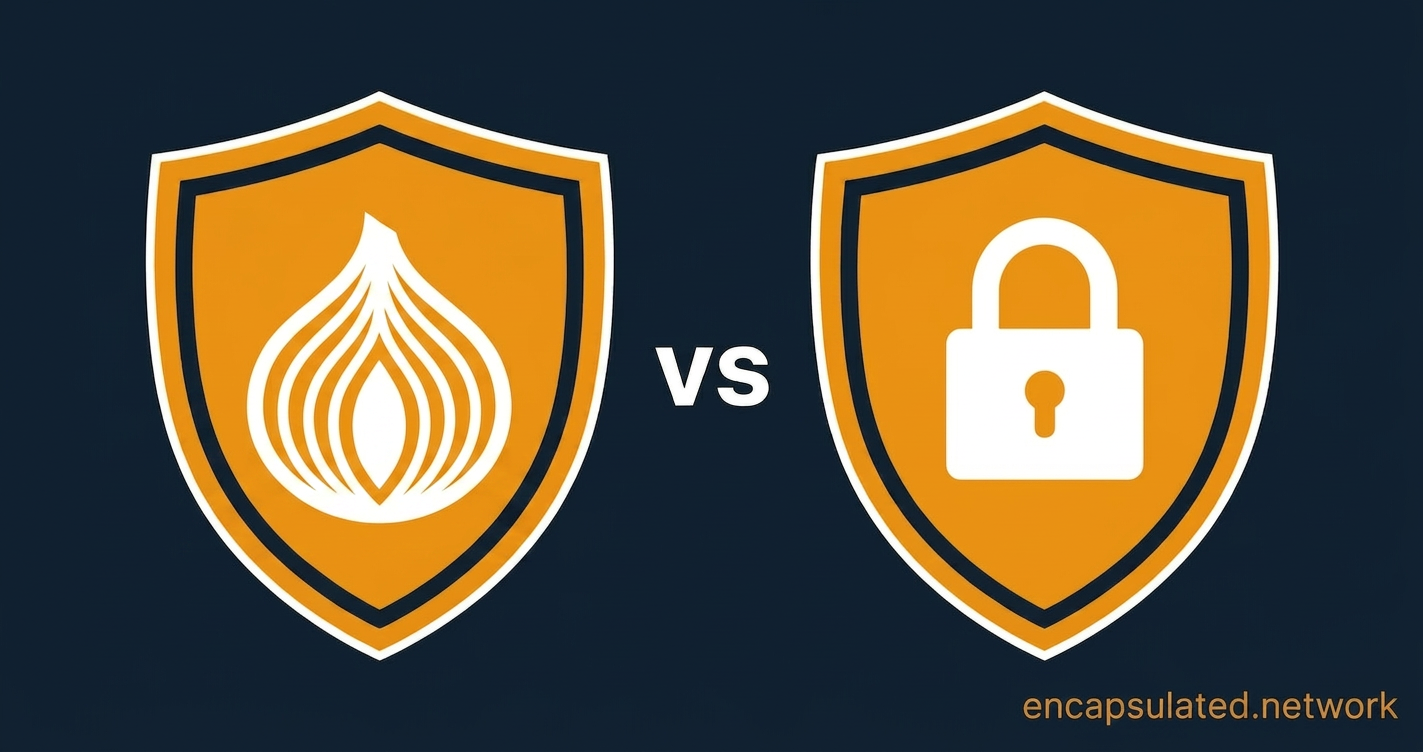
Two amber shields on a dark navy background with VS between them. The left shield contains a white onion cross-section icon representing Tor; the right shield contains a white closed padlock representing VPN

Tor and a VPN both hide your internet traffic from outside observers. What separates them is whether anyone still holds the complete picture: who you are and where you’re going. A VPN removes your ISP’s visibility into where you are going. Your destinations are encrypted inside the tunnel, and the websites you visit see the … Read more

WebRTC Leak: What It Is and How to Stop It

Coral shield with a white open padlock and a warning badge, representing a WebRTC IP leak bypassing VPN protection.

Last updated: June 1, 2026 · 36 min read You connected your VPN. The green light is on, your IP address has changed, and a quick check confirms the VPN server’s address is showing instead of yours. Then you run a WebRTC leak test and see your real, ISP-assigned IP address sitting in the results. … Read more

OpenVPN Explained: How the 25-Year-Old Protocol Still Wins

Electric Blue shield icon with a TLS security certificate overlapping its right side, on a dark navy background — featured image for the OpenVPN Explained article on encapsulated.network.

Last updated: June 03, 2026 · 35 min read OpenVPN has been in production since 2001 — longer than WireGuard has existed and longer than most of today’s internet infrastructure. Most guides treat it as the slow fallback you switch to when something else fails. This one explains how it actually works. TL;DR OpenVPN is … Read more

WireGuard Explained: How the Modern VPN Protocol Works

WireGuard VPN protocol featured image showing a coral shield with a padlock and two Curve25519 key icons representing WireGuard's public key pair authentication model on a dark navy background.

Last updated: June 03, 2026 · 31 min read WireGuard is a VPN protocol — a set of cryptographic rules that governs how two computers build an authenticated, encrypted tunnel between them — implemented as a kernel module in Linux and as native apps on Windows, macOS, iOS, and Android. Every VPN review says the … Read more

What Is IKEv2/IPsec? The Protocol Built for Mobile

Flat illustration of a teal shield with a white padlock on a dark navy background, with a Wi-Fi symbol and cellular tower icon overlapping the lower-right corner of the shield, representing IKEv2's MOBIKE feature keeping a VPN connected across network transitions.

Last updated: June 03, 2026 · 22 min read You opened your VPN app, went into settings, and found a list of protocols — WireGuard, OpenVPN, IKEv2. Maybe you picked one without quite knowing what it meant. Maybe your app picked it for you. Either way, IKEv2 is quietly handling more mobile VPN connections than … Read more

What Is a VPN? A Plain-English Explanation

Dark navy featured image for the article "What Is a VPN?" showing a globe with Electric Blue grid lines representing the internet, overlapped by a solid Electric Blue shield with a white padlock icon, representing VPN protection of internet traffic.

Last updated: June 03, 2026 · 25 min read You have probably seen the acronym dozens of times. On your phone’s settings screen, in a browser ad, on a colleague’s laptop at a coffee shop. Everyone seems to have an opinion on VPNs — and most of those opinions are either oversimplified or trying to … Read more

What Is a No-Log VPN? (And How to Verify the Claim)

Flat illustration on a dark navy background showing a large electric blue shield icon with a white padlock at its centre, overlapped at the lower right by a flat electric blue magnifying glass. The composition represents scrutiny and verification of a VPN no-log privacy claim.

Last updated: June 1, 2026 · 24 min read Every VPN provider in the market makes the same claim: we do not keep logs. It appears on landing pages, in privacy policies, and in review summaries across the web. The phrase has become so ubiquitous that it has largely stopped meaning anything specific — and … Read more