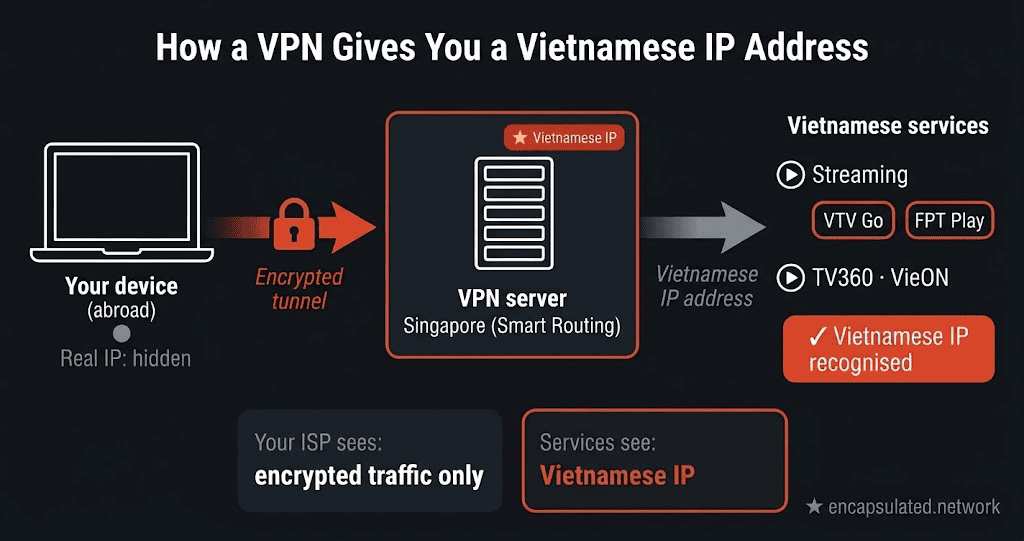
The fastest way to get a Vietnamese IP address is to connect through a VPN server located in Vietnam. Once connected, VTV Go, FPT Play and other Vietnamese services see the server’s Vietnamese IP address instead of yours.
That’s the fix if VTV Go won’t load from a hotel room abroad, or if you’re missing a World Cup match. The four steps below get you there.
How to Change Your IP to Vietnam in 4 Steps
Connecting to a VPN server in Vietnam routes your traffic through that server, so the website or app on the other end reads the server’s Vietnamese IP address rather than your own. The mechanics are the same wherever you’re connecting from. For the complete walkthrough, including leak checks and protocol troubleshooting, see how to change your IP address location.
Step 1: Choose a VPN with Vietnamese servers
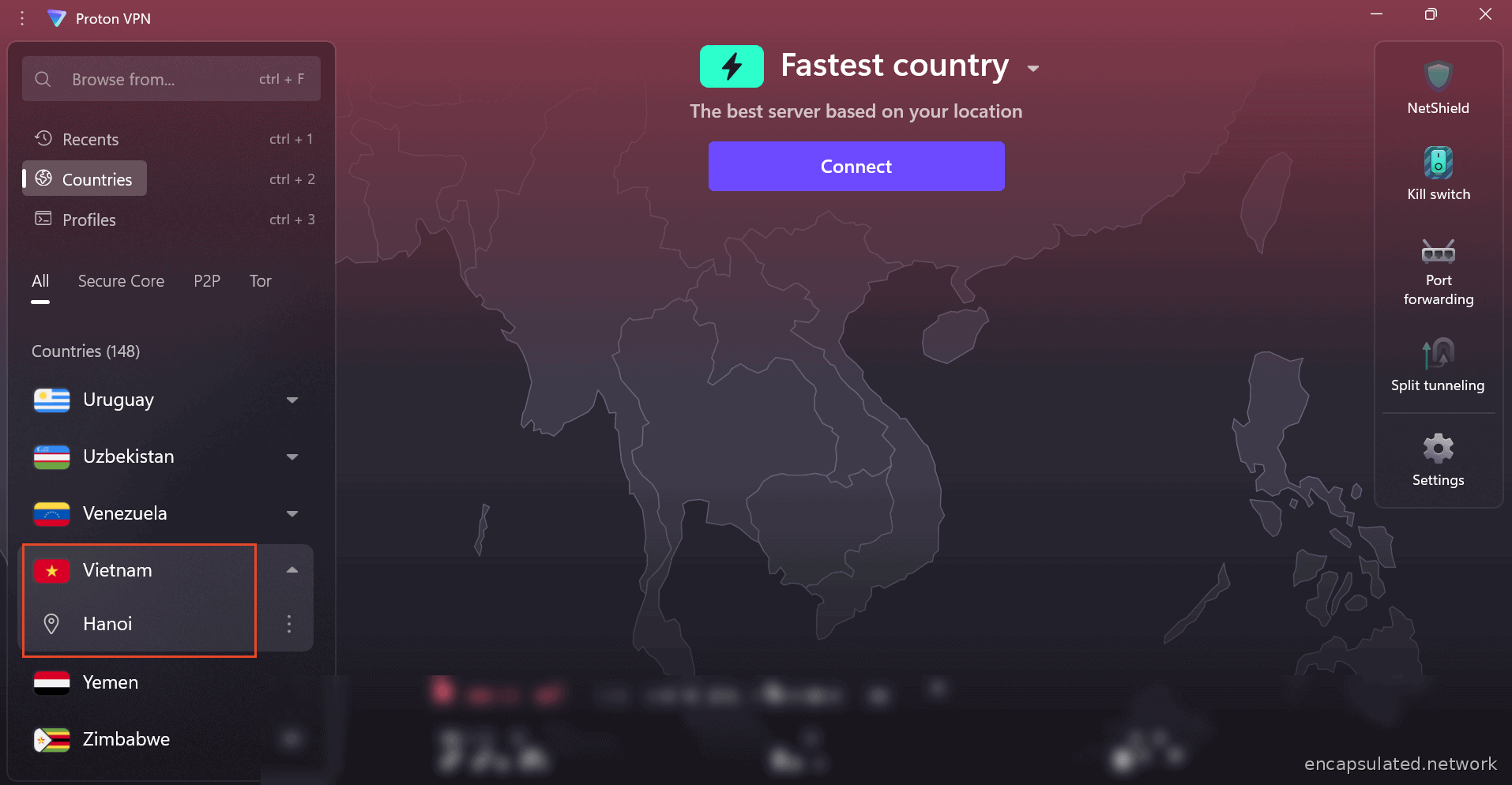
Confirm your provider lists Vietnam as a server location before subscribing, and check how many servers it runs there. ProtonVPN, for example, lists a single Vietnam location: Hanoi, with ten servers under that one entry. There’s no city-level choice to make with this particular provider. Vietnam isn’t split between Hanoi and Ho Chi Minh City the way some countries are split by city in a provider’s app.
Step 2: Install the app and connect to a server in Vietnam
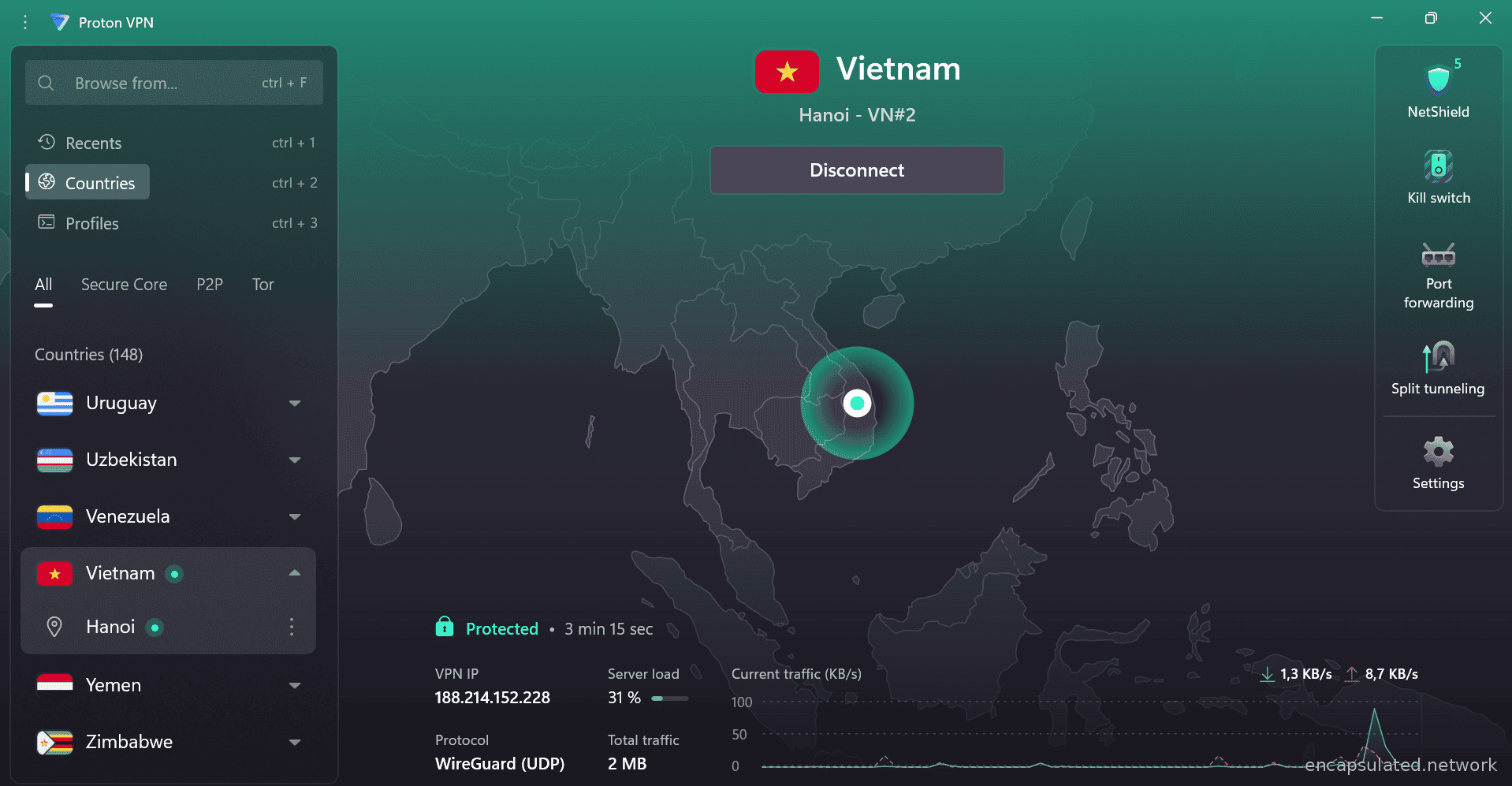
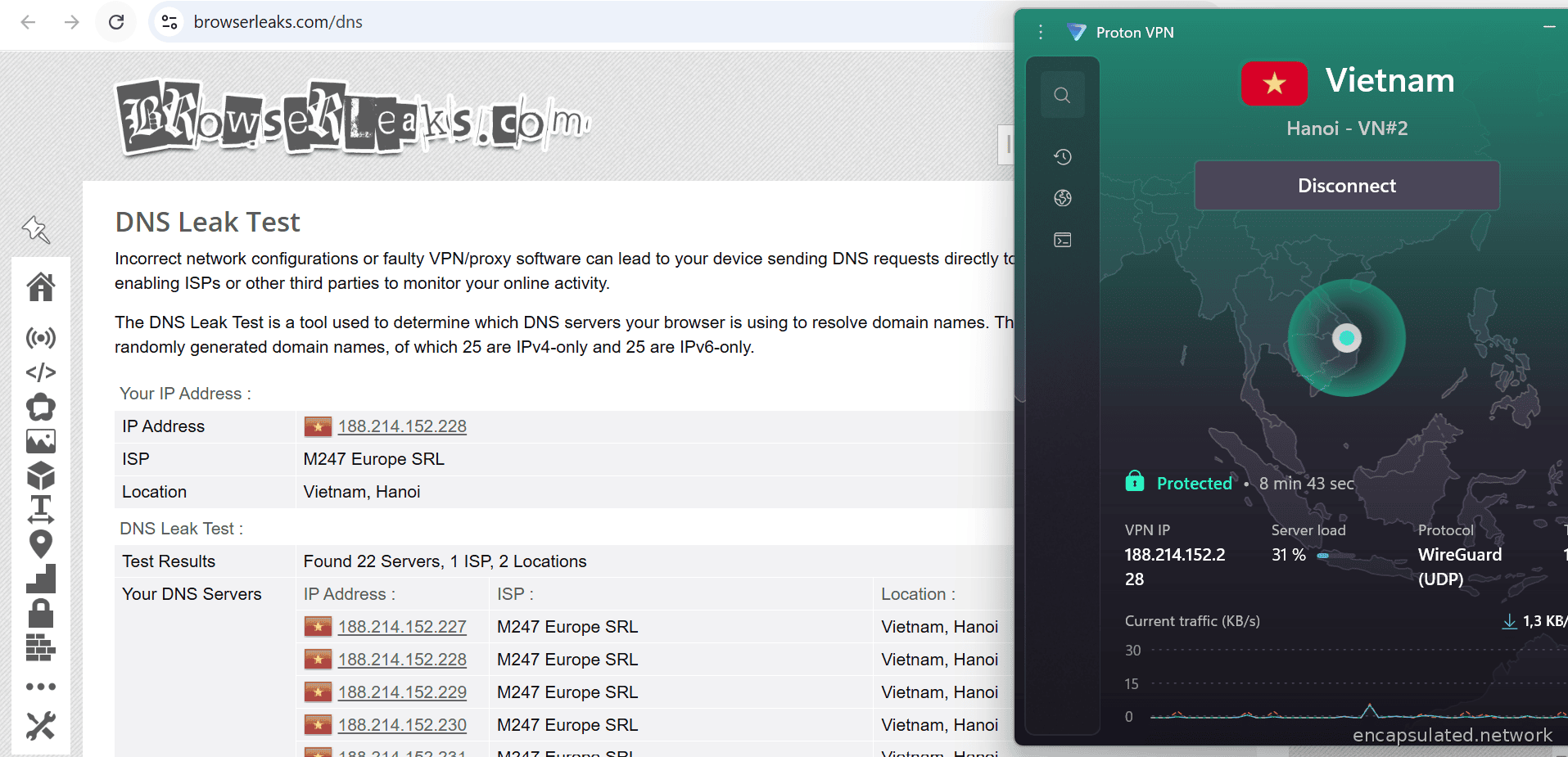
Install the application, sign in, and connect. WireGuard is the default protocol in most apps. ProtonVPN’s Vietnam location uses Smart Routing: the physical servers are located in Singapore and present a Vietnamese IP address rather than sitting inside Vietnam. It doesn’t affect the outcome — because the IP assigned is registered as Vietnamese, services like VTV Go and FPT Play still treat you as a Vietnam-based visitor.
Step 3: Verify your IP and DNS before opening any app
Before opening VTV Go or FPT Play, confirm the change took effect. Go to browserleaks.com/dns. The IP address shown should place you in Vietnam, and the DNS servers listed should belong to your VPN provider, not your home ISP. If the DNS servers don’t match the IP’s country, your queries are leaving the encrypted tunnel, which is the kind of mismatch some streaming platforms detect and block. Enable DNS leak protection in your VPN app’s settings if that happens, then run the check again.
Step 4: Open VTV Go or FPT Play and confirm access
With the connection verified, open whichever app you’re trying to reach. VTV Go’s Terms of Service prohibit using a VPN to change your apparent location, with account restriction listed as the consequence. If a service still won’t load once your IP and DNS check out, try a different server, clear the app’s cache, or close it completely and reopen it after the VPN connection is active.
On Android and iPhone
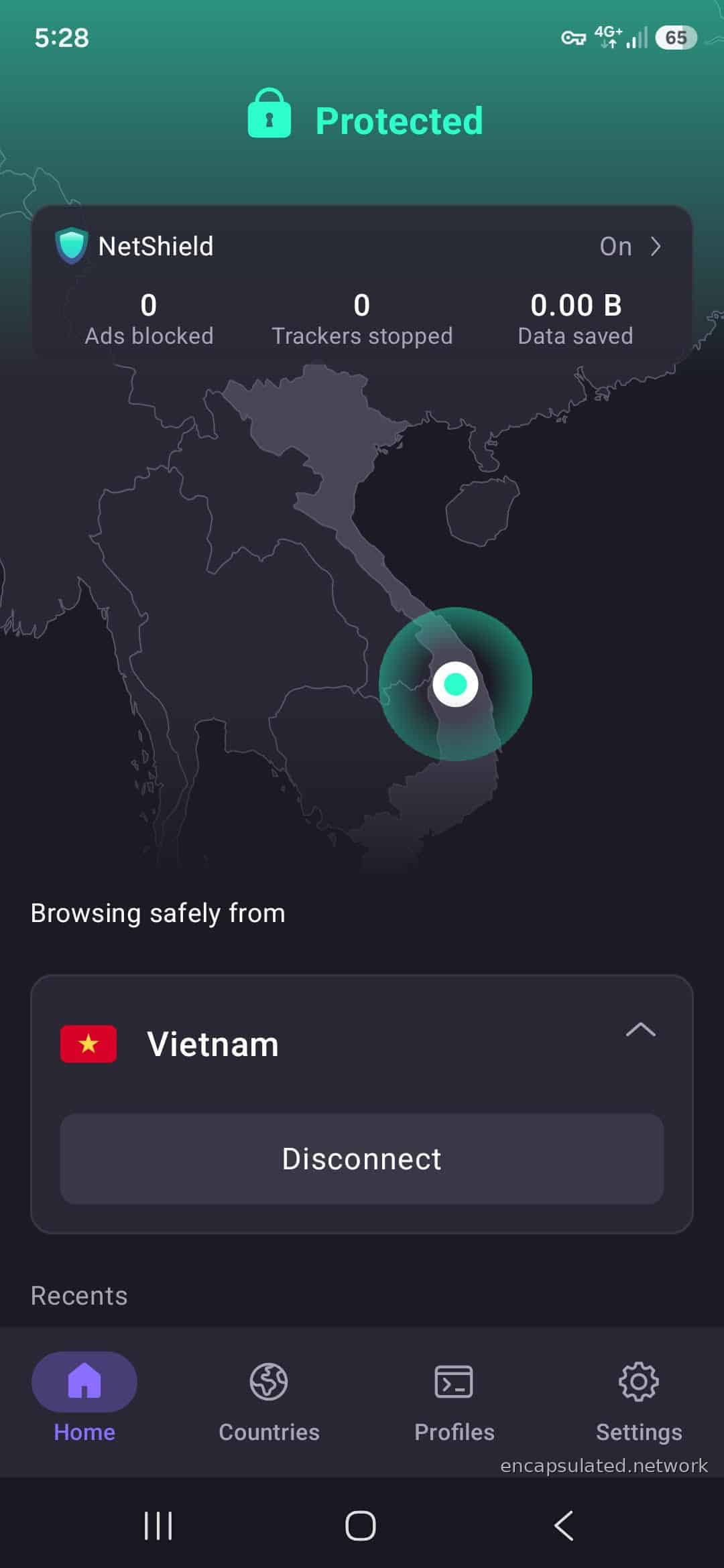
The four steps are identical on a phone. Install the ProtonVPN app, sign in, select Vietnam from the country list and connect. The only difference between platforms is a one-time prompt: on iOS, the first connection asks for permission to add a VPN configuration to the device — approve it, and it won’t appear again. On Android, a key icon in the status bar confirms the connection is active. Run the DNS check at browserleaks.com/dns in your mobile browser before opening VTV Go or FPT Play.
What You Can Actually Watch with a Vietnamese IP Address
VTV Go and FPT Play are the two platforms a Vietnamese IP directly unlocks. TV360 and VieON are also geo-restricted to Vietnam and accessible the same way. K+, VTC Now, and Clip TV have all closed — they still appear in older guides but ceased operations between January 2025 and January 2026.
VTV Go. The app of Vietnam Television, the national broadcaster, and since 2022 officially selected as Vietnam’s National Digital Television Platform, a designation under which it carries national-essential and provincial channels alongside VTV’s own programming. Core content is free with no account required. In 2026 VTV holds the exclusive broadcast rights for the FIFA World Cup in Vietnam, covering all 104 matches across television, radio, mobile and streaming, including the 19 July final. All matches remain free on VTV Go and on authorised relay partners including FPT Play and TV360. VTV Go launched paid VIP packages during the tournament covering Full HD (1080p) quality, catch-up replay, and exclusive companion programming. The matches themselves are not behind that paywall.
FPT Play. Operated by FPT Telecom. Following K+’s closure on 1 January 2026, Thai rights holder Jasmine International (JAS) secured exclusive Premier League distribution rights for Vietnam and appointed FPT Play as its local distributor, making FPT Play the exclusive Vietnamese outlet for Premier League coverage. Jasmine International holds the equivalent Premier League rights for Cambodia and Laos, distributed via Monomax.
TV360 and VieON — also geo-restricted to Vietnam. TV360 is Viettel’s consolidated streaming app, the successor to older, fragmented Viettel apps the company retired years ago. It holds UEFA Champions League and Bundesliga rights and is itself one of VTV’s authorised relay partners for the World Cup. VieON, owned by DatVietVAC, is geo-restricted to Vietnam for its main catalogue, though a separate version called VieON Global launched in January 2024 specifically for Vietnamese audiences abroad and isn’t geo-blocked.
Most people reaching for a Vietnamese IP are overseas Vietnamese and expats wanting access to home television and the World Cup; a smaller group of non-Vietnamese viewers with a specific interest in Vietnamese content makes up the rest. VieON Global was built specifically for the first group, which is why it skips the geo-block its main catalogue enforces.
K+, VTC Now, and Clip TV — all closed. Three platforms that still appear in older guides have closed: K+ ceased operations on 1 January 2026, VTC’s channels (and the VTC Now app that distributed them) stopped broadcasting on 15 January 2025, and Clip TV shut down on 31 December 2025.
Netflix Vietnam. Netflix isn’t blocked in Vietnam; it operates a full local service with its own catalogue, and a Vietnamese IP mainly changes which titles are available rather than whether you can watch at all. It’s a poor target for another reason: Netflix actively detects and blocks VPN and proxy traffic, while there’s no documented evidence that VTV Go or FPT Play do anything comparable.
A note on VTV Go’s terms. VTV Go’s Terms of Service state that content licensed for Vietnam may be unavailable outside the country, and explicitly prohibit using a VPN to get around that. Using a VPN to access streaming content technically violates the terms of service of most platforms with territorial licensing, and enforcement across the industry is overwhelmingly limited to blocking the session, not suspending the account.
Banking and Digital Identity from Abroad: Why a VPN Doesn’t Solve This
A Vietnamese IP address does not unlock Vietnamese banking access. If you want to use a VPN to get into Vietcombank, BIDV or another bank’s app from abroad, it’s the wrong tool. The barriers have nothing to do with where your traffic appears to originate.
The biggest one is biometric verification. Under State Bank of Vietnam Decision No. 2345/QĐ-NHNN, high-risk transactions require facial verification: on 1 September 2025, the SBV deactivated more than 86 million accounts, roughly 43 percent of all accounts in the country, for failing to complete it. Facial recognition has also been reported to struggle with non-Vietnamese faces, which has left e-wallets including MoMo effectively unusable for some foreign users regardless of their network connection.
The second is digital identity. From January 2026, Vietnamese citizens can no longer use a passport for domestic banking; a chip-based citizen ID or a Level 2 VNeID account is required instead. In practice this is where the diaspora hits a wall: VNeID Level 2 enrolment cannot be completed remotely and requires an in-person visit, and the VNeID app is reported to be unreliable or unavailable for citizens logging in from abroad. For those already outside the country, the workable path is NFC-scanning a chip-based citizen ID card, paired with SMS OTP over roaming or a Vietnamese SIM kept active in a second device. Neither of those involves a VPN.
The third barrier is SMS delivery. One-time passcodes sent by text to a Vietnamese number don’t reliably arrive abroad. Several major banks address this directly with an app-based OTP generator that doesn’t depend on SMS at all.
| Bank | App-based OTP product | Notes |
|---|---|---|
| Vietcombank | Smart OTP | Requires two prior SMS-OTP-verified transactions before activation; customers already abroad are directed to the bank’s hotline |
| BIDV | Smart OTP | Generates codes offline; no roaming required |
| Techcombank | Smart OTP | Also offers a hardware token as an alternative where the app isn’t usable |
| MB Bank | Digital OTP | Different branding from the other three, same underlying function |
All four work the same way: each has to be activated, and activation typically requires an SMS code or in-person verification. Set this up before leaving Vietnam, not from a hotel room once you’re gone. If you’re abroad and haven’t activated one of these, your bank’s support line is more reliable than a VPN.
Vietnam’s Cybersecurity Law in 2026: What It Means for VPN Users
Vietnam’s cybersecurity framework changed on 1 July 2026. Law No. 116/2025/QH15, passed in December 2025, is now in force and replaces both the 2018 Cybersecurity Law and the 2015 Law on Network Information Security.
A new obligation requires cyberspace service providers operating in Vietnam to identify their own users’ IP addresses, as part of a broader data retention regime administered by the Ministry of Public Security. It applies to service providers identifying the people who use their platforms; it is not a VPN-specific provision, and neither the law nor the authoritative legal commentary says anything about individual VPN use.
Liability under Vietnamese cybersecurity law — both the outgoing and incoming version — is conduct-based, not tool-based and not location-based. Specific acts are prohibited, including anti-state propaganda, disseminating false information, or distributing illegal content, and it’s that conduct that creates exposure, not VPN use itself or your location when you use it. Some of the law’s prohibited-conduct standards are written broadly enough to invite fair criticism over how much discretion that leaves regulators, but that’s a critique of which conduct is restricted, not evidence that VPN use itself is the problem.
Using a VPN to watch free national television from abroad, access a bank account, or secure a connection on public Wi-Fi all fall outside any prohibited category in Vietnam. The conduct that creates exposure is specific: accessing content or carrying out activity that is independently illegal, which is a much narrower set of actions than VPN use generally.
Frequently asked questions
What is a Vietnamese IP address?
It’s an IP address registered to a network inside Vietnam, which is how websites and apps determine that a connection is coming from the country. A VPN server located in Vietnam lends you its IP address for as long as you’re connected, which is what makes VTV Go and FPT Play treat you as a Vietnam-based visitor.
Are VTV Go and FPT Play really free?
VTV Go is free, with no account needed for core channels. FPT Play runs a freemium model: an ad-supported free tier covers movies, children’s content, and some sports, while paid VIP and Family packages unlock premium channels and additional live sports. For the 2026 World Cup specifically, live match viewing on FPT Play is free as part of its relay of VTV’s broadcast; premium add-ons such as Full HD (1080p) quality upgrades, catch-up replay, and the Sport Hub stats layer may require a paid tier depending on your existing plan.
What happened to K+, VTC Now and Clip TV?
K+ ceased operations 1 January 2026, VTC’s channels stopped broadcasting 15 January 2025, and Clip TV closed 31 December 2025.
Does a VPN help me access my Vietnamese banking app from abroad?
No. Vietnamese banks gate access through biometric verification and digital identity checks under Decision No. 2345/QĐ-NHNN, not IP-based geographic detection. A VPN doesn’t touch either of those mechanisms. The practical path for diaspora users is NFC-scanning a chip-based citizen ID card, paired with app-based OTP if you set one up before leaving Vietnam.
Why is my banking app still asking for verification even with a Vietnamese IP?
Because the verification isn’t checking your IP. It’s checking your face via biometric scan, your chip-based citizen ID or VNeID status, or your registered device — none of which a VPN addresses.
Do I need a Vietnamese SIM as well as a Vietnamese IP?
Not for streaming. VTV Go and FPT Play only check your IP address, not your SIM. For banking, the mechanism is more specific than it first appears: the bank always sends the OTP to the phone number registered on your account, but the physical SIM bearing that number needs to be active in your device with international roaming enabled. Switching to a travel eSIM and powering down your Vietnamese SIM stops OTP delivery, even though the bank is still sending to the correct number. This is why app-based OTP generators (Smart OTP, Digital OTP) exist — they work offline, without roaming, and without a signal.
What changed in Vietnamese cybersecurity law on 1 July 2026?
A new law, No. 116/2025/QH15, replaces both the 2018 Cybersecurity Law and the 2015 Network Information Security Law. It introduces a data-retention obligation requiring service providers to identify their users’ IP addresses, but it doesn’t introduce any new restriction on individual VPN use.
Does watching VTV Go with a VPN break any rules?
It isn’t illegal under Vietnamese law. It does technically violate VTV Go’s own Terms of Service, which is true of most streaming platforms with territorial licensing, and in practice the consequence is a blocked session rather than a banned account.